
Why did ancient Egyptian pharaohs marry their sisters?

Across Egyptian dynasties, royal marriage often followed a pattern that modern readers find difficult to understand: kings often married their sisters or half-sisters.
These unions occurred with remarkable frequency, from the Old Kingdom to the reign of Cleopatra VII. Akhenaten and Thutmose II are often described as having entered sibling marriages, as is Pepi II, as part of a larger religious and political system rather than as isolated cases.
Rather than signalling personal preference or royal indulgence, this pattern reflected the carefully planned system of god-given rule and dynastic continuity that relied on inherited legitimacy.
The sacred logic behind royal incest
Royal identity in ancient Egypt largely rested on the king’s sacred role as a heavenly being.
He was seen as a living god whose authority was believed to show that the cosmos stayed in balance, rather than a ruler among mortals.
Pharaohs were expected to govern under the principle of maat, which required justice and social order based on a stable cosmos, and their marriages worked as one of many tools to uphold that sacred order.
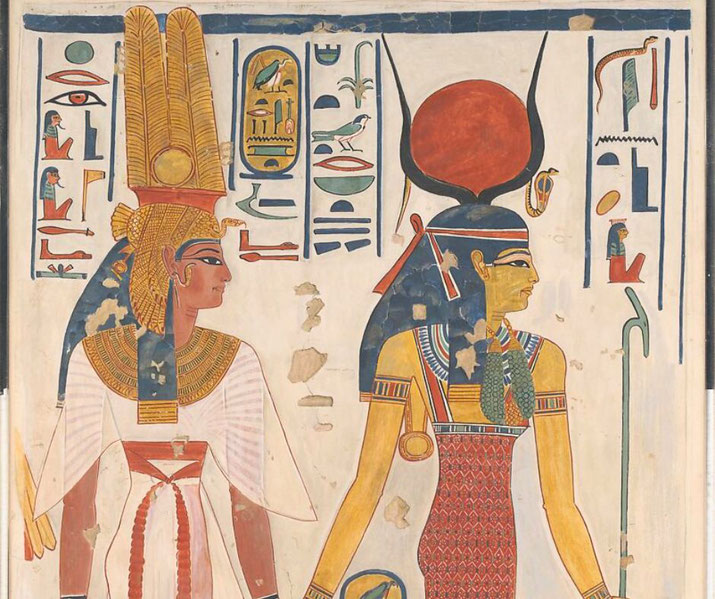
According to myth, Isis and Osiris, who were siblings and consorts, stood at the centre of Egyptian religious belief.
Their union produced Horus, who was the avenger and rightful king. For this reason, when pharaohs married their sisters, they presented themselves as following the pattern of the gods and reinforced the idea that royal authority was sacred.
In effect, the union concerned the creation of a sacred model that made their rule holy rather than the individuals involved.
In royal inscriptions and temple reliefs, queens did not appear simply as wives.
Instead, they often acted as ceremonial partners who confirmed that the king had a sacred nature as a god.
Carvings at Karnak and Medinet Habu and reliefs at Deir el-Bahri show queens who stood beside their husbands during rituals that symbolised the union of heaven and earth.
At Karnak, depictions of Ahmose Nefertari show her assisting Amenhotep I in ritual offerings and reinforce this religious partnership.
When the king married a sister who shared the royal bloodline, he surrounded his position with religious symbolism and greatly reduced doubt about his legitimacy.

Inheritance and succession in dynastic legitimacy
Royal succession in Egypt often required more than descent from the father alone.
A prince whose mother descended from a powerful royal line could claim the throne more effectively than a son born of a lesser-ranked wife.
Therefore, when a king married his sister, their child united the highest levels of royal ancestry on both sides, reducing disputes over inheritance and preventing families from outside the royal house from gaining influence.
For instance, during the early 18th Dynasty, Ahmose I married his sister Ahmose Nefertari, who held the highly important title “God’s Wife of Amun.”
She had played a central role in legitimising her husband’s reign after the defeat of the Hyksos.
As the mother of Amenhotep I, she passed on a lineage that became a key source of dynastic authority.
Her son’s claim rested on the sacred and royal lineage of his mother as well as on his father’s status.
This title, which was later held by Sitamun and Merytamun as well as by Shepenupet I, allowed royal daughters to control temple wealth and hold ceremonial power over Theban priesthoods.
At times, the safety of the dynasty depended on limits on access to the royal family.
When the pharaoh married a sister, he blocked the plans of rival noble families who may have tried to advance their daughters as royal consorts.
Instead of expanding the influence of outside clans, the king kept dynastic control within a closed circle of royal blood.
This meant that authority passed along a line that could not be easily contested.
Egyptian titles such as "King's Daughter" and "King's Sister" held political weight and often appeared in a formal list of titles, though they were not inscribed within cartouches, which were typically reserved for royal names that showed both family status and ceremonial rank.
The religious and ceremonial authority of royal women
Royal women's presence in official art and temple processions, and in major religious festivals, made them key figures in the support of sacred kingship.
The queen acted in a role higher than that of a lower-ranking figure and performed rituals that ensured the king’s connection to the gods stayed intact.
In several cases, royal women stepped beyond the role of consort and took direct political power.
Hatshepsut was the daughter of Thutmose I and had married her half-brother Thutmose II, then ruled after his death as pharaoh in her own right.
She legitimised her reign by claiming a sacred birth from the gods and referring to her father’s royal blood.
Without a marriage that kept the bloodline concentrated, her ability to ascend may have faced greater resistance.
Under Akhenaten, Nefertiti’s role expanded into religious leadership. She appeared beside him in temple scenes in which she performed the same rituals as the king.
Although the exact nature of her birth is debated, many scholars propose that she descended from a royal line or had ties strong enough to justify her prominent status.
Her daughters were born into this religious and political system and appear to have continued the practice of sibling marriage.
Meritaten, for example, may have married Smenkhkare in the final years of the Amarna period, according to some interpretations of reliefs that survived, although the evidence is still inconclusive.
Reliefs from Tell el-Amarna show these daughters who took part in state rituals, and this reinforced their priestly and dynastic roles.
As part of their ceremonial role, queens offered religious support to the state religion.
Their actions reinforced the idea that the king’s power came from more than inheritance and from sacred unity between equals who both possessed royal blood and fulfilled religious duties tied to the well-being of Egypt itself.
Historical patterns across dynasties
Sibling marriage appeared at several points across Egyptian history. During the 4th Dynasty, Khafre, who built the second pyramid at Giza, may have married his sister.
Later, Pepi II of the 6th Dynasty married Neith, who held the title 'King's Daughter' and may have been his half-sister, although this connection cannot be confirmed with certainty.
Such unions can be read as examples of how early dynasties maintained the pharaonic ideal rather than rare exceptions.
Commoners rarely practised sibling marriage, and marriage contracts from non-royal households show no comparable pattern, which suggests that the custom was largely confined to the royal family.
By the New Kingdom, sibling marriage had, in many royal households, become more fixed as an official custom.
Amenhotep III elevated his daughter Sitamun to the position of Great Royal Wife, and while many scholars believe this signalled a formal marriage.
While this created unease in modern scholarship, many ancient Egyptians at court may have viewed it as a continuation of god-given rule.
Akhenaten and his successors appear to have further turned the tradition into a regular royal custom, as daughters and sisters married into the line of kings to preserve authority during an era of theological reform.
Modern DNA analysis of royal mummies, which was presented in a study published in JAMA in 2010, had confirmed close consanguinity in several New Kingdom lineages, which may have contributed to health problems present from birth in rulers such as Tutankhamun.
Under the Ptolemies, the practice appears to have continued for political reasons.
Cleopatra VII had married her younger brother Ptolemy XIII and later co-ruled with Ptolemy XIV.
Although she later broke with this pattern by allying herself with Roman leaders, she had already followed the Egyptian model of sibling union.
Previous Ptolemaic rulers, including Cleopatra II and Cleopatra III, often married brothers or uncles to help maintain dynastic power.
The Ptolemies spoke Greek and ruled a foreign dynasty, and they adopted the local royal customs to present themselves as legitimate successors to the pharaohs.
In most periods, the main reason seems to have stayed the same, since royal sibling marriage preserved political control and secured ritual legitimacy, which in turn prevented the division of power among many groups.
The practice answered the demands of royal ideology, mythology, and dynastic stability rather than personal preference.
