
How the goddess Ma’at influenced every aspect of ancient Egyptian life and death

To the ancient Egyptians, Ma’at governed the laws of nature and the behaviour of every individual, including kings and priests, as well as ordinary commoners.
They believed that her presence explained why the sun rose and why the Nile flooded, as well as why justice prevailed.
From the earliest myths onward, Ma’at existed as a force in the universe and a sacred figure whose influence reached across temples and courtrooms, as well as tombs, and guided the living and judged the dead.
Ma’at and the order of the cosmos
According to Egyptian creation stories, Ma’at was believed to have become established by the creator god as a guiding principle at the moment of creation and ensured that the world did not collapse into chaos.
In the Heliopolitan cosmogony, she appeared as the daughter of the sun god Ra, and her presence kept the world in harmony from the moment Atum had come forth from the primeval waters.
Her power was believed to sustain the regular motion of the stars and to control the flooding of the Nile, and it also preserved the seasonal cycle that farmers depended on.
Gods such as Ra and Thoth operated within the boundaries she established, and they upheld her order as a sacred duty.
Osiris, though more closely associated with the afterlife, enforced Ma’at during judgement of the dead.
By maintaining her presence, the gods preserved a stable universe that worked in regular and orderly ways.
Importantly, many Egyptian texts warned that without Ma’at, the world would fall into isfet, a state of disorder, falsehood, and destruction.
Each night, Ra battled the serpent Apep, and Ma’at’s strength allowed him to rise again at dawn.
Priests regularly conducted daily rituals to support this effort, particularly in major temple centres like the temple of Amun-Re at Karnak, where hymns had recorded Ma’at as the sustainer of heaven and earth.
As a result, every sunrise reinforced the belief that Ma’at still governed creation and that sacred harmony still held.
Ma’at and royal power
In Egyptian belief, from the moment a king ascended the throne, his ability to rule depended on his commitment to uphold Ma’at.
Pharaohs received the royal crowns and other symbols of power, and they also offered an image of Ma’at to the gods during coronation rituals as a sign of their sacred responsibility.
Reliefs and inscriptions depicted this gesture in temple scenes, which showed their duty to uphold the sacred order of the world.
They presented themselves as the protectors of balance, and they claimed that they built monuments and enforced justice, and that they waged war to preserve the order of the universe.
For example, Amenhotep III described his large building programme, which had included the Luxor Temple and the Colossi of Memnon, as a direct offering to Ma’at.
Ramesses II declared that his victories over Egypt’s enemies, such as those depicted at the Battle of Kadesh on the walls of the Ramesseum, had happened because he had followed her truth.
Royal inscriptions often stated that the king “lived by Ma’at” and “offered Ma’at daily,” and they used those phrases to show that power without justice would collapse.
Kings also identified themselves with deities who upheld Ma’at, such as Horus and Thoth, and they ordered that images of Ma’at be carved into temple gateways and boundary stelae to declare their loyalty to the law set by the gods.
Ma’at in law and government
As a guiding principle, Ma’at effectively provided the basis for Egypt’s justice system.
Judges and scribes often worked as her agents on earth, and some officials wore amulets or displayed symbols depicting her feather to symbolise their oath to judge truthfully.
Egyptian courts generally relied on precedent and moral instruction, together with community values, rather than on set written laws, to decide cases in a way that preserved balance and fairness.
For that reason, lying under oath or issuing false verdicts carried legal consequences and also brought spiritual danger, since violating Ma’at risked both public disorder and punishment from the gods.
In one popular story from the Middle Kingdom, a peasant named Khun-Anup appealed repeatedly to corrupt officials by invoking Ma’at, and this story showed how ordinary Egyptians viewed her as a source of justice even when the legal system failed.
The story is known as "The Eloquent Peasant", and it survives on Papyrus Berlin 3023 and illustrates that justice remained a serious expectation held before the gods even for commoners.
Educational texts like The Instructions of Ptahhotep dated to the 5th Dynasty around 2400 BCE and strengthened this expectation and instructed scribes to speak truth, act with humility, and avoid selfishness, because every decision they made had to match Ma’at’s values.
Common people and Ma'at in daily life
Among villagers and labourers, belief in Ma’at often guided how people behaved toward one another and how they understood their place in the world.
Farmers typically looked to Ma’at when they observed the regular return of the Nile flood, and they saw signs of her disruption in times of drought or disease.
Artisans and traders conducted business with the belief that fairness, honesty, and trust would bring favour from the gods, while deceit and greed would bring misfortune.
To strengthen that view of life, parents taught their children to “do Ma’at” so that they spoke truthfully, respected elders, and acted with fairness toward neighbours.
Household proverbs warned against actions that could unbalance the social order, such as the spread of rumours or the withholding of payment.
Officials recorded grain yields and labour hours, along with tax contributions, which helped to ensure social stability and fairness in society.
While these efforts served practical purposes, they also aligned with the wider religious idea that disorder in administration could threaten Ma’at.
Temples regularly hosted ceremonies that honoured Ma’at as a goddess and as a principle that governed daily life.
Priests often included her name in offerings and prayers, together with annual festivals, and scribes regularly included her feather in letters and contracts, along with legal petitions.
Her image was often depicted as a woman with an ostrich feather on her head or as the feather alone, and appeared in both art and written records.
In this way, her presence reached into every layer of society, ensuring that both private conduct and public policy remained aligned with the sacred order.

Ma'at in the final judgment and the afterlife
Upon death, every Egyptian expected to stand before the gods and be judged according to Ma’at.
In the Hall of Two Truths, Anubis placed the deceased’s heart on a scale opposite the feather of Ma’at, and if the heart balanced evenly, the soul entered the Field of Reeds.
If the heart weighed too heavily with sin, Ammit, the devourer, consumed it, and the soul ceased to exist.
Burial goods and tomb inscriptions often included the “Negative Confession,” a set speech spoken by the soul that claimed innocence.
The deceased claimed to have committed no acts that violated Ma’at, such as lying, stealing, blaspheming, or oppressing the poor, and each of these statements aligned with the expectations of the forty-two judges appointed by the gods who were in charge of the trial.
Typical declarations included, “I have not stolen,” “I have not killed,” and “I have not uttered lies.”
Those texts made clear that eternal life depended on personal conduct that aligned with the order of the universe rather than on status or wealth.
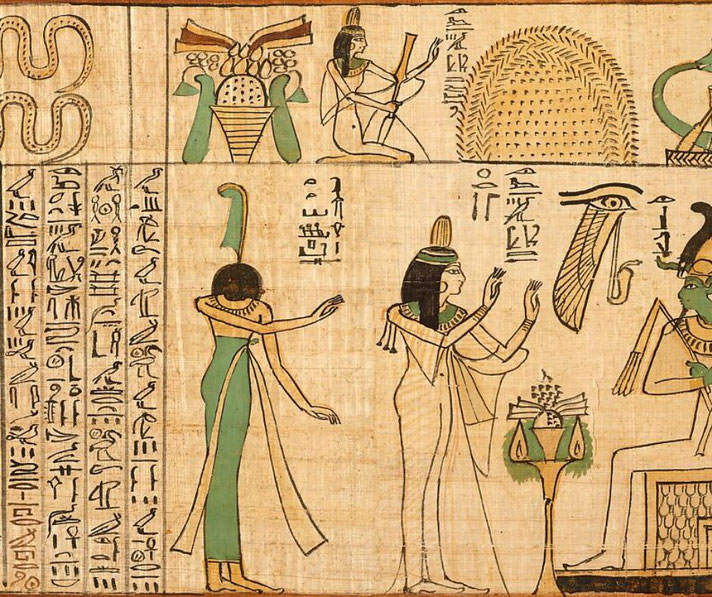
Tomb walls frequently depicted this judgement scene, in which Anubis adjusted the scales and Thoth recorded the outcome, as Osiris sat as the final judge of the soul’s fate.
The scene appeared most famously in the Book of the Dead, such as in the Papyrus of Ani (British Museum EA 10470), and families often buried the dead with amulets in the shape of Ma’at’s feather and recited prayers to ensure her favour.
Because of these rituals, Egyptians had viewed moral living as preparation for the afterlife, where Ma’at would determine whether their journey continued or ended.