
Osiris: The mysterious Egyptian god of death and resurrection
Among the oldest religious traditions of ancient Egypt, the figure of Osiris stood at the centre of beliefs about kingship and burial rites grounded in sacred justice for many Egyptians.
From the earliest funerary texts in the Old Kingdom to the dramatic temple rituals at Abydos during the New Kingdom, Egyptians often described Osiris as both a slain ruler and a resurrected god who governed the afterlife.
His story combined betrayal and the violent dismemberment that ended in restoration and became the foundation for how Egyptians explained death, judged morality, and prepared for what came after.
The ancient origins of Osiris in Egyptian history
Well before the pharaohs unified Egypt under a single crown, local religious traditions in the Nile Delta had already begun to worship a deity who was connected with agriculture and with the cycle of flooding that renewed seasonal growth.
Later tradition often claimed that Osiris began as a god of fertility, tied to the annual reappearance of vegetation after the inundation of the Nile.
However, the earliest clear references to him had appeared in the Pyramid Texts by the late Fifth Dynasty, around the 24th century BCE.
Local cults identified him with renewal, particularly as plants came up from soil that had appeared lifeless weeks earlier.
Eventually, as Egypt had come under stronger central control during dynastic rule, Osiris took on new roles and features.
During the Old Kingdom, which began around 2686 BCE, he appeared in the Pyramid Texts, such as Utterance 219 and Utterances 273–274, which include resurrection motifs associated with Osiris, whose fate had begun to connect with the pharaoh’s own afterlife.
Though his role as a judge had not fully developed at that point, these texts positioned him as a central figure in the royal journey to the next world.
Kings who died were commonly said to “become Osiris,” and they took on his identity and passed into the next world under his authority.
His story came to express the journey from death to eternal life and offered a set of spiritual ideas that applied to every Egyptian, including the king.
Gradually, the city of Abydos in Upper Egypt had become the main centre for his cult, particularly by the early Middle Kingdom.
Many important Middle Kingdom officials built tombs near what they believed to be his burial place because they hoped to associate themselves with his power.
Over time, priests had developed carefully planned ceremonies at the site, which attracted pilgrims who wanted to take part in the annual rites that reenacted Osiris’s death and return.
Other important temples at Busiris and Dendera also honoured Osiris. The spread of this ritual calendar into household religion and local temples shows how Osiris’s myth moved from elite texts to popular belief.
The violent and disturbing myth of Osiris
According to one widespread Egyptian myth, Osiris once ruled Egypt with wisdom and brought laws and systems of farming that reinforced justice to the land.
His brother, Set, resented his success and plotted to destroy him. First, Set constructed a highly decorated chest designed to fit Osiris’s exact body.
Then, at a feast, he challenged the guests to lie in it, claiming it as a gift for whoever fit.
When Osiris entered the chest, Set slammed it shut and cast it into the Nile. Some later versions of the myth added striking details, such as the claim that the chest was sealed with molten lead, though this element does not appear in original Egyptian accounts.
Soon after, Isis began her long and dangerous search for the body. She tracked it to a distant land where the chest had lodged in a tree that grew around it.
Later Hellenistic sources included writers such as Plutarch and identified the location as Byblos.
After recovering it, she returned to Egypt and hid it, only for Set to discover the corpse once again.
He hacked the body into fourteen pieces and scattered them across the land to prevent Osiris from ever rising again.
Later texts noted that Isis could not find his phallus and fashioned a golden one, which completed the restoration and allowed her to conceive Horus.
Eventually, Isis, assisted by Nephthys and Anubis, found and gathered most of the parts.
After restoring them with sacred rites, she revived Osiris briefly through sacred rituals and conceived their son, Horus.
Earlier Egyptian texts had not specified the means of conception, though later versions of the myth described a magical union that enabled her to bear the child.
As a result of his condition, Osiris could no longer remain among the living. He descended into the Duat, where he assumed his place as ruler and judge of the dead.
His presence in the underworld established both the geography and legal structure of the Egyptian afterlife.
According to some explanations, the number fourteen expressed ideas of completeness and transition.
Why this story was so important to the Egyptians
The myth of Osiris answered basic questions about what happened after death and why rituals mattered for justice in both sacred and human spheres.
Since Osiris had died, been buried, restored, and returned, Egyptians saw their own funerary journey as an imitation of his experience.
They wrapped the dead in linen as Isis had wrapped her husband, buried them in tombs made in the same form as his, and offered prayers that invoked his protection.
Importantly, Osiris’s fate reinforced the moral order. Set’s crime required punishment, and the later conflict between Horus and Set provided the structure for sacred law.
After years of struggle, the gods held a tribunal to settle the matter, ultimately granting victory to Horus, who then ruled as the living king while Osiris ruled the dead.
This judgement confirmed the idea that evil could be overcome through lawful succession and judgement by the gods, and that revenge alone could not achieve this.
In daily life, many Egyptians upheld this belief by following moral teachings about truthfulness and loyalty guided by restraint.
At death, the soul faced Osiris and his tribunal, who weighed the heart against the feather of Ma’at.
A balanced heart indicated a just life and allowed the soul to pass into the Field of Reeds.
A heart heavy with sin was devoured by Ammit, a fearsome creature with the head of a crocodile and the front torso of a lion or leopard, with the hindquarters of a hippopotamus.
Rituals, offerings, and recitations of spells all helped align the soul with Osiris, whose own resurrection gave hope that order would always return after chaos.
How Osiris was depicted in Egyptian religion
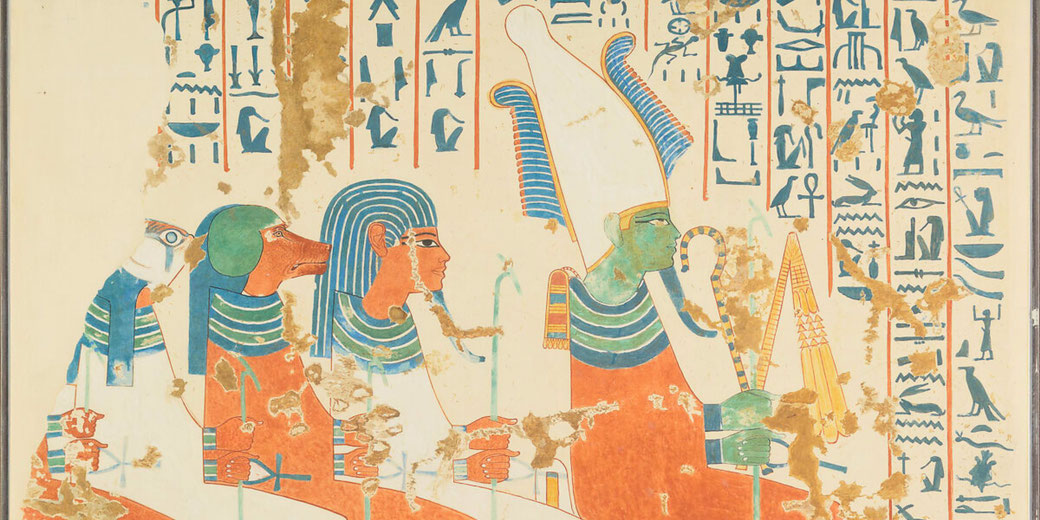
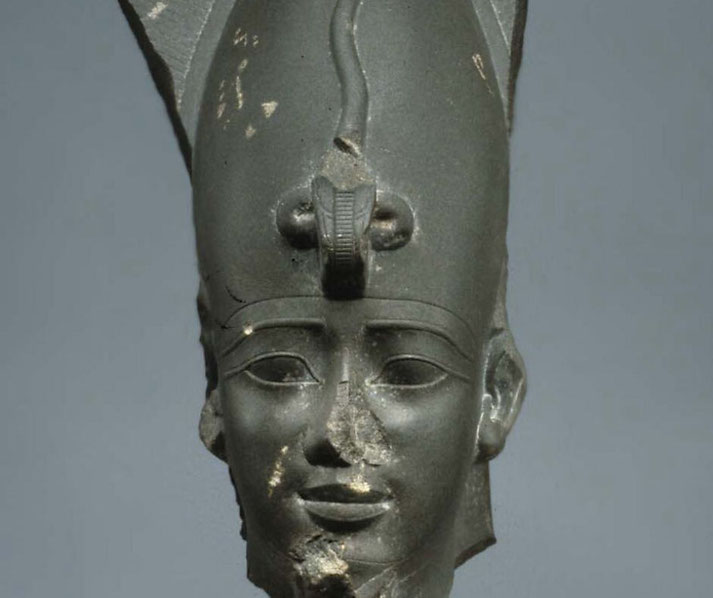
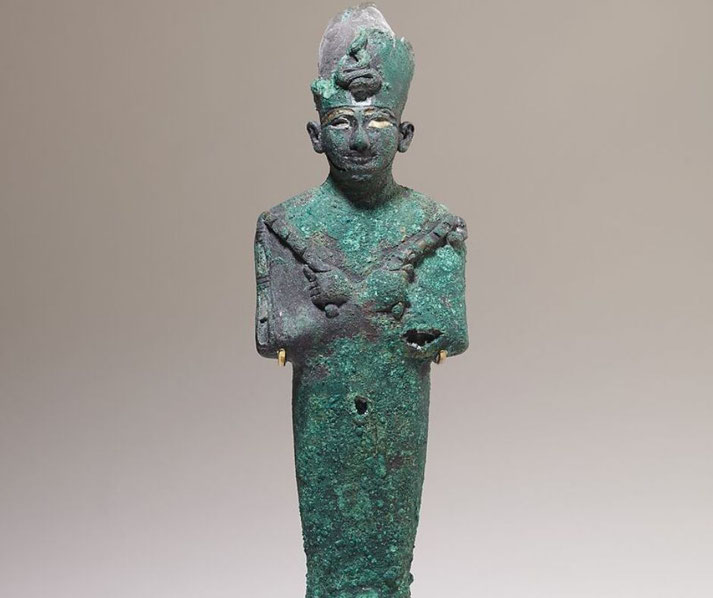
Osiris almost always appeared in funerary art and temple reliefs as a god-king who had passed through death but still ruled with authority.
His body was tightly wrapped in white linen and showed his embalmed form, while his green or black skin symbolised fertility and new life that came from the rich soil of the Nile.
He wore the tall Atef crown flanked by ostrich feathers and held the crook and flail, both of which signified kingship and protection expressed through royal discipline.
The crook symbolised shepherding guidance, and the flail suggested royal authority and agricultural abundance.
Often, artists placed Osiris in the Hall of Judgement, seated on a throne beside the scales that determined the fate of each soul.
He did not act alone, since judges such as Thoth, the baboon-headed scribe, and Ma’at, the goddess of truth, appeared nearby, forming a heavenly courtroom.
At the feet of the tribunal stood Ammit, ready to consume the hearts of those who failed the test.
In this role, Osiris embodied more than punishment and was the final standard by which all earthly behaviour would be measured.
Later, during the New Kingdom, tombs in the Valley of the Kings displayed detailed scenes in which Osiris welcomed the deceased or granted them safe passage into the blessed world.
Painted papyri inserted into coffins often depicted Osiris in fields of grain, and this reinforced his connection to both agriculture and spiritual reward.
Notable examples, such as the Papyrus of Ani and the Papyrus of Hunefer, featured the Weighing of the Heart scene with Osiris presiding.
The set of images surrounding him largely stayed stable for centuries, a sign of how central his story had become to Egyptian religion.
How did the Egyptians worship Osiris?
Rituals dedicated to Osiris often took place at both the state and personal level. At Abydos, pilgrims arrived during the month of Khoiak, at the most sacred centre of his worship, to take part in dramatic restagings of his myth.
Priests processed sacred statues down the Nile so that they reenacted his funeral and burial, and the sequence culminated in restoration.
Crowds followed, and they mourned at first, then they rejoiced as the image of the god rose again.
The planting of Osiris beds, small plots of barley in trays made in the image of the god, became a symbolic act that pointed to resurrection, repeated in homes and temples across Egypt.
Archaeologists have found these sprouting figures in tombs at Deir el-Bahari and elsewhere.
Meanwhile, families who prepared the dead took great care to align each burial with the story of Osiris.
Mummification methods followed the sequence of his reassembly. Rituals involved recitations of hymns to Isis and the use of protective amulets invoking Anubis, together with funerary texts that instructed the soul on how to speak in the judgement hall.
Wealthier households could afford scrolls of the Book of the Dead, which included images of Osiris presiding over the tests of the afterlife.
Spell 125, which described the Negative Confession, became especially important in presenting the deceased as morally pure.
At temples such as Philae during the Ptolemaic and Roman periods, priests honoured both deities in closely connected rites, and Isis received worship there.
While Philae became a major cult centre for Isis, Osiris's main cult site remained Abydos.
Shrines to Osiris remained hidden for part of the year and were brought out during special ceremonies that copied his return from the Duat.
For the living, participation in these rites usually offered more than comfort, since it secured a place in the next world under the guidance of the god who had already gone before them.