
How the ancient Egyptian army was organised and used in battle
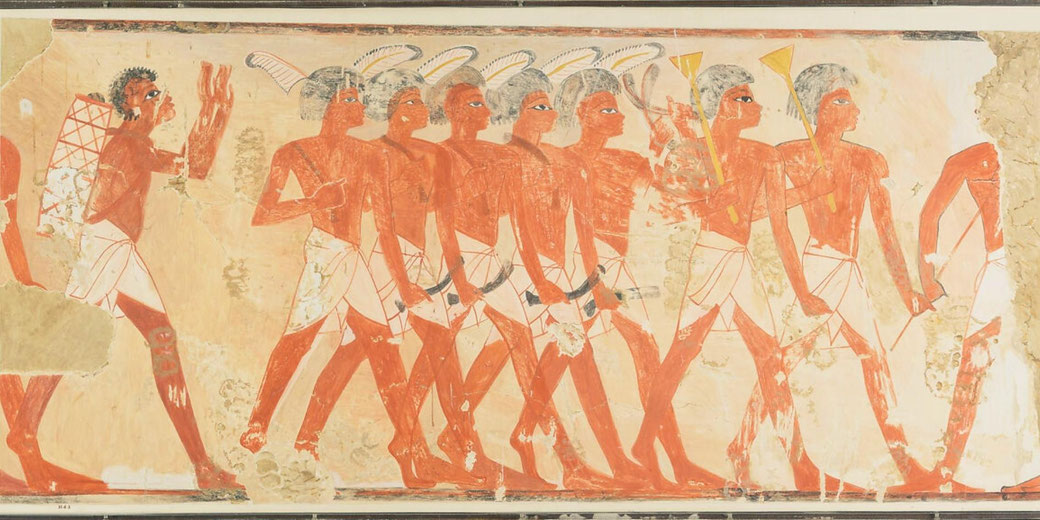
For much of Egyptian history, the army was the force that protected the Nile Valley by securing desert frontiers, punished rebellious cities, and carrying pharaoh’s authority as far as Nubia and Libya in the south, and Syria and Canaan in the north.
However, its organisation changed over time, since the forces of the Old Kingdom differed a great deal from the professional armies of the New Kingdom.
By the reigns of Thutmose III and Ramesses II, when the empire was at its height, Egypt could send large and disciplined armies far from home, which included scribes, supply officers, charioteers, archers, and scouts.
Early armies and local levies
In the Old Kingdom, Egypt did not maintain a large, permanent army in the later New Kingdom pattern.
Instead, it required local officials, known as nomarchs, to raise men from their nomes (provinces) whenever the pharaoh required frontier patrols or large military expeditions.
Many of these soldiers were farmers who left their fields for short campaigns and then returned to civilian life after the expedition had ended.
Their weapons were usually simple: spears and bows, together with wooden shields and maces, plus axes and throw sticks.
A useful example comes from the autobiography of Weni, an official who served under Pepi I in the Sixth Dynasty.
Weni claimed that he gathered troops from across Egypt through local officials and led them against the “sand-dwellers”, a term usually understood to refer to people east of Egypt in Sinai or southern Canaan.
These early forces were quite flexible in how they could be used, from raids and guard duty, to local defence, or even protecting mining expeditions into Sinai to protect the quarrying parties in the desert.
Surviving reliefs and inscriptions from this time already show soldiers in ordered files, which suggests that discipline and drill already mattered.
The army becomes more professional
During the Middle Kingdom, Egyptian kings took greater interest in frontier defence, especially in Nubia to the south.
This policy became especially clear under Senusret III, who campaigned in Nubia and tightened Egyptian control over the Second Cataract region.
His boundary inscription at Semna warned that Nubians were not to pass north except for trade or official business, which shows how military power, trade control and border administration were being used together.
The fortresses he constructed, such as Buhen and Semna, guarded the Nile routes and controlled trade, while their garrisons watched the movement of hostile Nubian groups.
These mudbrick forts had incredibly thick walls and towers, along with gates, magazines, barracks and administrative rooms.
Clearly, they showed that Egypt had developed a more permanent military presence in the region.
By the New Kingdom, from about 1550 BCE, Egypt had become a major military power.
The earlier Hyksos rule over northern Egypt had exposed Egyptian rulers to new types of military equipment, such as horse-drawn chariots and composite bows.
Then, after the expulsion of the Hyksos, rulers such as Ahmose I, Thutmose III, Seti I and Ramesses II used these same tools to successfully campaign outside Egypt.
By this point, the army contained career soldiers, specialist officers, foreign auxiliaries and chariot crews, and could fight across long distances in the Levant and Nubia.
Infantry: the backbone of the army
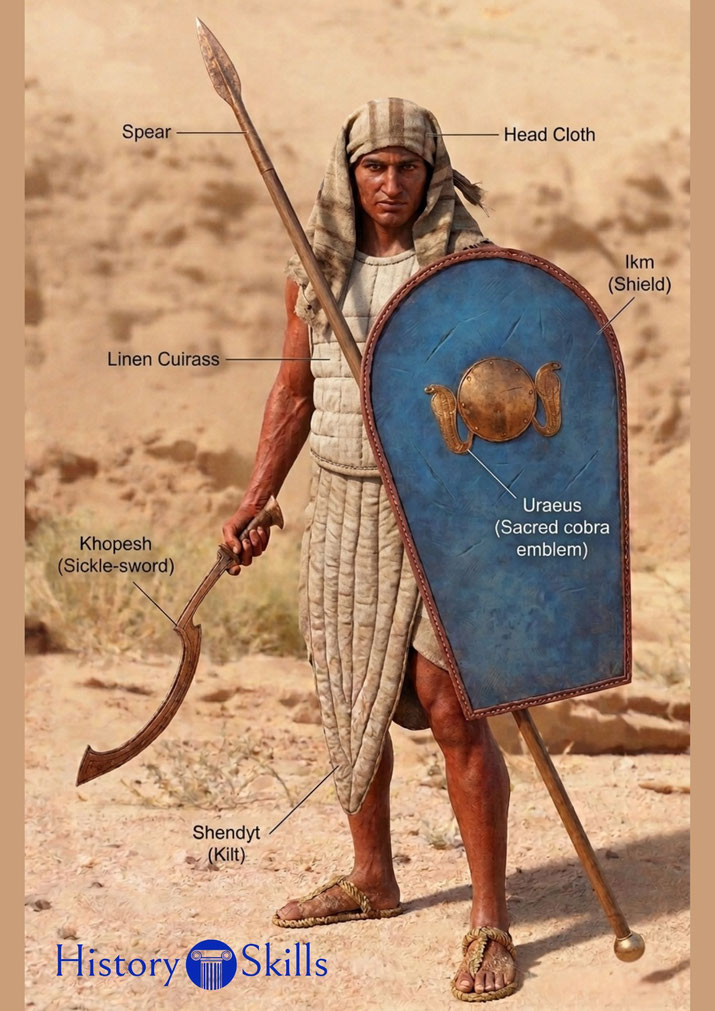
The largest part of the Egyptian army was the infantry. They typically carried spears and bows, with shields for protection and daggers or axes for close combat.
However, their exact equipment depended largely on a person’s individual wealth, as they appear to be required to supply their own weapons and armour.
Spearmen could stand in close groups for protection and assault, and shield-bearers helped protect men from arrows and javelins.
The most famous weapon was known as the ‘khepesh’, which was a curved sickle-sword that soldiers carried, and could be useful in close combat after the enemy line had been weakened.
Archers were especially important for Egyptian armies. They had long used the simple self bow, bit New Kingdom soldiers also used the more powerful composite bow, which was made from wood and horn, with sinew and glue added for strength.
Surviving examples include an Early New Kingdom bow fragment from Thebes, which is dated to about 1550–1295 BCE, made from wood and horn.
Archers could fire into enemy formations before the infantry advanced, and they could disrupt chariot crews and city defenders, as well as lightly protected troops.
Nubian archers had a particularly high reputation, and Egyptian texts often refer to Nubia as a land known for skilled bowmen.
The wooden model of about forty Nubian archers from the tomb of Mesehti at Asyut, from around 2000 BCE, gives a vivid example of how these troops were remembered in Egyptian burial art.
Chariots and battlefield speed
Perhaps the most readily recognisable weapon of the New Kingdom army is the war chariot.
Egyptian chariots were light and fast, with a usual crew of two men: a driver and a warrior armed with a bow and quiver, or, at times, javelins and sometimes a shield.
Although, the chariot did not smash through infantry in the manner of later cavalry charges.
Instead, it worked as a mobile firing platform, since its value lay in speed and shock, as well as pursuit and command.
At the Battle of Megiddo in 1457 BCE, Thutmose III used discreet movement through the narrow Aruna Pass to surprise a coalition of Canaanite princes.
His chariot forces and infantry then attacked the enemy near Megiddo. The account of the battle that we have access to today is based on the records of the royal scribe Tjaneni and was later inscribed at Karnak.
The siege that followed lasted seven or eight months, and it ended with tribute, prisoners, weapons, chariots and livestock taken by the Egyptians.
Another famous battle took place at Kadesh in c. 1274 BCE, where Ramesses II faced the Hittites in Syria.
Once more, chariots dominated the action. The pharaoh's army was organised into four main divisions named after the gods Amun, Re, Ptah and Seth.
When Hittite chariots struck the Egyptian camp after Egyptian intelligence had failed, the fact that the Egyptian divisions were spread-out made the crisis more dangerous.
Ramesses later claimed that his personal courage saved the day. However, the surviving Egyptian account is clearly royal propaganda, and Hittite evidence discovered later indicates that the battle ended without a clear victory for either side.
Later, after further tension between the two powers, Egypt and the Hittite empire agreed to a peace treaty, which is often described as the earliest known surviving international peace treaty.
Foreign troops and specialist fighters
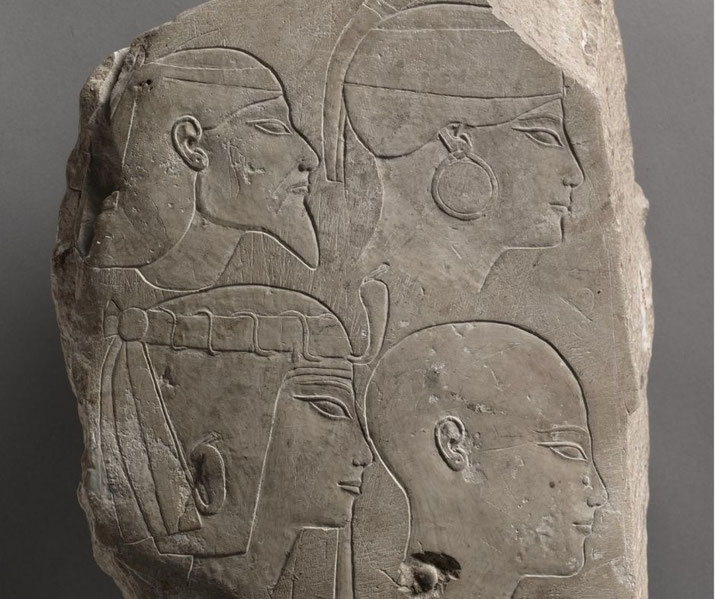
Egyptian armies often included soldiers from outside Egypt. Nubians, Medjay, Libyans, Sherden and other groups could appear as auxiliaries, guards, skirmishers or elite fighters.
In particular, the Medjay had begun as Nubian desert troops and later became associated with policing and security inside Egypt, while the Sherden were one of the groups connected to the Sea Peoples in Egyptian texts, and New Kingdom scenes show them as helmeted warriors who fought for Egypt after earlier conflict.
At Kadesh, Sherden warriors appear as part of Ramesses II’s personal guard, and their horned helmets, round shields and foreign-style weapons made them visually distinct from Egyptian troops.
These foreign troops brought some very useful skills, which meant that they also allowed pharaohs to increase military manpower without relying only on Egyptian farmers.
These soldiers could know desert routes and frontier warfare, with skills in archery or close combat, and some had experience in seaborne raiding.
As such, Egyptian commanders used them in places where their skills gave the army an advantage.
Command and supply systems
What we often forget is that an ancient army required more than just offensive military units to work well; it also needed scribes and quartermasters, along with heralds, standard-bearers, priests, doctors, grooms, armourers and transport crews.
For instance, scribes were needed to count rations, recorded equipment, listed prisoners, and helped officers control supplies.
Grain and beer, together with water, cattle, arrows, spare bowstrings, leatherwork and chariot parts, had to reach the army in usable condition.
Thankfully, the Nile gave Egypt a major advantage, since soldiers and equipment, with their various supplies, could move by boat through the centre of the kingdom, which made internal transport easier than in many neighbouring lands.
Campaigns into Syria and Canaan required careful preparation through border forts and coastal routes, and armies had to secure wells and roads, along with supply points.
In Nubia, the river and fortress chain allowed Egyptian forces to project power southward and to control trade in gold and cattle, as well as ivory and prisoners.
Siege warfare and fortified cities
Many Egyptian campaigns did not finish in open battle. In Syria and Canaan, cities often retreated behind walls, and Egyptian armies had to surround them and cut supplies until surrender became likely.
The siege of Megiddo after Thutmose III’s victory lasted seven or eight months.
Siege warfare required patience and constant pressure, supported by guards, ladders, battering tools and close watch over the defenders.
Once captured, Egypt usually avoided destroying them entire, but usually wanted loyalty and goods, which were usually paid tribute.
When this happened, it provided access to important trade and transport routes, so conquered rulers often stayed in place under Egyptian supervision.
What is more, their children could be taken to Egypt for education at court, which helped bind local elites to the pharaoh.
The Amarna Letters, a collection of about four hundred cuneiform tablets from the 14th century BCE, help show how this system worked in Canaan.
In those letters, local rulers wrote to the Egyptian court about loyalty, threats, supplies and requests for military support, which shows that Egyptian power depended on diplomacy and pressure as well as armed force.