
Historical sources on the Prague Spring
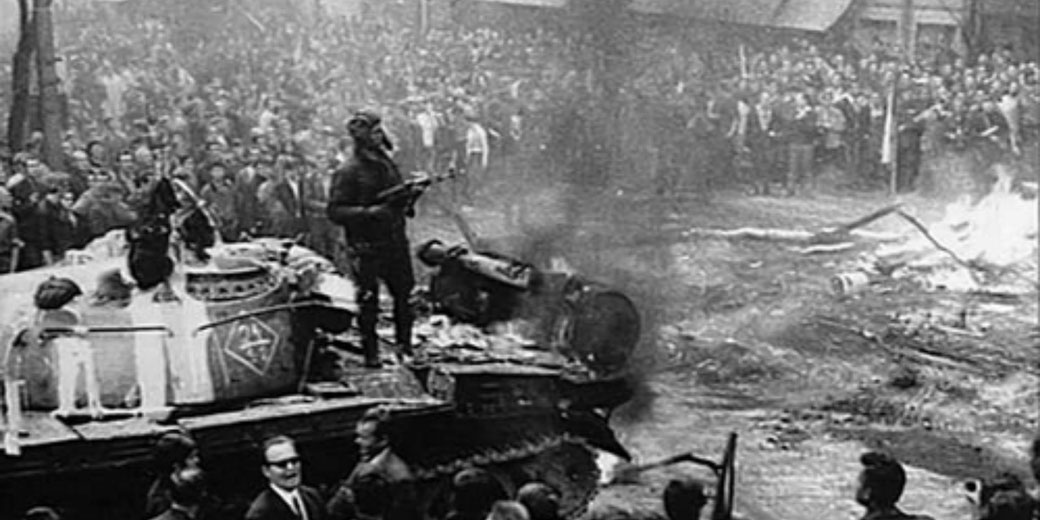
The Prague Spring of 1968 was a period of political reform in communist Czechoslovakia under the leadership of Alexander Dubček, who promoted greater freedom of expression, reduced censorship and a more democratic form of socialism.
Soviet leaders feared that the reforms would weaken Communist Party control and encourage similar demands across Eastern Europe.
On the night of the 20th of August 1968, troops from the Soviet Union and several Warsaw Pact countries invaded Czechoslovakia, arrested its leaders and ended the reform program.
The following sources examine the causes, aims and suppression of the Prague Spring through American government reports, Soviet political arguments and later historical studies.
Source 1
Extract A
"When Alexander Dubcek was elected first secretary of the Czechoslovak Communist Party (KSC) in January 1968, he intended to 'put a human face on communism.' His government drafted an 'Action Program' outlining its goals, which were basically a return to socialism as it had existed in the country from 1945 to 1948, before the Soviet Union imposed a harsher regime of communism. He presided over a widespread popular movement to 'de-Stalinize' and 'democratize' communism in Czechoslovakia. The entire country was giddy with the spirit of reform. The world dubbed it the 'Prague Spring.'"
Extract B
"The expanding freedom in Czechoslovakia earned Dubcek the support of the majority of its citizens, but hard-liners in the KSC began to coalesce against him, especially Vasil Bil'ak, Alois Indra, and Drahomir Kolder, who feared his reforms. Leaders of other Warsaw Pact countries -- East Germany's Walter Ulbricht and Poland's Wladyslaw Gomulka, as well as Todor Zhivkov of Bulgaria -- were deeply concerned that the spirit of reform might spread to their countries. Indeed, Polish students had already rallied for change, and the slogan 'Poland is waiting for its own Dubcek' had appeared on more than one wall. Ulbricht and Gomulka were among the first voices calling for military intervention."
Contextual information:
This document was produced by the National Security Agency of the United States government as part of its Cryptologic Almanac 50th Anniversary Series, declassified and published on the NSA's public website. It was written to review the 1968 Prague Spring and the American signals intelligence response during the Soviet-led invasion of Czechoslovakia. The NSA is the United States government agency responsible for signals intelligence and codebreaking.
Bibliographical reference:
United States National Security Agency. (n.d.). From spring, into a long winter's night: The Czechoslovakian crisis of 1968 (Part One). National Security Agency, pp. 1–2. https://media.defense.gov/2021/Jun/29/2002751866/-1/-1/0/FROM_SPRING_PART_ONE.PDF
Copyright: This is a work of the United States Government and is in the public domain under 17 U.S.C. § 105.
Source 2
Extract A
"In the 1960s, however, changes in the leadership in Prague led to a series of reforms to soften or humanize the application of communist doctrines within Czech borders. The Czech economy had been slowing since the early 1960s, and cracks were emerging in the communist consensus as workers struggled against new challenges. The government responded with reforms designed to improve the economy. In early 1968, conservative leader Antonin Novotny was ousted as the head of the Communist Party of Czechoslovakia, and he was replaced by Alexander Dubcek. The Dubcek government ended censorship in early 1968, and the acquisition of this freedom resulted in a public expression of broad-based support for reform and a public sphere in which government and party policies could be debated openly. In April, the Czech Government issued a formal plan for further reforms, although it tried to liberalize within the existing framework of the Marxist-Leninist State and did not propose a revolutionary overhaul of the political and economic systems."
Extract B
"After the invasion, the Soviet leadership justified the use of force in Prague under what would become known as the Brezhnev Doctrine, which stated that Moscow had the right to intervene in any country where a communist government had been threatened. This doctrine, established to justify Soviet action in Czechoslovakia, also became the primary justification for the Soviet invasion of Afghanistan in 1979."
Extract C
"Finally, in April of 1969, the Soviets forced Dubcek from power in favor of a more conservative administrator. In the years that followed, the new leadership reestablished government censorship and controls preventing freedom of movement, but it also improved economic conditions, eliminating one of the sources for revolutionary fervor."
Contextual information:
The Office of the Historian is a division of the United States Department of State that produces official historical analyses of American foreign policy. This essay was written by professional historians employed by the U.S. federal government as part of the Milestones in the History of U.S. Foreign Relations series, which covers key events in twentieth-century international affairs from an American perspective. It draws on declassified State Department records and other primary sources.
Bibliographical reference:
United States Department of State, Office of the Historian. (n.d.). Soviet invasion of Czechoslovakia, 1968. U.S. Department of State. https://history.state.gov/milestones/1961-1968/soviet-invasion-czechoslavkia
Copyright: This is a work of the United States Government and is in the public domain under 17 U.S.C. § 105.
Source 3
Extract A
"At about midnight on 20 August, fifteen to sixteen Soviet divisions, augmented by three Polish divisions and smaller elements of Hungarian, Bulgarian, and East German forces left their assembly areas and entered Czechoslovakia. They struck from three directions: the largest concentration attacked from the north, along the East German border, headed for Prague and Pitzen [Plzen], while smaller formations displaced from the Soviet Union's Carpathian Military District, and from Hungary. At the same time, airborne forces departed bases in the Soviet Union, heading for key locations in Czechoslovakia. The Soviet blitzkrieg was not resisted by Czech forces, following the Czech Presidium's appeal not to offer resistance."
Extract B
"With Dubcek and his top lieutenants arrested and hustled off to Moscow, Czechoslovak radio continued to broadcast. Ironically, the Soviets had aided the Czechs in constructing an underground radio broadcast system, for use in the case of enemy attack. Now it was used against them -- announcers, broadcasting from secret locations advised citizens to avoid violence. Instead, they were instructed to engage the soldiers in conversation, to write signs in Cyrillic [the alphabet used by Russians] telling them to go home, to hold out transistor radios to them while announcers told them in Russian to go home. Warnings were issued to particular citizens 'not to go home,' if they were in danger of being arrested. Messages were passed from one person to another, and citizens were asked to remove all highway signs, street signs, and house numbers in an effort to confuse the invaders. Essayist Lea Sevcik points out that this effort was so successful that the only signs remaining in the country were 'those pointing to Moscow.'"
Extract C
"Replaced as first secretary by Gustav Husak, Dubcek was put to work as a forester, repairing chain saws for his livelihood. Thousands lost their jobs in the political purges which inevitably followed, and because it was illegal to be unemployed, many of the country's intellectuals were put to toiling at menial jobs. Half a million people were expelled from the Communist Party, and some 150,000 Czechs fled the country."
Contextual information:
This document is the second part of the NSA Cryptologic Almanac article cited in Source 1. It covers the Soviet-led invasion itself on the night of 20–21 August 1968 and its immediate aftermath, drawing on declassified signals intelligence records and historical scholarship available to the NSA. It was produced by the United States government and is publicly available on the NSA's official defence website.
Bibliographical reference:
United States National Security Agency. (n.d.). From spring, into a long winter's night: The Czechoslovakian crisis of 1968 (Part Two). National Security Agency, pp. 1–3. https://media.defense.gov/2021/Jun/29/2002751868/-1/-1/0/FROM_SPRING_PART_TWO.PDF
Copyright: This is a work of the United States Government and is in the public domain under 17 U.S.C. § 105.
Source 4
"In April the KSC [Czechoslovak Communist Party] Presidium adopted the Action Program that had been drafted by a coalition headed by Dubcek and made up of reformers, moderates, centrists, and conservatives. The program proposed a 'new model of socialism,' profoundly 'democratic' and 'national,' that is, adapted to Czechoslovak conditions. The National Front and the electoral system were to be democratized, and Czechoslovakia was to be federalized. Freedom of assembly and expression would be guaranteed in constitutional law."
Contextual information:
The Country Studies series was produced by the Federal Research Division of the United States Library of Congress for the U.S. Department of the Army. Each volume was written by area specialists and published to provide factual background on the political history and economic conditions of countries across the world. The Czech Republic volume covers Czechoslovakia from its origins to the post-communist era and is based on a range of scholarly and primary sources.
Bibliographical reference:
Library of Congress, Federal Research Division. (1993). The Prague Spring, 1968. In Czech Republic: A country study (Area Handbook Series). U.S. Government Printing Office. https://country-studies.com/czech-republic/the-prague-spring,-1968.html
Copyright: This is a work of the United States Government and is in the public domain under 17 U.S.C. § 105.
Source 5
Extract A
"The peoples of the socialist countries and Communist parties certainly do have and should have freedom for determining the ways of advance of their respective countries. However, none of their decisions should damage either socialism in their country or the fundamental interests of other socialist countries, and the whole working class movement, which is working for socialism. This means that each Communist party is responsible not only to its own people, but also to all the socialist countries, to the entire Communist movement. Whoever forget this, in stressing only the independence of the Communist party, becomes one-sided. He deviates from his international duty."
Extract B
"Discharging their internationalist [international brotherhood] duty toward the fraternal peoples of Czechoslovakia and defending their own socialist gains, the U.S.S.R. and the other socialist states had to act decisively and they did act against the antisocialist forces in Czechoslovakia."
Contextual information:
Sergei Kovalev was a journalist and political theorist who wrote for Pravda, the official newspaper of the Soviet Communist Party. He wrote this article in September 1968 to provide an ideological justification for the Warsaw Pact invasion of Czechoslovakia, arguing that no socialist country had the right to take actions that damaged the collective socialist community. The principles laid out in this article became known in the West as the Brezhnev Doctrine, after Soviet leader Leonid Brezhnev, who reiterated and expanded on them in a speech to Poland in November 1968.
Bibliographical reference:
Kovalev, S. (1968, September 26). Sovereignty and the international obligations of socialist countries. Pravda, p. 4.
Copyright: Public domain.