
Historical sources on the life of Julius Caesar
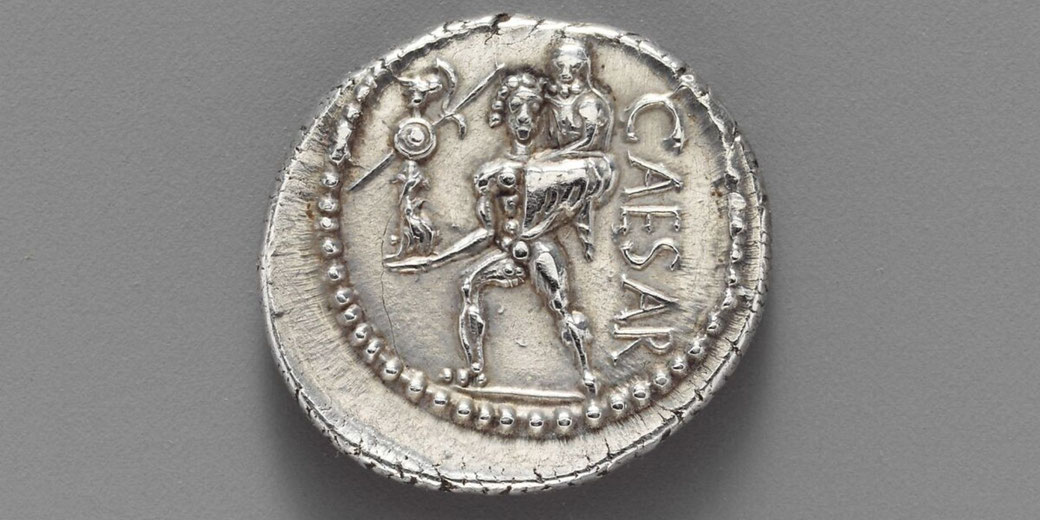
These sources offer three perspectives on Julius Caesar drawn from ancient biographical accounts written in the first and second centuries AD.
The extracts from Suetonius's Life of Julius Caesar and Plutarch's Life of Caesar cover the major episodes of Caesar's political career, from his alliance with Pompey and Crassus through to his assassination and its aftermath.
A third source, also from Suetonius, covers the reign of the Emperor Vespasian and the construction of the Colosseum, and provides a useful point of comparison for thinking critically about source relevance and selection.
Source 1
Extract A
"Thereupon Caesar, especially incensed by this slight, by every possible attention courted the goodwill of Gnaeus Pompeius, who was at odds with the senate because of its tardiness in ratifying his acts after his victory over king Mithridates. He also patched up a peace between Pompeius and Marcus Crassus, who had been enemies since their consulship, which had been one of constant wrangling. Then he made a compact with both of them, that no step should be taken in public affairs which did not suit any one of the three."
Extract B
"Backed therefore by his father-in-law and son-in-law, out of all the numerous provinces he made the Gauls his choice, as the most likely to enrich him and furnish suitable material for triumphs. At first, it is true, by the bill of Vatinius he received only Cisalpine Gaul [the part of Gaul south of the Alps, in what is now northern Italy] with the addition of Illyricum [the region along the eastern Adriatic coast]; but presently he was assigned Gallia Comata [the unconquered territories of Gaul north and west of the Alps] as well by the senate, since the members feared that even if they should refuse it, the people would give him this also."
Extract C
"Then Caesar cried: 'Take we the course which the signs of the gods and the false dealing of our foes point out. The die is cast,' said he."
[Caesar spoke these words in 49 BC as he crossed the Rubicon River, the boundary between his province of Cisalpine Gaul and Roman Italy. Roman law forbade any general from bringing his army across this river without the senate's permission. By crossing it, Caesar was committing an act of war against the Roman state.]
Extract D
"Then turning his attention to the reorganisation of the state, he reformed the calendar, which the negligence of the pontiffs [the priests who managed the Roman calendar] had long since so disordered, through their privilege of adding months or days at pleasure, that the harvest festivals did not come in summer nor those of the vintage in the autumn; and he adjusted the year to the sun's course by making it consist of three hundred and sixty-five days, abolishing the intercalary month [the extra month that had been inserted into the Roman calendar to make up for its inaccuracy], and adding one day every fourth year."
Extract E
"For not only did he accept excessive honours, such as an uninterrupted consulship, the dictatorship for life [a permanent appointment to absolute power, which broke with Roman tradition that a dictatorship could only be temporary], and the censorship of public morals, as well as the forename Imperator [a title of military command that later became the basis of the word 'Emperor'], the surname of Father of his Country, a statue among those of the kings, and a raised couch in the orchestra..."
Extract F
"More than sixty joined the conspiracy against him, led by Gaius Cassius and Marcus and Decimus Brutus."
Extract G
"Immediately after the funeral the commons ran to the houses of Brutus and Cassius with firebrands, and after being repelled with difficulty, they slew Helvius Cinna when they met him, through a mistake in the name, supposing that he was Cornelius Cinna, who had the day before made a bitter indictment of Caesar and for whom they were looking; and they set his head upon a spear and paraded it about the streets."
Extract H
"Hardly any of his assassins survived him for more than three years, or died a natural death. They were all condemned, and they perished in various ways — some by shipwreck, some in battle; some took their own lives with the self-same dagger with which they had impiously slain Caesar."
Extract I
"He died in the fifty-sixth year of his age [which, counting back from 44 BC when he was assassinated, places his birth in 100 BC], and was numbered among the gods, not only by a formal decree, but also in the conviction of the common people."
Contextual information:
Gaius Suetonius Tranquillus was a Roman historian and biographer who worked as a secretary under Emperor Hadrian in the early second century AD. He wrote The Twelve Caesars, a collection of biographies of Roman rulers from Julius Caesar to Domitian, drawing on imperial archives and earlier accounts. His biography of Julius Caesar is one of the most detailed ancient accounts of Caesar's political career and assassination.
Bibliographical reference:
Suetonius. Life of Julius Caesar (J. C. Rolfe, Trans., 1913; Vol. I, pp. 25, 29, 45, 55, 99, 107, 117, 119). William Heinemann. (Original work written ca. 121 AD).
Copyright: Public domain.
Source 2
Extract A
"So as soon as he entered the city he assumed a policy which deceived everyone except Cato. This policy was to reconcile Pompey and Crassus, the most influential men in the city. These men Caesar brought together in friendship after their quarrel, and by concentrating their united strength upon himself, succeeded, before men were aware of it, and by an act which could be called one of kindness, in changing the form of government."
Extract B
"Pompey, however, immediately after his marriage, filled the forum with armed men and helped the people to enact Caesar's laws and give him as his consular province Gaul on both sides of the Alps for five years, together with Illyricum [the region along the eastern Adriatic coast] and four legions [units of the Roman army, each typically consisting of around 4,000 to 6,000 soldiers]."
Extract C
"When he came to the river which separates Cisalpine Gaul [the part of Gaul south of the Alps] from the rest of Italy (it is called the Rubicon), and began to think carefully, now that he drew nearer to the fearful step and was agitated by the magnitude of his ventures, he checked his speed. Then, halting in his course, he communed with himself a long time in silence as his resolution wavered back and forth, and his purpose then suffered change after change."
[This event took place in 49 BC. Roman law forbade any general from bringing his army across the Rubicon without the senate's permission. By crossing it, Caesar was committing an act of war against the Roman state.]
Extract D
"But finally, with a sort of passion, as if abandoning calculation and casting himself upon the future, and uttering the phrase with which men usually prelude their plunge into desperate and daring fortunes, 'Let the die be cast,' he hastened to cross the river; and going at full speed now for the rest of the time, before daybreak he dashed into Ariminum [a Roman town on the Adriatic coast, just south of the Rubicon] and took possession of it."
Extract E
"However, the Romans gave way before the good fortune of the man and accepted the bit [submitted to his authority], and regarding the monarchy as a respite [a relief] from the evils of the civil wars, they appointed him dictator for life. This was confessedly a tyranny, since the monarchy, besides the element of irresponsibility, now took on that of permanence."
[Caesar was appointed dictator for life in 44 BC. This was a significant departure from Roman tradition, in which the office of dictator was a temporary emergency appointment.]
Extract F
"But Caesar laid the problem before the best philosophers and mathematicians, and out of the methods of correction which were already at hand compounded one of his own which was more accurate than any. This the Romans use down to the present time, and are thought to be less in error than other peoples as regards the inequality between the lunar and solar years."
Extract G
"Among events of man's ordering, the most amazing was that which befell Cassius; for after his defeat at Philippi [a battle in northern Greece in 42 BC, where Caesar's assassins were finally defeated by his successors] he slew himself with that very dagger which he had used against Caesar; and among events of heavenly ordering, there was the great comet, which showed itself in great splendour for seven nights after Caesar's murder, and then disappeared..."
Extract H
"At the time of his death Caesar was fully fifty-six years old [placing his birth in 100 BC], but he had survived Pompey not much more than four years..."
Contextual information:
Plutarch was a Greek historian and biographer who wrote in the late first and early second centuries AD. His work Parallel Lives paired biographies of famous Greeks and Romans, and his Life of Caesar is one of the most thorough ancient accounts of Caesar's career. Plutarch drew on earlier histories and his own extensive reading, and his biography covers Caesar's political career and assassination in considerable detail.
Bibliographical reference:
Plutarch. Parallel Lives: Life of Caesar (B. Perrin, Trans., 1919; Vol. VII, pp. 471, 475, 521, 523, 575, 581, 605). William Heinemann. (Original work written ca. 75 AD).
Copyright: Public domain.
Source 3
Extract A
"He also undertook new works, the temple of Peace hard by the Forum and one to the Deified Claudius on the Caelian mount, which was begun by Agrippina, but almost utterly destroyed by Nero; also an amphitheatre [an oval open-air stadium used for gladiatorial contests and public spectacles] in the heart of the city, a plan which he learned that Augustus had cherished."
[The amphitheatre referred to here is the building now known as the Colosseum, begun by the Emperor Vespasian around AD 70, more than a century after Julius Caesar's assassination in 44 BC. Vespasian belonged to the Flavian dynasty, and the Colosseum was known in ancient times as the Flavian Amphitheatre. It had no connection to Julius Caesar.]
Contextual information:
Gaius Suetonius Tranquillus was a Roman historian and biographer who worked as a secretary under Emperor Hadrian in the early second century AD. His biography of Vespasian forms part of The Twelve Caesars. Vespasian reigned as emperor from AD 69 to AD 79, more than a century after Julius Caesar's death.
Bibliographical reference:
Suetonius. Life of the Deified Vespasian (J. C. Rolfe, Trans., 1914; Vol. II, p. 303). William Heinemann. (Original work written ca. 121 AD).
Copyright: Public domain.