
Passchendaele: Understanding the carnage of World War One's most infamous battle
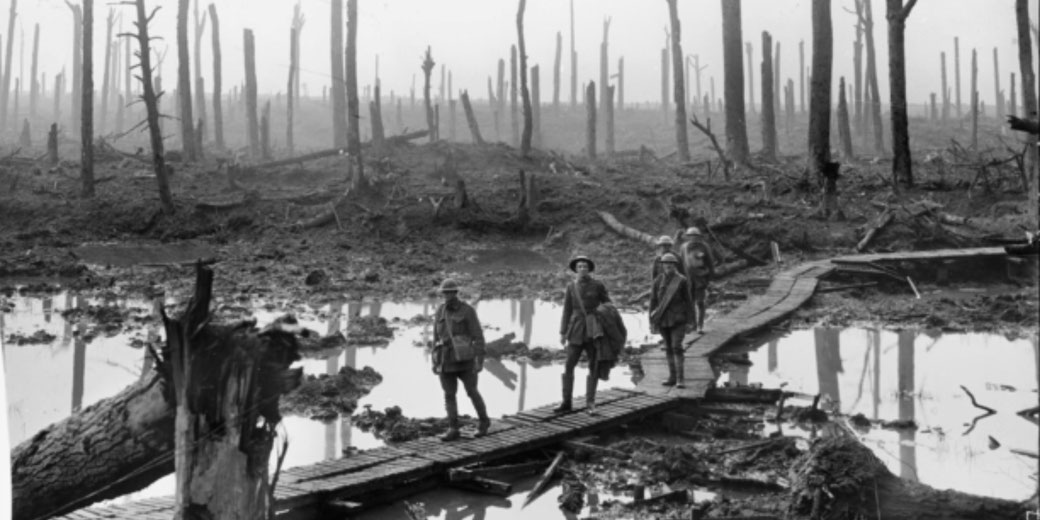
In the summer and autumn of 1917, Allied commanders launched the Third Battle of Ypres across the waterlogged fields of Flanders.
What began as an attempt to seize high ground and disrupt German submarine operations along the Belgian coast quickly deteriorated into one of the most terrible campaigns of the war.
As artillery destroyed the terrain and rain fell without end, soldiers became trapped in a bog of clinging mud and clouds of gas that turned every advance into a struggle that few survived.
Why did the battle occur?
By early 1917, the Western Front had reached a state of deadlock. General Sir Douglas Haig proposed a renewed offensive near the city of Ypres, with the aim of capturing the Gheluvelt Plateau and advancing to the village of Passchendaele, then driving on toward the channel ports of Zeebrugge and Ostend.
He argued that success would prevent further U-boat attacks on British shipping and relieve pressure on the French army, which had suffered severe losses during the failed Nivelle Offensive.
Haig believed that a clear breakthrough could even bring the war to a close before the end of the year.
At the same time, political leaders faced difficult decisions, since the Russian Revolution in February 1917 had significantly weakened the Eastern Front, and German forces appeared ready to shift more divisions to the west.
French troops had mutinied in large numbers and were, in many cases, incapable of launching new attacks.
As a result, the British Expeditionary Force remained effectively the only force that was available to mount a significant operation on the Western Front.
German Chief of Staff General Erich Ludendorff and Crown Prince Rupprecht prepared to meet this threat by reinforcing strongpoints and constructing deep concrete pillboxes.
By late June, Haig had secured permission to proceed. Although Prime Minister David Lloyd George doubted the likely outcome, he lacked an alternative plan and feared damaging British unity with the Allies.
As events moved forward, preparations began for what would become a drawn-out campaign fought in some of the worst conditions that soldiers had experienced during the Great War.
Planning and preparation for mass slaughter
Prior to the main offensive, British and Dominion engineers had spent months on the battlefield as they prepared it, and their units had included Australian and New Zealand contingents, who laid mines and moved supplies into position.
On 7 June 1917, nineteen enormous mines detonated beneath the German lines at Messines Ridge.
The explosion killed thousands instantly and was a first step in the attack that encouraged Haig to continue with his broader objectives.
The blast was reportedly heard as far away as London and ranked among the largest non-nuclear detonations in history.
On 18 July, a massive artillery bombardment began across the Ypres salient, during which British gunners, who fired millions of shells from more than three thousand guns, tore up the soil and destroyed German forward positions.
However, the constant shelling also destroyed the network of drainage canals that had controlled groundwater levels.
Combined with weeks of heavy rain, the bombardment flooded the battlefield and transformed it into a sea of mud.
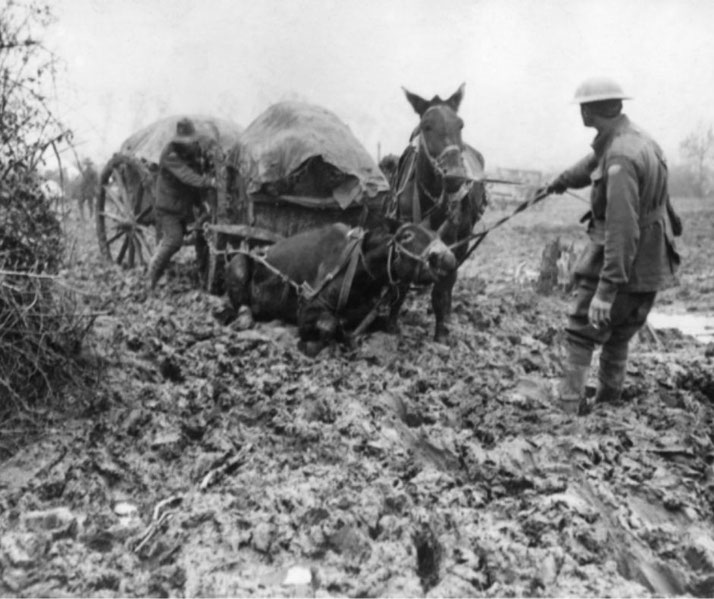
At this point, supply routes became nearly impossible to maintain. Roads broke apart, pack animals sank, and duckboard walkways collapsed under their own weight.
Despite these conditions, senior commanders pressed ahead. They believed the enemy had become weak enough and that delaying the attack would cause further logistical problems.
As the date of the assault approached, men and equipment continued to arrive near the front lines, often under fire and with poor shelter.
Expectations of a quick advance across open ground faded rapidly.
The key events of the Battle of Passchendaele
On 31 July 1917, the first wave of British and Dominion troops attacked across a front extending east of Ypres.
The night before, very heavy rain had soaked the battlefield, and by morning, the ground had turned to thick sludge.
Within hours, entire battalions became bogged down under enemy fire. German defenders, positioned in concrete pillboxes, fired continuously from elevated positions.
Throughout August, attacks continued at Langemarck, though gains remained limited. N
ew divisions, many of which were made up of conscripts, suffered very heavy losses as they attempted to cross ground that had already been badly damaged.
Meanwhile, German counterattacks used the terrain to their advantage and retook many of the positions seized at enormous cost.
During September, General Herbert Plumer introduced new tactics that focused on smaller objectives.
By coordinating artillery with short advances, his forces captured Menin Road and Polygon Wood, then pushed on to Broodseinde Ridge.
The approach proved more effective, though casualties remained high. The Battle of Broodseinde on 4 October alone resulted in over 20,000 Allied and German casualties, with thousands of Australians among the wounded and killed.
As the offensive reached its final phase in October, Canadian forces under General Arthur Currie were ordered to take Passchendaele village.
Despite his strong objections and warnings about the expected casualties, the attack proceeded.
Between 26 October and 10 November, the Canadians fought uphill across broken ground, often waist-deep in mud and exposed to artillery fire.
On 6 November, they secured the village, or at least what little of it still remained.
The 1st and 2nd Canadian Divisions took on the heaviest part of the final assault, and they pushed through an area that had become a graveyard of shattered trees and destroyed equipment.
The nightmarish conditions of the battlefield
Throughout the campaign, the battlefield deteriorated into a swamp. Rain fell almost constantly and shell holes filled with water and turned into traps.
Men attempting to cross the ground slipped, sank, and often drowned. Even when wounded soldiers were rescued, they were frequently lost during transport or died of exposure before reaching aid stations.
Medical units struggled to operate under such conditions. Each stretcher team required up to twelve men, as duckboards shifted and flooded routes washed away.
Supplies arrived late or failed to arrive altogether. The wounded had been exposed to the elements for hours and developed trench fever and frostbite, as well as gangrene in the worst cases.
What is more, poison gas shells added another layer of suffering. In particular, mustard gas settled into low ground and soaked into uniforms, blistering skin and damaging lungs.
It caused long-term respiratory injuries, but rarely caused immediate choking to death.
Also, phosgene and chlorine drifted across the battlefield, and men without effective masks stood little chance of survival.
As medical supplies ran out, doctors made decisions about who could be saved and who could not.
Among those who fought, survivors recalled scenes of horror that seemed unmatched by any earlier battle.
Letters and diaries spoke of comrades who drowned in silence, their cries muffled by mud.
Corpses lay exposed or submerged and, in some cases, became part of the trench walls.
The dead became landmarks that soldiers used to navigate an otherwise featureless plain of grey water and brown earth.

How many people were killed at Passchendaele?
By the end of the campaign, estimates had placed Allied casualties at around 275,000, with between 60,000 and 70,000 killed.
German casualties likely ranged from 200,000 to 250,000, depending on the source.
Some records place the total number of casualties near half a million.
Australian forces suffered approximately 36,000 casualties, which included over 6,500 dead, while New Zealand’s contribution came from a much smaller population and resulted in just over 5,000 total casualties, of whom around 845 were killed.
Canadian divisions, particularly during the final phase, recorded at least 16,000 casualties.
British infantry battalions, replenished with conscripts and under-trained recruits, absorbed much of the burden and suffered very heavy losses.
Importantly, many of the dead were never identified. Bodies disappeared in the mud, and even when found, identification often proved impossible.
Today, the Tyne Cot Memorial lists nearly 35,000 names of men who have no known grave.
Across Flanders, similar monuments stand in silent testimony to those who were lost beneath the ground.
Public response to the losses grew steadily, as newspapers printed seemingly endless casualty lists.
Families across Britain and the Dominions learned that their sons, brothers, or husbands had vanished without trace.
Military leaders defended the campaign, but many veterans and politicians began to question its value.
Medical studies conducted after the war showed long-term trauma suffered by those who endured Passchendaele, which contributed to a growing awareness of what would later be called shell shock.
What happened after the battle?
Passchendaele Ridge had been taken and proved impossible to use for further operations.
Trenches flooded within days. Equipment became unusable. Troops who remained in the area spent the winter in combat as they tried to hold positions that offered little real strategic advantage.
In March 1918, the German Spring Offensive took back much of the territory that the Allied forces had taken during the campaign.
The Allies, weakened by previous losses, often struggled to hold the line. Within months, Passchendaele had once again become a battlefield littered with smashed remains and unburied dead.
After the war, critics studied the campaign in detail. Some people, such as Haig’s supporters, claimed that it had weakened German strength and helped the Allies keep going.
Others described the battle as a waste of manpower and a failure of leadership.
General Currie spoke long after the war and stated plainly that the village had no value worth the cost.