
Lawrence of Arabia: The amazing story of a British scholar who led an Arab revolt during WWI
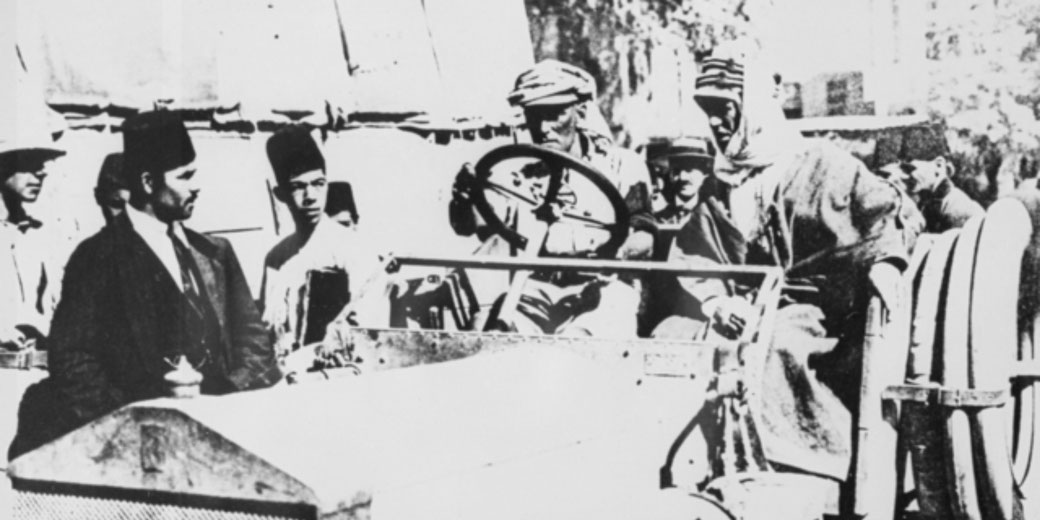
During the First World War, as empires bled each other dry on the battlefields of Europe and the Ottoman Empire clung to its Arab provinces, one British officer launched a campaign that helped change both military strategy and imperial aims.
Known as T. E. Lawrence, he rode with Bedouin fighters across hundreds of kilometres of rugged terrain and blew up trains on the Hejaz Railway as he helped capture key Ottoman outposts, such as the Red Sea port of Aqaba.
He frequently combined academic and linguistic knowledge with irregular tactics and transformed himself from an archaeologist into a guerrilla commander whose influence reached from Cairo to Damascus.
Lawrence's privileged early life
Born on 16 August 1888 in the village of Tremadog in Wales, Thomas Edward Lawrence entered a household shaped by hidden scandal.
His father was Sir Thomas Chapman and he had abandoned his wife and estate to live with Sarah Junner, who was their children’s governess, and they adopted the surname Lawrence to conceal their arrangement.
Eventually, the family settled in Oxford, where Lawrence had largely grown up surrounded by books and a quiet home life with strict rules and a focus on study.
As a child, he immersed himself in medieval history, with a special interest in military architecture and ideas about knighthood and honour.
At Jesus College, Oxford, he studied history and wrote his thesis on Crusader castles in the Levant, such as Krak des Chevaliers and Kerak.
For research, he had travelled alone across Palestine and Syria in 1909, where he walked over 1,000 kilometres and slept in villages along the way.
During this journey, he learned regional dialects and took detailed sketches of fortresses as he developed a respect for Arab customs that would shape his later approach to diplomacy and warfare.
After he had graduated with first-class honours in 1910, he joined the British Museum’s digs at Carchemish, which were near the Syrian-Turkish border.
There, he worked alongside Leonard Woolley, who led the site, and he answered to Reginald Campbell Thompson, who supervised the work on behalf of the museum.
Lawrence refined his Arabic and began to understand relationships between tribes in the region.
Significantly, his time in the Middle East coincided with growing local anger under Ottoman rule.
By 1914, he had mapped parts of the Sinai Peninsula for British military use, and this work provided strategic information ahead of the coming war.
How Lawrence began his work for the British army
When war erupted and the Ottoman Empire joined the Central Powers, British authorities looked for ways to weaken Ottoman control in the Arab provinces.
In response, they established the Arab Bureau in Cairo in 1916, which monitored intelligence and developed political strategies for the region.
Lawrence joined in 1915 as a junior officer with special knowledge of Arabic and regional affairs, but his reputation quickly grew due to his knowledge of tribal structures and local politics.
Figures such as Gilbert Clayton and David Hogarth played central roles in the Bureau's operations.
At the same time, Sharif Hussein bin Ali of Mecca had entered secret negotiations with the British because he wanted support for an Arab revolt.
In exchange for an uprising against Ottoman forces, Hussein demanded post-war independence for Arab lands that stretched from the Red Sea to Iraq.
These negotiations were set out in writing in the McMahon–Hussein Correspondence of 1915–1916.
The British, eager to open a new front against the Ottomans, gave cautious assurances.
Lawrence, who had studied the Hashemites and their ambitions, believed Faisal, Hussein’s son, could lead a credible revolt and help balance Ottoman authority.
After securing approval, Lawrence travelled to the Arabian Peninsula in late 1916 and met Faisal in the desert, near Wadi Safra.
Some sources place this meeting closer to Yanbu, a location used frequently by Faisal’s forces.
Regardless, he advised him to avoid direct confrontations with Ottoman regulars and instead use guerrilla tactics, but Lawrence argued that Arab forces often held the advantage in mobility, knowledge of the terrain, and tribal networks.
As a result, the campaign shifted toward sabotage and hit-and-run operations.
Lawrence accompanied raids on Ottoman railways and garrisons and provided British gold for local fighters as he helped coordinate supply drops by sea and air.
How he became a leader in the Arab Revolt
By early 1917, Lawrence had become increasingly essential to the Hashemite command.
As Arab fighters regularly attacked the Hejaz Railway in repeated ambushes, they cut off Ottoman reinforcements and disrupted troop movements between Medina and Damascus.
The first major railway raid took place in January 1917, and over time, Arab fighters eventually derailed or destroyed over seventy trains.
The raids were often small in scale, and they forced the Ottomans to commit large numbers of troops to defend exposed tracks and stations.
Meanwhile, Lawrence’s reports back to Cairo urged continued support, and his influence with British commanders increased.
In one of the most daring operations of the campaign, Lawrence led a force across the Nefud Desert to take the port of Aqaba from the landward side.
The Ottomans were convinced that the only threat would come from the sea, and they left their inland defences exposed.
Lawrence travelled through the Wadi Sirhan and across the unforgiving desert with the support of tribal leader Auda abu Tayi, whose fighters played a key role in the attack.
On 6 July 1917, Arab fighters seized Aqaba after a rapid march and brief battle.
The victory gave the British a supply base on the Red Sea and opened a new line of advance into Ottoman-held Syria.
However, Lawrence was exhausted and sunburnt, and he rode a borrowed camel across 250 kilometres of desert to inform British authorities in Egypt of the triumph.
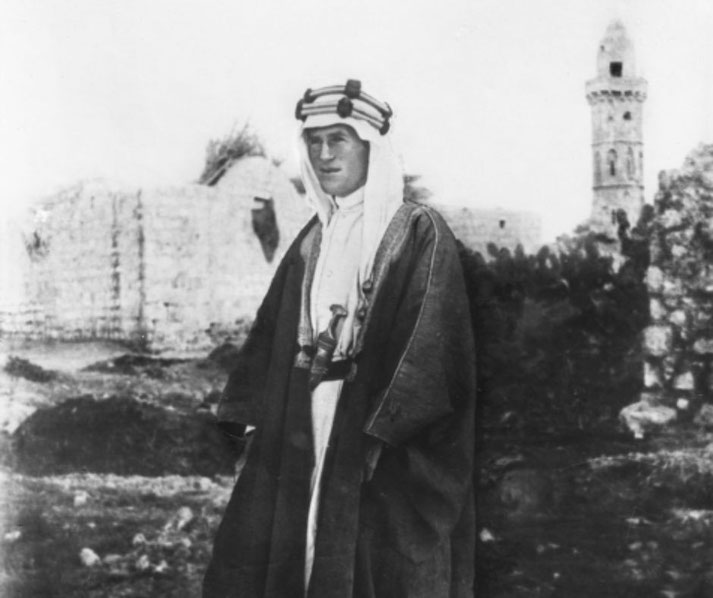
Over the next year, Lawrence helped expand the revolt’s reach as he coordinated a series of actions that aimed to weaken Ottoman supply lines.
Tribal leaders remained divided by local rivalries, but Lawrence worked constantly to mediate disputes and offer incentives so that he could build a loose alliance.
He continued to ride in the field and wore Arab robes as he adopted local customs, which earned him a level of respect rare for a European.
Although British officers distrusted the irregular nature of Arab warfare, Lawrence believed their mobility and motivation proved far more valuable than discipline or formal training.
In September 1918, Arab forces and their British allies moved against Ottoman positions in the Levant.
General Edmund Allenby oversaw the wider campaign, and his coordination with Lawrence ensured the success of the northern push.
The campaign culminated in the entry of Faisal’s troops into Damascus on 1 October, with Lawrence at his side.
It appeared to mark the birth of an Arab kingdom, free from Turkish rule and built on Arab unity.
However, British and French officials had already drafted plans to divide the region into spheres of influence, and the newly formed Arab government in Damascus, led by Faisal, would prove short-lived.
Lawrence's strained relationship with the British
Behind the scenes, Allied promises to the Arabs had already been compromised by the 1916 Sykes-Picot Agreement, which outlined how Britain and France would divide former Ottoman lands after the war.
Lawrence, who discovered the agreement during his service but kept it secret, found himself in an impossible position.
He had encouraged Arab leaders to fight with the hope of independence, even though Europe’s empires intended to rule the same lands they had promised to liberate.
In 1919, Lawrence travelled to the Paris Peace Conference as part of Faisal’s delegation.
There, he tried to lobby for Arab independence and presented evidence of Arab military contributions.
He met with senior diplomats, including Woodrow Wilson and Georges Clemenceau, and appealed to the principle of self-determination.
The King–Crane Commission, which later examined the region’s future, echoed many of Lawrence’s concerns.
Yet European powers prioritised their colonial goals. Britain secured mandates in Iraq and Palestine, while France claimed Syria.
When French troops forced Faisal out of Damascus in 1920, Lawrence considered it a personal betrayal of both the Arab cause and his own efforts.
Back in Britain, he struggled with the fame that had grown around him and he refused official awards and rejected a knighthood offered by King George V.
Instead, he turned to writing, producing Seven Pillars of Wisdom, an account of the revolt that mixed detailed observation with literary narrative.
Although he admitted that he had changed facts during the war, he defended his choices as necessary to keep the revolt alive.
He portrayed himself as someone caught between orders from his own government and promises to his Arab allies.
The initial print run in 1926 was limited to private circulation, with a later edition published in 1935.
To escape public attention, he enlisted in the Royal Air Force under the name “T. E. Shaw” and later transferred to the Tank Corps.
His RAF service number and identity were known only to a few close associates.
His attempts to disappear into ordinary service did little to suppress public fascination.
Journalists and politicians continued to seek him out, and authors pursued him, even though he retreated into near isolation until his sudden death in a motorcycle accident in Dorset in 1935.
Did Lawrence lie to both the British and the Arabs?
During the revolt, Lawrence often presented a different version of events to each side he dealt with.
To the Arabs, he offered assurances of post-war independence because he knew that British policy would likely deliver something far less.
To his superiors, he overstated the unity and effectiveness of tribal fighters, and he concealed the deep rivalries and fragile alliances that threatened the revolt’s cohesion.
His deception came from a conviction that the larger goal of Arab liberation justified tactical dishonesty, rather than from malice.
Later, in both private correspondence and published writings, he admitted that he had misrepresented facts.
He expressed guilt about the way he had misled Faisal and described anger about Britain’s betrayal of its pledges, and he admitted frustration with his own limitations.
Yet many historians question how much of his account can be trusted. Seven Pillars of Wisdom is rich in detail yet contains dramatic details and scenes that lack evidence that supports them.
Critics, such as Richard Aldington, argued that he embellished his influence, but others, like Liddell Hart, defended his strategic ideas. His narrative shows the confusion and moral conflict of wartime service.
Still, archival records confirm many, though not all, of the operations he described, such as the raid on Aqaba and the sabotage of the Hejaz Railway.
His reports and letters, together with his maps, influenced British strategy across the Arabian front.
Whether he lied or not, his actions had significant long-term consequences. He encouraged a revolt that changed the balance of power in the Middle East, even if the promised rewards never materialised.
Lawrence of Arabia still fascinates readers and viewers because he operated outside the usual pattern.
He was neither general nor politician, yet he influenced both. His influence endures through the questions he raised about loyalty to allies and about betrayal by great powers, and through the personal costs that followed when he tried to fight for ideals in a world ruled by empires.