
What was Germany’s 'blank cheque' before WWI?
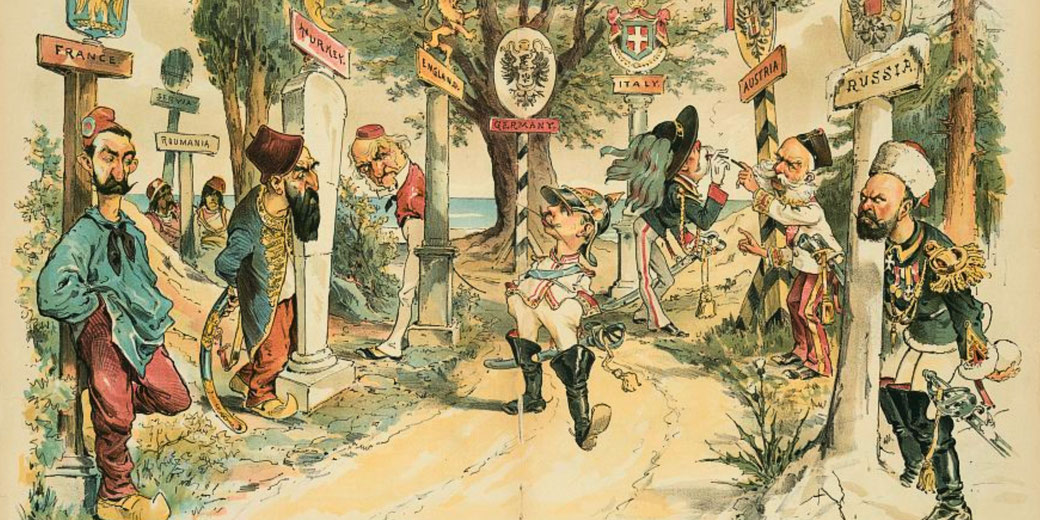
On 5 July 1914, German officials offered Austria-Hungary what was effectively support without conditions in whatever action it chose to take against Serbia.
This decision was made just days after the assassination of Archduke Franz Ferdinand and removed much of the caution Austria-Hungary might have felt and gave it the confidence to issue a deliberately severe ultimatum.
Crucially, German support was not written down and came with no clear limits or requirements to check first. That open-ended commitment was later known as the 'blank cheque' and helped to trigger a series of rising tensions that led to general war by early August.
Key events from the 19th century
Following the defeat of Napoleon in 1815, the leading monarchies of Europe set up a diplomatic system at the Congress of Vienna which was designed to preserve peace by a balance of power among rival states as far as the great powers could manage.
Austria, Prussia, Russia, and Britain agreed to cooperate to stop revolutionary threats and to maintain political stability across the continent.
For much of the 19th century, that system operated without a general European war, but nationalist unrest and imperial rivalry repeatedly strained the agreement.
By the 1860s, Prussia’s Chancellor Otto von Bismarck had begun to change much of the European order by military means.
After he had started successful wars against Denmark in 1864, Austria in 1866, and France in 1870, he unified the German states under Prussian leadership and declared the creation of the German Empire in 1871.
That moment was staged at the Palace of Versailles and altered Europe’s balance permanently.
Germany rapidly became a powerful, industrialised empire with modern infrastructure and a highly capable military backed by a large population.
France had lost Alsace and part of Lorraine in 1871 and directed much of its effort toward revenge and military reform, so Bismarck responded and created a network of diplomatic treaties meant to contain France and reassure Germany’s other neighbours.
The Dual Alliance with Austria-Hungary in 1879 provided mutual support against Russia, while the Triple Alliance of 1882 included Italy.
These arrangements discouraged France from acting alone and gave Germany generally reliable partners.
However, they depended on Bismarck’s careful diplomacy, and once Kaiser Wilhelm II dismissed him in 1890, Germany abandoned caution for a more aggressive approach.
Soon after, France reached a closer relationship with Russia, which led to the Franco-Russian Alliance in 1894.
Over time, Britain moved closer to both powers, and by 1907, the Triple Entente joined France and Russia with Britain and stood opposite the Triple Alliance.
Europe became increasingly locked into two armed camps, and each new crisis increased the risk that war would spread beyond a local dispute.
Earlier incidents such as the Bosnian Crisis of 1908 and the Balkan Wars of 1912–13 had already heightened tensions, particularly between Austria-Hungary and Serbia.
What is a 'blank cheque'?
In diplomatic terms, a 'blank cheque' describes a promise of support without conditions offered by one state to another, without clear limitations or requirements for supervision.
The phrase draws its meaning from the idea of a signed cheque left blank, which allowed the recipient to determine the value.
Within a political context, it means that one government has allowed another to act freely, with the assurance that backing will follow no matter the consequences.
During the July Crisis of 1914, this expression came to describe Germany’s verbal assurance to Austria-Hungary.
Although no written treaty confirmed the pledge, the offer gave Austria-Hungary the confidence to deliver an ultimatum that had been designed to be unacceptable.
Germany did not ask to see the ultimatum before it was sent, nor did it attempt to restrain Vienna’s position, so Austria-Hungary escalated a diplomatic incident into a military confrontation.
Importantly, the blank cheque differed from previous forms of alliance coordination, as Germany promised support and encouraged swift and firm action.
While the existing alliance system already committed Germany to support Austria-Hungary in the event of certain types of war, the blank cheque went further and gave support without qualification.
It showed that Germany would act regardless of whether Austria’s actions risked the start of a wider conflict.
The circumstances of the 'blank cheque' in 1914
On 28 June 1914, Archduke Franz Ferdinand was the heir to the Austro-Hungarian throne and was murdered in Sarajevo by Gavrilo Princip, a Bosnian Serb who was affiliated with the nationalist group Young Bosnia and who was trained with assistance from members of the Black Hand.
His assassination shocked many in Vienna and created intense pressure on Austria-Hungary’s leaders to respond.
Senior figures such as Chief of the General Staff Franz Conrad von Hötzendorf had long argued for war with Serbia since they saw the smaller kingdom as both a political threat and a destabilising force in the Balkans.
Within days, Austria-Hungary’s government debated how to respond. It quickly became clear that any action taken against Serbia would likely attract Russian support for the Serbs.
Austria-Hungary was weakened by years of internal splits and military underinvestment and could not realistically afford to act alone.
For that reason officials in Vienna decided to consult their German ally before proceeding.
On 4 July, Count Hoyos arrived in Berlin with a personal letter from Emperor Franz Joseph and a written note which outlined Austria-Hungary’s desire to act firmly against Serbia.
By the following day, Hoyos and Ambassador Szögyény had presented their case to German leaders.
Significantly, the Germans did not hesitate for long to offer full support. Kaiser Wilhelm II stated that Austria-Hungary could count on German backing no matter the outcome, while Chancellor Bethmann Hollweg confirmed that support would apply even if Russia became involved.
The German leadership believed that war with Russia might be inevitable, particularly as Russia's "Great Military Programme" of 1913 aimed to expand its army to over 2 million men by 1917, which threatened to tip the balance of power.
Although some German leaders hoped the crisis would remain contained, they also accepted the risk of escalation.
Internal records from Berlin show that military and political figures believed war with Russia might be inevitable.
For them, a controlled conflict in 1914 seemed preferable to a larger one in future years, especially since Russia was in the middle of a major rebuild of its forces and an update of its equipment.
How the 'blank cheque' was offered
On 5 July, Count Szögyény met Kaiser Wilhelm II at Potsdam to deliver Emperor Franz Joseph’s letter.
After hearing Austria-Hungary’s intentions, the Kaiser expressed full support for whatever action Vienna chose to take.
The next day, Bethmann Hollweg met with Austrian officials and confirmed that Germany would back Austria-Hungary under all circumstances.
This was the moment that transformed the Austro-German alliance from a conditional partnership into a one-sided guarantee.
Over the following days, almost no effort was made to set limits or request conditions. Germany did not ask to review the ultimatum Austria-Hungary intended to send to Serbia.
Instead, German officials encouraged a rapid response and assured Vienna that they would face down Russia if necessary.
That assurance, although informal, carried enormous weight, so Austria-Hungary no longer had to fear diplomatic isolation or military defeat.
Soon after these meetings, Kaiser Wilhelm departed for his summer cruise in the North Sea.
He did so under the belief that Austria-Hungary would deliver its ultimatum quickly and that Serbia would be forced to comply.
Meanwhile, Germany’s military leaders had begun to prepare backup plans for a wider war.
General Helmuth von Moltke was head of the German General Staff and warned that conflict with Russia would almost certainly draw in France, and that any war must begin with a swift offensive in the west.
Germany’s reliance on the Schlieffen Plan depended on an already existing military strategy to defeat France first, then turn east, and meant that room for diplomacy quickly vanished.
Even so, Germany never seriously attempted to delay Austria’s response or broker a peaceful solution.
Instead, it urged haste and encouraged the belief that a firm position would prevent a larger war, so this advice removed the possibility of compromise.
The role of the 'blank cheque' in starting WWI
Austria-Hungary issued its ultimatum to Serbia on 23 July 1914, which demanded that Serbia suppress nationalist groups and anti-Habsburg propaganda, and it demanded that Austrian officials be allowed to operate inside Serbia to supervise investigations and security operations.
That final condition posed a clear violation of Serbia’s sovereignty. The demands were framed in such a way that Austrian leaders expected rejection.
The ultimatum imposed a 48-hour deadline, which was widely considered unreasonable by diplomatic standards.
On 25 July, Serbia delivered a response that accepted nearly all points but objected to foreign officials who operated within its borders.
Despite the calm tone of the reply, which included a proposal to refer the dispute to the Permanent Court of Arbitration at The Hague, Austria-Hungary rejected it and began military preparations.
On 28 July, it declared war on Serbia, and the next day Russia ordered partial mobilisation to support its Slavic ally.
Germany now took centre stage. On 31 July, it sent an ultimatum to Russia that demanded a halt to mobilisation, followed by another to France that requested neutrality in the event of a Russo-German conflict.
Russia refused to back down, and on 1 August, Germany declared war. Two days later, it declared war on France and invaded Belgium as part of the Schlieffen Plan.
That action drew Britain into the conflict on 4 August, and within a week, most major European powers had entered the war.
The blank cheque did not cause war on its own, but it removed key obstacles to escalation, so Austria-Hungary, no longer fearing Russian intervention, delivered a far more extreme ultimatum than it otherwise would have risked.
Germany, having committed to support its ally without restraint, refused to reconsider its position when war threatened to spread.
Once the crisis accelerated, the alliance system ensured that each nation acted according to already existing military plans, which left little room for negotiation or retreat.
Diplomatic efforts included British Foreign Secretary Sir Edward Grey's proposal for a conference that involved several countries to resolve the dispute, and they received almost no genuine support from Berlin.
Contestability: How important was the 'blank cheque'?
The significance of the blank cheque has been a subject of historical debate, since some scholars argue that Austria-Hungary had already decided to confront Serbia and used the guarantee only to confirm a path already chosen.
From that perspective, Germany’s support made limited difference to Austria’s determination.
However, others contend that without German encouragement, Austria-Hungary might have pursued a less risky course or accepted Serbia’s concessions.
Evidence from German archives shows that officials in Berlin promised support and actively encouraged Vienna to act quickly and firmly.
They did not pressure Austria to accept mediation, nor did they suggest delaying the ultimatum.
Instead, their advice created a sense of urgency and conveyed the message that a show of strength would keep Russia out of the conflict.
While Austria-Hungary issued the ultimatum and declared war, the confidence to do so rested on the security of German backing.
The blank cheque gave Austria a degree of freedom to act that it had not enjoyed in previous Balkan crises.
In earlier disputes, the risk of Russian intervention had forced Vienna to act with caution.
In 1914, much of that restraint vanished, as Germany’s more aggressive foreign policy, known as Weltpolitik, had replaced Bismarck’s Realpolitik and encouraged a policy of firmness rather than compromise.
The July Crisis involved a chain of decisions by multiple actors, each of which contributed to the outbreak of war.
Yet the blank cheque altered the calculations in Vienna at a critical moment.
Without it, Austria-Hungary might have hesitated, modified its demands, or tried to secure greater international support.
Instead, it acted with confidence, triggering a war that quickly exceeded all expectations.