
How Renaissance humanism inspired the Protestant Reformation
By the late fifteenth century, many educated Europeans had begun to question long-accepted religious and intellectual authorities.
As scholars recovered Greek and Roman texts that had been stored in monastic libraries and translated them into Latin and everyday languages, they developed new approaches to learning that focused on reasoned analysis and on rhetorical skill grounded in source-based evidence.
With that revival of classical thinking came a growing willingness to examine the Church’s teachings and religious customs more critically and, within a few decades, those same humanist ideas helped to provide the intellectual framework for a religious transformation that would fracture Catholic unity and give rise to the Protestant Reformation.
Birth of critical scholarship
During the fourteenth century, Italian scholars such as Francesco Petrarch and Giovanni Boccaccio had begun to search for neglected Latin manuscripts, so that they could understand the intentions of ancient authors on their own terms instead of repeating medieval interpretations.
In 1345, Petrarch rediscovered Cicero’s letters, which sparked renewed interest in republican ideals and humanist rhetoric.
Over time, their efforts had gradually given rise to the studia humanitatis, a curriculum that valued grammar, rhetoric, poetry, history, and moral philosophy based upon classical models.
Rather than rely on second-hand glosses or scholastic commentary, humanists aimed to read texts in the original language and evaluate meaning through careful linguistic and historical inquiry.
Eventually, scholars used that method for religious texts as well as secular ones. In the 1440s, Lorenzo Valla applied humanist philology to religious and political claims when he examined the Donation of Constantine closely.
In his Discourse on the Forgery of the Alleged Donation of Constantine, written around 1440, he demonstrated that the Latin style of the document did not match that of the fourth century and concluded that the papal claim to imperial authority lacked historical basis.
As a result, Valla’s findings gave weight to the argument that the Church had acquired power through forgery rather than divine appointment.
Spread of humanist education across Europe
During the fifteenth century, as humanist texts moved northward from Italy, their influence had slowly begun to change the educational standards of universities in cities such as Paris, Leuven, and Oxford.
Movements like the Brethren of the Common Life promoted lay education and fostered a generation of students who would later engage in reform.
Erasmus had studied at one of their schools, and Luther was influenced by similar educational trends but did not receive direct instruction from them.
Students studied Latin more rigorously, debated classical ethics, and learned to construct arguments based on primary evidence rather than appeals to authority.
With the invention of the printing press in the 1450s, publishers such as Aldus Manutius in Venice and Johannes Froben in Basel printed Greek and Latin editions of classical texts, Church Fathers, and eventually Scripture.
Manutius founded the Aldine Press in 1494 and produced portable and affordable editions that made classical learning more accessible.
Froben collaborated directly with Erasmus to publish the Novum Instrumentum omne in 1516, the first printed Greek New Testament.
As a result, theologians who favoured reform encountered a wider range of ideas and often discovered inconsistencies between Church doctrine and earlier writings.
Some of those students later became Protestant leaders, armed with the philological skills and a careful sense of historical judgement needed to re-examine Christian doctrine.
The academic world they inhabited no longer demanded blind acceptance of tradition, since it encouraged interpretation grounded in careful logic and in precise use of language that aimed to persuade on moral grounds.
Martin Luther and the humanist tools of reform
After he had studied at the University of Erfurt, where he received his bachelor’s degree in 1502 and his master’s in 1505, Martin Luther began to teach at Wittenberg in 1508, where humanist influences had already become influential.
He read classical authors and theological works critically and later used the 1516 Greek New Testament published by Erasmus to challenge Church teaching.
He noticed that certain Latin translations misrepresented the Greek original, especially in passages related to formal penance and to questions of faith and salvation.
Thanks to that discovery, he could argue that Church doctrine had drifted from the biblical message.
Soon after, when he posted the Ninety-Five Theses in 1517, Luther used a format based on a university-style debate rather than an appeal to church officials.
His arguments relied on close readings of Scripture and questioned whether the sale of indulgences had any biblical justification.
In support of his cause, Philipp Melanchthon joined him at Wittenberg in 1518 and brought with him a thorough background in Greek and classical rhetoric.
Known as the praeceptor Germaniae, or “teacher of Germany,” Melanchthon helped build the educational foundation of the Lutheran Reformation.
Together, they crafted a theology that could usually withstand intellectual scrutiny and persuade both scholars and the educated public.
Erasmus and the rejection of superstition
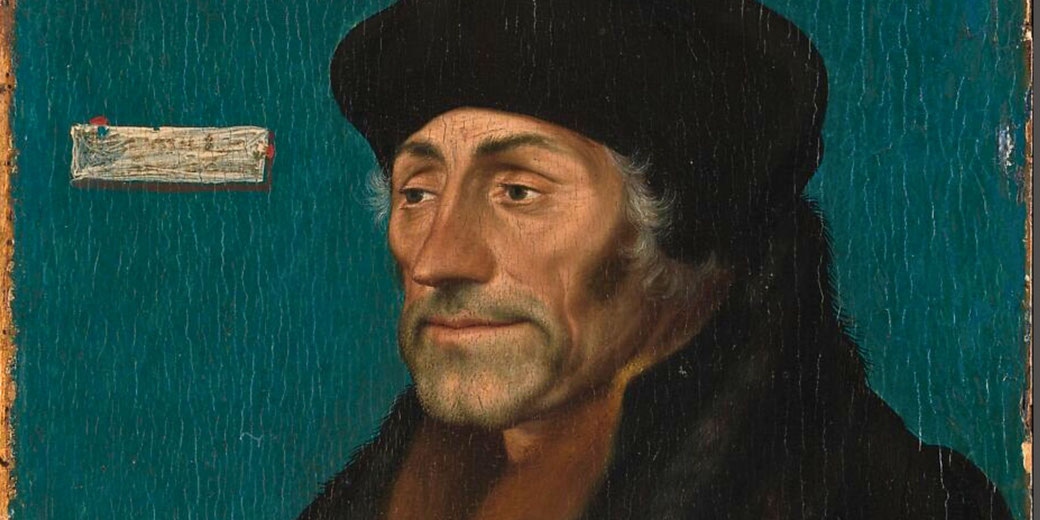
Among those who changed Christian scholarship before the Reformation, Desiderius Erasmus played a central role.
Trained in the humanist tradition, he believed that true Christian life began with personal devotion and direct knowledge of Scripture.
In Handbook of the Christian Soldier, published in 1503, he argued that outward rituals and Church ceremonies had become distractions from genuine moral reform.
Sharp, humorous works such as In Praise of Folly mocked the excesses of monastic institutions and the trade in relics, as well as the weight of a growing ecclesiastical bureaucracy.
More importantly, Erasmus exposed errors in the Church’s official Latin Bible. He retranslated the Greek term metanoeite as “repent,” not “do penance,” and this change corrected the Vulgate’s phrasing of paenitentiam agite.
This weakened the scriptural basis for indulgences, and as a result, many early Protestant arguments drew directly from his work.
Although Erasmus remained committed to Church unity and avoided joining the Reformation, his methods made it possible to question centuries of accepted interpretation without abandoning faith altogether.
The humanist attack on ecclesiastical tradition
From the early sixteenth century, the belief that Scripture held highest religious authority began to replace confidence in papal decrees and Church councils in many regions.
As such, reformers argued that Church doctrine must align with the Bible, not the other way around.
That view, known as sola scriptura, depended on the humanist principle, because it called for a return to original sources and for the rejection of reliance on second-hand interpretations.
Among those who used that approach most consistently, John Calvin is probably the most famous.
He studied at the Collège de la Marche and Collège de Montaigu in Paris, where he received a humanist education grounded in rigorous study of grammar and rhetoric and in the ethical questions posed by moral philosophy.
He later combined his training in classical rhetoric and Roman law with a deep reading of Scripture.
In 1536, his Institutes of the Christian Religion offered a clear and organised summary of Christian teaching which was based on textual analysis and logical consistency.
He continued to revise the Institutes, with the final and most complete edition published in 1559, and as Protestantism spread across Europe, ministers and theologians who had received similar training often used the same tools to defend their positions and construct new church structures.
Reformed academies included institutions such as the Geneva Academy, which had been founded in 1559, and they placed humanist subjects at the centre of Protestant education and helped make these intellectual methods a regular part of study.
Over time, those efforts replaced the Roman control over official theology with a wide network of Protestant communities that kept close ties to the humanist movement that had helped bring them into existence.