
What was life like for women and girls in the Aztec Empire?
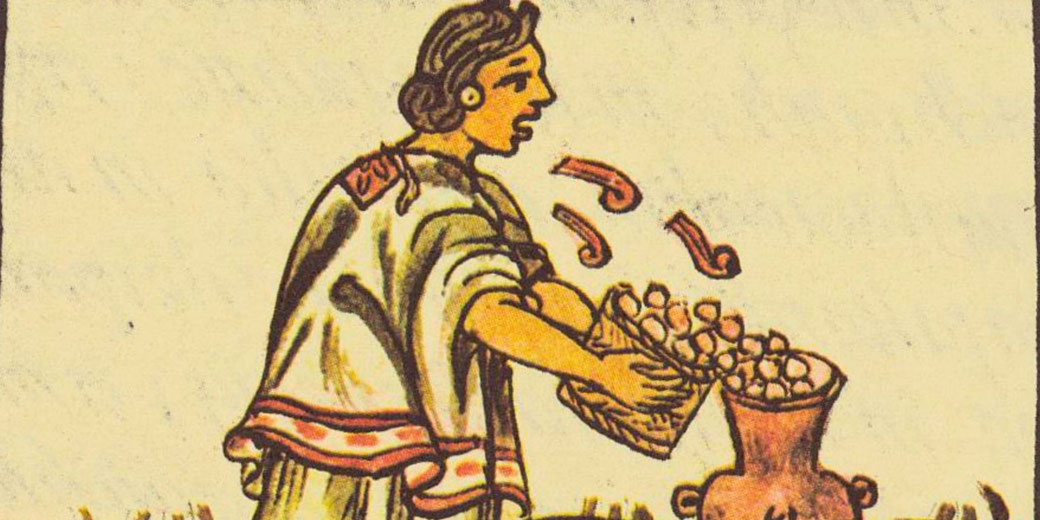
The structure of Aztec society placed women within clearly defined roles, and these roles involved a wide range of responsibilities across family and economy, as well as religion.
As girls grew, they were trained in practical and ceremonial tasks that prepared them for adulthood. In fulfilling these expectations, women contributed to both the organisation of daily life and the continuation of cultural values.
The patriarchal world of the Aztec Empire
The Aztec civilisation, like many pre-Columbian societies, was hierarchical, with nobles (pipiltin) and commoners (macehualtin) forming the major levels of their society.
In both of these social groups, Aztec women held a certain degree of power and influence, and they played defined roles that contributed to the functioning and well-being of their communities.
Gender roles in Aztec society were well-defined, with clear expectations for both men and women.
Men were often warriors and political leaders, as well as high priests, and women were entrusted with the important tasks of managing the household and participating in economic activities.
In this way, women played an essential role in the survival and stability of the empire.
This should not be understood as Aztec society wholly confining women to domestic roles, though.
Women could own and inherit property, engage in trade, and were often active participants in religious ceremonies.
In fact, there are records of women becoming well-respected painters, public speakers, performers, and singers.
Early childhood and education of girls
The birth of a child in Aztec society was accompanied by rituals and celebrations, which highlighted both the cultural richness of the Aztec civilisation and the expectations that were placed on the child from a young age.
The birth of a daughter was greeted with joy and anticipation. Mothers and midwives would conduct a series of rituals and prayers to the goddess of childbirth, Tlazolteotl, as well as other deities, and this signified the spiritual importance of bringing a new life into the world.
The naming of girls in Meso-America was generally very different from the modern world.
Most were simply named ‘the oldest’ or ‘the youngest’, as well as ‘the middle child’, rather than being given a real, personal name.
This may be due to the fact that the parents wanted to wait until they had a sense of their personality before choosing a name that would suit them.
During infancy, young Aztec girls were mostly cared for by their mothers, who were their first and most important role models.
In these early years, mothers would pass on fundamental life skills and knowledge to their daughters.
The home was the primary site of learning, where girls were introduced to the roles and responsibilities that they were expected to fulfil in adulthood.
By the age of five, girls would have begun to learn how to make yarn, as well as how to cook and clean.
It is said that all little girls were taught the prayers they would say in their future wedding ceremony, along with the regular ones which were used on a daily basis.
They would also be taught how to spin yarn and weave cloth, as well as how to master the art of embroidery.
As they grew older, the education of Aztec girls was largely structured around their expected roles as adults.
At around 12 years of age, girls would usually attend a local school called cuicacalli (‘house of song’), where they were further trained in domestic tasks and also learned about religion and ethics, as well as societal values.
The cuicacalli was part of the larger institution that was known as the telpochcalli (‘youth house’), which educated the majority of Aztec children and also provided military training for boys.
Girls from noble families sometimes attended the calmecac, which was a higher institution of learning that was typically reserved for nobles and those who had been chosen for religious service.
The calmecac provided a more thorough education, which included lessons in history, mythology, astronomy, ethics, art, and music.
This difference in education shows the layered social structure of Aztec society and indicates the varying expectations for girls of different social statuses.

Marriage and family life
Marriage in Aztec society was an important institution that went further than the union of two individuals. It acted as an alliance between families and, in some cases, provided a way to establish political ties between different factions within the empire.
For women, marriage was a significant event that would determine their status, responsibilities, and lifestyle.
Most marriages were arranged by the parents, but it was not uncommon for the prospective bride and groom to have some say in the matter.
A series of rituals, which involved both families, would precede the wedding. This often included a feast and the exchange of gifts, as well as the invocation of blessings from various deities.
Upon marriage, an Aztec woman typically moved into her husband’s home, which began her role as a wife and eventually a mother.
Within the household, Aztec women assumed the role of primary caretakers and household managers.
They were responsible for tasks such as cooking and cleaning, as well as managing domestic resources.
Aztec women held considerable influence within their households. Childbearing and child-rearing were considered sacred duties for Aztec women.
As wives, they could elevate their family’s status, and as mothers, they influenced future generations of workers and warriors, as well as leaders.
The intimate space of the home was a site of domestic work, but it was also a place where power was negotiated, where traditions were upheld, and where societal values were both challenged and reinforced.
Women's roles in the economy
The economic contributions of women in the Aztec Empire were significant, and their influence went further than the domestic sphere.
Aztec women were involved in a variety of occupations, and they contributed to the economy through activities such as farming and trading, as well as craft production.
Agriculture was the backbone of the Aztec economy, and men primarily tended to the fields. Women also played an important role in this area.
They were responsible for processing agricultural products, like grinding maize into dough for tortillas and preparing other foodstuffs, as well as spinning and weaving cotton for textiles.
The production of these goods sustained the family and often provided commodities for trade in local markets.
Markets were the economic centres of the Aztec Empire and were busy hubs of trade where goods from all corners of the empire were exchanged. Here, women were actively involved as traders or merchants.
Some women were part of the pochteca, which was the professional merchant class.
Members of this class often undertook long trade expeditions and accumulated considerable wealth.
Craft production was another area where women contributed to the economy.
They were skilled potters and weavers, as well as jewellers, and they created goods for both domestic use and trade.
The finely woven textiles that were produced by Aztec women were particularly prized and acted as a form of currency in the Aztec economy.
One notable aspect of Aztec society was that women had the right to own property.
They could inherit land and pass it on to their children, which indicates a level of economic independence and influence that is not commonly associated with pre-Columbian societies.
Did women have a role in Aztec religion?
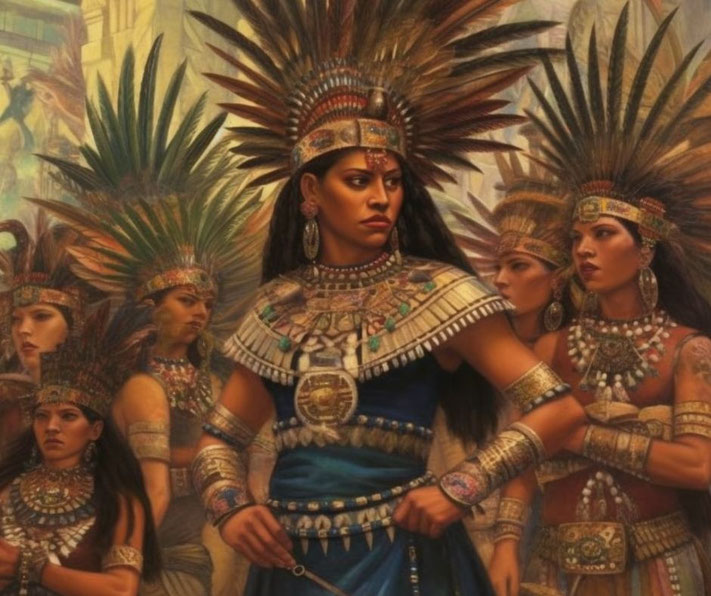
Religion was a central part of Aztec life, and it arguably permeated every aspect of their society. Women were active participants in these spiritual areas.
In private religious life, Aztec women would offer prayers and sacrifices to the household gods, perform rituals that were related to birth and marriage, as well as death, and teach their children about the pantheon of Aztec deities and the religious customs of their society.
One of their favourite goddesses was Cihuacoatl, who was the Woman-Snake and who was depicted with a spear and shield.
This deity was particularly worshipped by midwives, as it was believed that she helped birthing mothers seize a new spirit from the cosmos and guide it into their child.
At the communal level, women participated in a variety of religious festivals and ceremonies.
They played roles in agricultural rites and fertility rituals, as well as offerings to various deities.
In these public rites, women’s contributions were essential for successful communication with the gods, and this is arguably a sign of their religious significance in Aztec society.
The Aztec pantheon included several powerful female deities, such as Coatlicue (the earth goddess) and Tlazolteotl (the goddess of childbirth and fertility), as well as Xochiquetzal (the goddess of beauty and love, as well as female sexual power).
The existence of these goddesses arguably speaks volumes about the spiritual agency of women and the respect that was given to feminine powers in Aztec religion.
In addition to their roles as worshippers, some women held formal religious roles as priestesses. They attended to specific deities and maintained temples, and they even led certain ceremonies.
In the most sacred religious institution, the calmecac, there were women who were known as cihuapipiltin (‘honoured women’), and they devoted their lives to the service of the gods.
The role of Aztec women in warfare
Warfare was predominantly a male domain, but the influence of women in Aztec warfare should not be overlooked.
The primary contribution of Aztec women to warfare was through support roles.
Women were responsible for providing food and clothing, as well as other supplies, to their warrior kin.
They prepared meals for the soldiers and wove clothing and uniforms, as well as items like the ichcahuipilli, which was a type of padded cotton armour that was worn by Aztec warriors.
These efforts were not often highlighted, but they were important for sustaining the military efforts of the Aztec Empire.
In addition to these supportive roles, Aztec women also held symbolic importance in the context of warfare.
The mother of a warrior held a high status and was expected to encourage her son’s bravery and martial ability.
When a warrior fell in battle, his mother was honoured with his weapons and shield, and this recognised her role in raising a brave soldier.
Interestingly, there are historical accounts of women who participated directly in battles.
In exceptional cases, women were known to have fought alongside men and to have defended their cities during sieges.
Such instances of women in combat were not the usual occurrence, but they demonstrate the fluidity of gender roles during times of crisis.
Lastly, women also influenced Aztec warfare through their roles in religion.
Goddesses like Coyolxauhqui, who was the celestial warrior goddess, and Itzpapalotl, who was the obsidian butterfly that was often associated with warrior souls, underscored the spiritual aspects of warfare and acted as patrons for Aztec warriors.

The impact of the Spanish conquest on Aztec women
The Spanish Conquest, which was led by Hernán Cortés in the early 16th century, had profound and devastating impacts on the Aztec Empire and led to its eventual collapse.
Aztec women experienced these impacts in specific and often devastating ways. Their lives were permanently changed by the violence and disease, as well as the cultural upheaval, that the conquest had brought about.
With the arrival of the Spanish and their indigenous allies, Aztec society was exposed to diseases such as smallpox and measles, as well as influenza, against which they had no natural immunity.
These epidemics wiped out a large portion of the indigenous population, including a significant number of women.
This resulted in the loss of many lives and also disrupted the family structures and societal roles that Aztec women had upheld.
During the violent conflicts and in their aftermath, many Aztec women were subjected to physical abuse and exploitation, as well as slavery, by the Spanish.
Women, who were the bearers of culture and the primary caregivers, suffered greatly during these upheavals.
In terms of societal structure and roles, the Spanish Conquest and the colonial period that followed led to a marginalisation of women’s roles.
The Spaniards imposed their own social rules, which included stricter gender roles that were based on their patriarchal society.
The economic and religious agency, as well as the social agency, that Aztec women had once enjoyed was significantly reduced, and they were often confined to domestic spaces and largely excluded from public and political life.
During these difficult conditions, Aztec women also played important roles in the survival of their culture.
Malinche, who was also known as Doña Marina, is one of the most famous Aztec women from this period.
She acted as an interpreter and adviser to Hernán Cortés and played a significant role in his interactions with the Aztec emperor Moctezuma II.
Malinche’s story, which is often viewed as controversial, highlights the difficult realities of women’s experiences during the conquest.
Furthermore, Aztec women, through their roles as mothers and caregivers, were central to preserving and passing on cultural knowledge and traditions, particularly in the face of Spanish attempts at cultural assimilation.
They ensured the survival of indigenous languages and stories, as well as customs, and they laid the foundation for the continuing influence of Aztec culture in Mexico today.