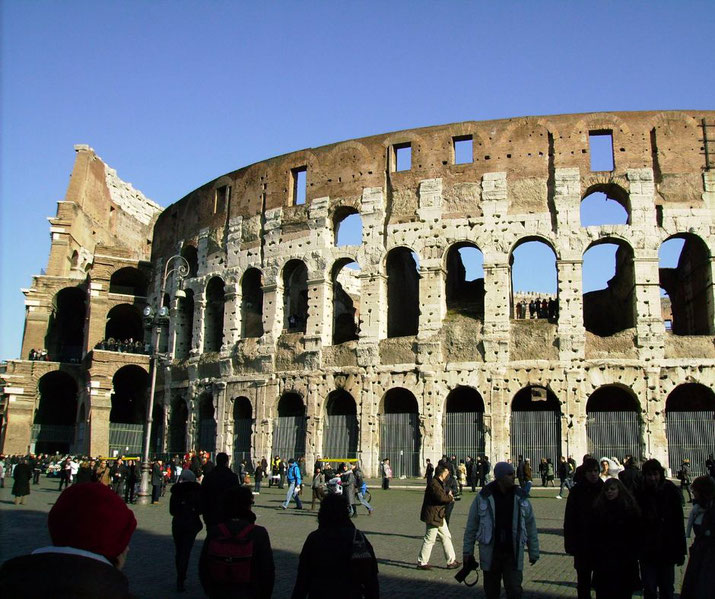
The Colosseum: Rome's grand arena of life and death
Near the Roman Forum, not far from where the emperors once addressed the Senate and dictated terms to foreign kings, stands a large structure that once echoed with the clash of steel and the roar of thousands.
The Colosseum was also called the Flavian Amphitheatre and was Rome’s primary venue for public executions that also functioned as combat entertainment.
Originally constructed on the ruins of a hated ruler’s private estate, it became a monumental display of military wealth that reinforced political messaging and presented state power as leisure.
The name "Colosseum" likely derived from the nearby Colossus of Nero, a bronze statue that once towered beside the amphitheatre and reinforced its imperial links.
However, the term itself did not become common until centuries later.
Ancient Rome before the Colosseum
Under Emperor Nero’s rule, Rome became a city defined by spectacle and mistrust, where imperial authority often appeared more concerned with personal excess than public welfare.
After the Great Fire of AD 64 destroyed vast sections of the urban centre, Nero seized the opportunity to appropriate the cleared land for his Domus Aurea, a large palace that featured banquet halls coated in gold leaf, a dining room that rotated, artificial scenery, and a private lake.
The palace covered over 100 acres and reportedly included vineyards and an animal park, which forced many citizens from prime urban land and showed Nero’s disregard for traditional Roman values.
Public discontent soon grew, as many believed that Nero had sacrificed civic needs to glorify his own reign.
Following Nero’s suicide in AD 68, the empire fell into chaos during the Year of the Four Emperors as each rival, Galba, Otho, Vitellius, and eventually Vespasian, struggled to secure power.
Once Vespasian had become victorious, he faced an urgent need to restore stability to a fractured state.
To regain public confidence, he began removing traces of Nero’s excess and launched several projects that restored infrastructure and civic pride.
Among these, his most symbolic decision was to drain Nero’s private lake and convert the site into a public arena.
By doing so, he physically dismantled the former emperor’s vanity project and reclaimed the space for the people of Rome.
Who built the Colosseum, and why?
Shortly after assuming power, Vespasian ordered the construction of a new amphitheatre in the centre of Rome.
The location, at the heart of the former Golden House, ensured that the project would send a clear political message.
The funding came from loot captured during the First Jewish–Roman War, especially from the sack of Jerusalem in AD 70.
Roman historian Josephus wrote about the many Jewish prisoners who were brought to Rome following the war, and some modern estimates say over 50, 000 worked on imperial building projects such as the Colosseum.
By using this captured wealth to build a space of public entertainment, the emperor presented himself as both a victorious general and a generous ruler.
As Suetonius later recorded, Vespasian took pride in restoring to the citizens what Nero had once claimed for himself.
Construction began in AD 70, though Vespasian had died before its completion, and his son, Titus, took responsibility for finishing the project and officially opened the Colosseum in AD 80.
As part of the opening ceremony, Titus held one hundred days of public games, during which the amphitheatre hosted gladiator contests, exotic animal hunts, and theatrical combat reenactments.
According to Martial and Cassius Dio, events included staged battles and displays of artificial scenery, though historians continue to debate whether naval battles occurred within the amphitheatre itself or elsewhere.
Following Titus’ death, his younger brother Domitian expanded the structure by completing the hypogeum and constructing the upper tier, which increased the seating capacity, and, as a result, the Colosseum became the largest amphitheatre in the Roman world and the most enduring symbol of Flavian rule.
Its incredible design and architecture
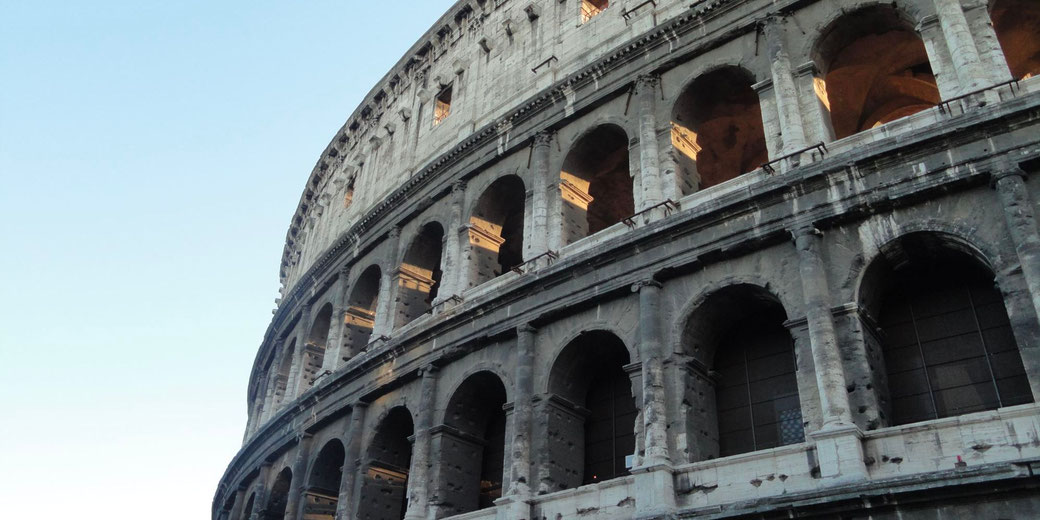
Built using a combination of travertine limestone, Roman concrete, and volcanic tufa, the Colosseum measured roughly 189 metres long, 156 metres wide, and 48 metres high.
It could hold over 50, 000 spectators, arranged by social rank across four levels.
Roman architects incorporated 80 archways to ensure rapid crowd movement, while the vomitoria, exit corridors that were designed to move people out efficiently, allowed the structure to fill and empty within minutes.
The outer walls featured three tiers of arches, each of which was decorated with attached columns in the Doric, Ionic, and Corinthian styles, from lowest to highest, which added both visual order and structural strength.
The use of stacked orders and barrel vaults set a new standard for amphitheatre design across the empire and heavily influenced later European stadium architecture.
Social hierarchy dictated the seating arrangement, since senators and high-ranking officials occupied the lower rows, while women, the poor, and slaves were restricted to the top levels.
Above them, a retractable awning known as the velarium provided shade. The velarium, which skilled sailors from the Roman navy operated, required extensive rigging and coordination to function properly.
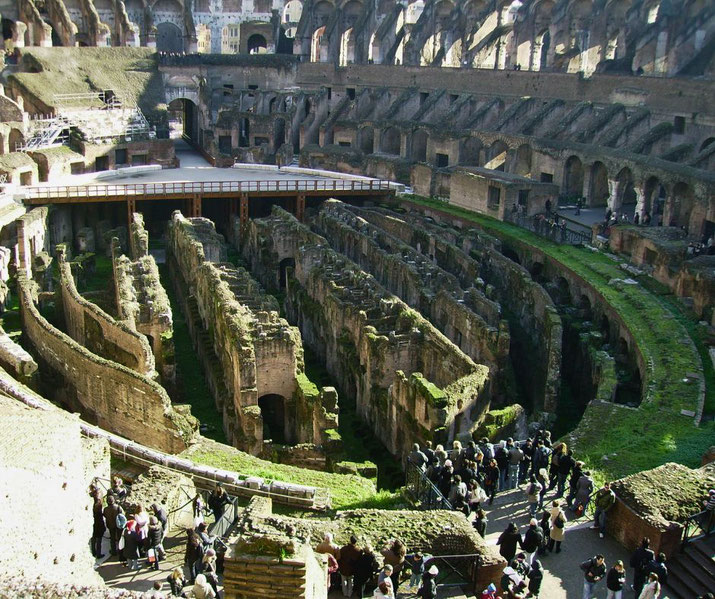
Meanwhile, beneath the wooden arena floor, the hypogeum consisted of two underground levels which were filled with animal cages, lifting platforms, and trapdoors.
These features allowed organisers to introduce fighters and beasts into the arena unexpectedly, which created moments of surprise that increased audience engagement.
Crucially, sound and sightlines were carefully designed. From every tier, the crowd could hear announcements, cheer for contestants, and follow the events with clear visibility.
The arena surface was regularly covered in sand, which helped to absorb blood and bodily fluids.
Every structural feature, whether functional or decorative, served the larger goal of delivering continuous entertainment that reinforced the social and political order of the Roman world, and the widespread use of opus caementicium, a durable Roman concrete, enabled the Colosseum to be completed in under a decade for its primary superstructure.
The gory games and spectacular events it hosted
From its opening celebrations, gladiators, who were trained fighters from various social backgrounds, fought to entertain, but also to display discipline and courage that exposed the consequences of disobedience.
Some were prisoners of war or convicted criminals; others were slaves or volunteers who fought for fame or payment.
They trained in ludi gladiatorii and specialised in specific fighting styles, such as the secutor, murmillo, or retiarius, each with distinct weapons and armour.
Pairs were carefully matched to create suspense, and some bouts ended when a fighter requested missio, or mercy, from the editor or the crowd.
Ancient writers described how audience gestures, such as a turned thumb, could influence a fighter's fate, while historians offered different explanations for these signals.
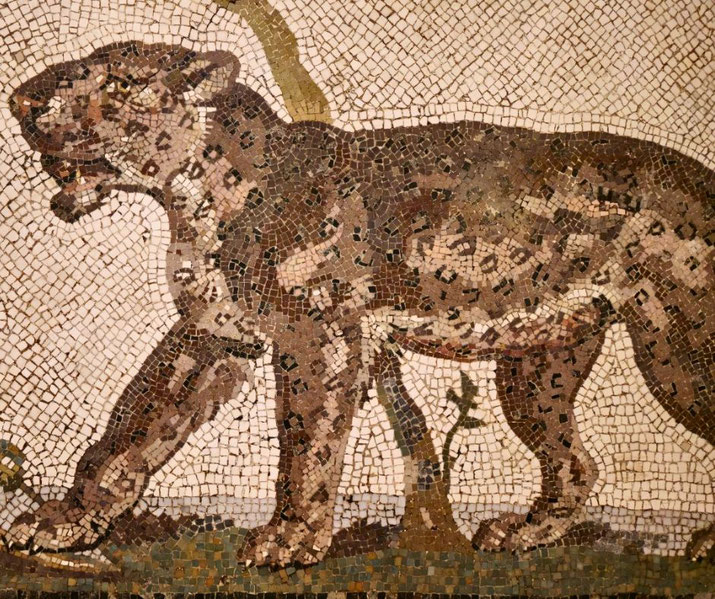
Animal hunts also took place earlier in the day. Known as venationes, these events pitted hunters against wild animals brought from distant provinces.
Lions, leopards, ostriches, elephants, and even hippos appeared in the arena.
Sometimes, they fought one another, but more often they attacked condemned prisoners or specially trained bestiarii.
Midday intermissions featured damnatio ad bestias, in which criminals were executed as part of theatrical stories, which showed Roman justice and the consequences of treason, rebellion, or sacrilege.
During major festivals or special celebrations, the Colosseum reportedly hosted over 100 days of games, though this was not a typical yearly occurrence.
Occasionally, emperors introduced large-scale exhibitions that recreated historical or mythical battles.
Under Emperor Commodus, who reportedly fought hundreds of animals himself, the line between emperor and entertainer became unclear.
In that environment, the crowd became a political tool, since applause could approve imperial actions and disapproval could lead to punishment.
Famous fighters such as Spiculus earned fame and fortune, showing that every game combined spectacle and danger so that each event presented state propaganda in equal measure.
Why did people stop using the Colosseum?
By the fifth century, imperial priorities shifted, and public tastes changed. As Christianity became more influential, Roman authorities came under pressure to abandon traditional blood sports.
Church leaders condemned the games as immoral and spiritually harmful, which eventually influenced legislation, and in AD 404 Emperor Honorius formally banned gladiatorial combat, citing moral and religious objections.
By then, emperors such as Theodosius I had already issued anti-pagan decrees that weakened support for traditional spectacles.
Animal hunts and lesser spectacles continued for some time, but they gradually lost public support and imperial sponsorship.
Repeated earthquakes also damaged the building. The most destructive occurred in 1349, when the outer southern wall collapsed.
Earlier earthquakes, such as one recorded in AD 847, also caused substantial damage.
At least five major earthquakes over nine centuries affected its structure. For centuries afterward, locals had used the ruins as an easy source of building materials.
By the Middle Ages, the Colosseum had been turned into a fortress by powerful Roman families, such as the Frangipani, and later became homes and shops.
Over time, much of the stone was stripped for use in churches and palaces, including St Peter’s Basilica.
During the eighteenth century, the Catholic Church began to associate the Colosseum with the martyrdom of early Christians.
Although little archaeological evidence supports the claim of widespread executions of Christians at the site, some isolated incidents may have occurred.
Pope Benedict XIV declared the amphitheatre sacred in 1749. Today, the Pope leads the Stations of the Cross procession there every Good Friday.
In the modern era, systematic excavation and preservation began in the nineteenth century, which led scholars to uncover the hypogeum, map the seating arrangements, and document construction methods.
In 1980, UNESCO named the Colosseum a World Heritage Site as part of the Historic Centre of Rome, and today the Colosseum continues to attract millions of visitors each year.
While its former glory has faded, the structure still bears scars that showed damage to the structure and the political and cultural consequences of a civilisation that ruled the known world and entertained itself with blood.