
Was the Treaty of Versailles unfair?
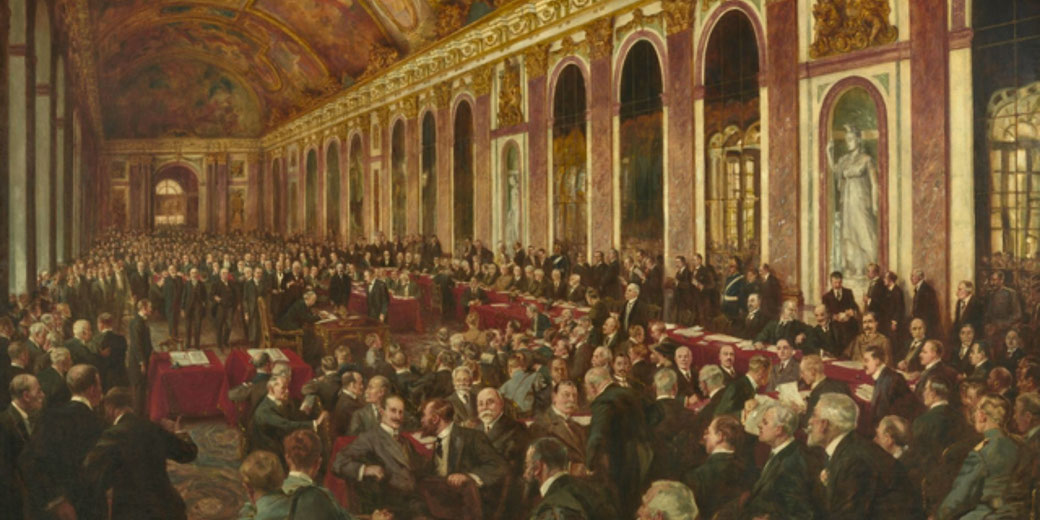
On 28 June 1919, German delegates signed the Treaty of Versailles in the Hall of Mirrors at the Palace of Versailles, accepting peace terms that followed more than four years of devastating conflict.
Hermann Müller and Johannes Bell signed on behalf of the Weimar government, but the ceremony felt less like a negotiation and more like a sentencing.
The Allies had excluded Germany from the discussions that produced the treaty's 440 articles, presenting the draft in May 1919 as a finished text and permitting only written objections on points of detail.
When Germany protested the central clauses, Allied leaders refused to bargain and issued an ultimatum: sign or face renewed war.
Whether the treaty was genuinely unfair or simply unacceptable to the defeated party is a question that has occupied historians for over a century, and the answer depends on whose perspective you consider and what standard of "fairness" you apply to the aftermath of a war that killed approximately 20 million people.
The terms Germany accepted under protest
The treaty contained provisions that affected nearly every aspect of German national life.
Article 231, commonly known as the War Guilt Clause, required Germany to accept responsibility for the war's losses and damage, and Allied lawyers treated this as the legal basis for reparations.
German readers saw that acceptance as a moral verdict on the entire nation, which is why German politicians and public figures viewed the clause as the treaty's most humiliating provision.
The clause did not attempt to explain every cause of the July 1914 crisis, and the gap between legal liability and popular interpretation fuelled controversy from the start.
Territorially, Germany lost approximately 13 per cent of its pre-war land and about 10 per cent of its population.
France reclaimed Alsace-Lorraine, the region it had surrendered after the Franco-Prussian War of 1870–1871.
The newly reconstituted Poland received most of the provinces of Posen and West Prussia, creating the so-called "Polish Corridor" that separated East Prussia from the rest of Germany.
The industrial Saar Basin came under League of Nations administration for fifteen years, and France took ownership of the Saar coal mines and received their output as compensation for the destruction of coal mines in northern France during the war.
Germany also ceded Eupen-Malmedy to Belgium, transferred Northern Schleswig to Denmark after a plebiscite, and accepted the creation of the Free City of Danzig under League supervision.
In Upper Silesia, the Allies organised a plebiscite and then divided the region, which left Germany without part of a critical industrial area.
The treaty also stripped Germany of all its colonies and redistributed them as League mandates in Africa and the Pacific, with territories administered after 1919 by Britain, France, Japan, South Africa, Australia, and New Zealand.
Every one of these territorial losses hit Germany's economy hard, since the transferred regions contained valuable agricultural land, industrial infrastructure, and natural resources.
The military restrictions were equally severe, and they effectively stripped Germany of its capacity to wage offensive warfare.
The German army could not exceed 100,000 soldiers, and the treaty banned conscription, dissolved the General Staff, and prohibited tanks, heavy artillery, and poison gas.
The navy was restricted to a small surface fleet, including six battleships, six light cruisers, twelve destroyers, and twelve torpedo boats, with a personnel ceiling of 15,000, and submarines were forbidden entirely.
Germany could maintain no air force at all. The Rhineland, a strategically important region on Germany's western border, was to be demilitarised, and the Allies paired that rule with an occupation system on the left bank of the Rhine and bridgeheads, followed by staged withdrawals over fifteen years.
For a nation that had prided itself on military strength since unification in 1871, such restrictions felt like a calculated effort to reduce Germany to a second-rate power.
Why it provoked such outrage
From the Allied perspective, the clause provided the legal justification for demanding reparations, since international law required a finding of responsibility before financial penalties could be imposed.
The clause itself stated that Germany and its allies carried responsibility for all losses and damage suffered by the Allied governments and their nationals "as a consequence of the war imposed upon them by the aggression of Germany and her allies."
To Allied lawyers and diplomats, the wording was a necessary legal tool.
For Germans across the political spectrum, the clause amounted to a moral condemnation of the entire nation.
Many German citizens believed the war had been a defensive conflict triggered by alliance obligations and miscalculations rather than deliberate German aggression.
The idea that Germany alone carried guilt for the war seemed to ignore the actions of other powers, particularly Russia's early mobilisation and Austria-Hungary's ultimatum to Serbia.
Prominent German historians and politicians spent the 1920s mounting a sustained campaign to discredit Article 231, producing document collections and scholarly works designed to distribute blame more evenly among the pre-war great powers.
Reparations burden and its economic consequences
As a direct result of the war guilt assignment, the Allied Reparation Commission announced in 1921 that Germany owed 132 billion gold marks in reparations, a figure often compared to roughly 33 billion US dollars at the time.
The Allies presented that headline figure through the London Schedule of Payments in May 1921, which also set out deadlines and the mix of cash and deliveries in kind (including coal and timber) and organised the total through a bond scheme.
Under that schedule, the A and B bonds totalled 50 billion gold marks as the portion the Allies expected Germany to actually pay.
The sheer scale of the figure shocked German economists and politicians, who argued that paying such an amount would cripple the German economy for generations.
Historians have debated the actual severity of the reparations burden with considerable care.
Economist John Maynard Keynes, who had attended the Paris Peace Conference as a British Treasury representative, published The Economic Consequences of the Peace in 1919.
He argued that the reparations were economically destructive and would destabilise all of Europe.
Keynes believed that a prosperous Germany was essential for European recovery, and that punishing it financially would produce political extremism and resentment.
His book became enormously influential and did much to establish the popular view that the treaty was excessively punitive.
More recent scholarship has questioned Keynes's conclusions. Historian Sally Marks argued in her influential work that Germany actually paid a relatively small proportion of the total reparations bill, and that much of the "inability to pay" story was a deliberate strategy by German leaders to avoid compliance.
The reparations system also produced a serious confrontation in January 1923, when French and Belgian forces occupied the Ruhr after disputes over arrears and deliveries.
The German government answered with passive resistance and state support for strikers and firms, which added pressure to public finances during the 1923 inflation crisis.
Between 1920 and 1931, Germany paid an estimated 20 billion gold marks, a substantial sum but far less than the 132 billion originally demanded.
The Dawes Plan of 1924 reorganised the payment schedule and relied on foreign loans without fixing a final total, and the Young Plan of 1929 set a new schedule and reduced the overall sum.
The Lausanne Conference in July 1932 then effectively ended the reparations system during the Great Depression.
From Marks's perspective, Germany's economic difficulties in the 1920s owed more to the government's own fiscal mismanagement than to the reparations themselves.
How the Allies justified their demands
The peace conference took place under enormous public pressure, and the Allied leaders had limited room for generosity.
French Prime Minister Georges Clemenceau, whose country had suffered catastrophic physical destruction during four years of fighting on its own soil, insisted on terms that would prevent Germany from ever threatening France again.
Approximately 1.4 million French soldiers had died in the war, and sections of northern France lay in ruins.
For Clemenceau, weakening Germany militarily and economically was a matter of national survival rather than vindictiveness.
British Prime Minister David Lloyd George was more moderate in private, but he had won the 1918 general election on promises to make Germany pay the full cost of the war.
Popular slogans like "squeeze the German lemon until the pips squeak" captured the public mood in Britain, and Lloyd George could not easily retreat from his campaign promises.
American President Woodrow Wilson arrived in Paris with his Fourteen Points, a set of idealistic principles that included national self-determination and the creation of a League of Nations.
Wilson's vision was more conciliatory than those of his European counterparts, yet he made significant compromises to secure their agreement to the League, which he considered the treaty's most important element.
Italy also sat at the table through Prime Minister Vittorio Emanuele Orlando, whose demands over Adriatic territories added another layer of bargaining pressure among the victors.
The Allied perspective helps explain the treaty's severity. For example, France had experienced invasion and occupation, and Britain had lost nearly a million soldiers.
The smaller Allied nations had suffered proportionally even greater devastation.
From the Allied viewpoint, Germany had started the conflict through its unconditional support of Austria-Hungary in July 1914 and its violation of Belgian neutrality, and so it was appropriate that Germany should bear the financial and territorial costs of reconstruction.
French leaders also pursued an Anglo-American security guarantee as a backup to the Rhineland settlement, and that plan collapsed after the United States Senate refused to ratify the treaty settlement.
This left France more reliant on the treaty's enforcement mechanisms.
The German perspective on fairness
Germany's representatives had expected a negotiated peace based on Wilson's Fourteen Points, so the final treaty came as a profound shock.
When Foreign Minister Ulrich von Brockdorff-Rantzau received the draft terms in May 1919, he protested that the conditions violated the agreed basis for the armistice, and he rejected the idea that Germany alone carried responsibility for the war.
The German government considered refusing to sign, and only gave in when the Allies threatened to resume military operations and advance into German territory.
Within Germany, the treaty created a powerful sense of injustice that ran through political culture throughout the Weimar Republic.
Politicians who signed or supported the treaty faced a sustained campaign of vilification, and right-wing extremists murdered Matthias Erzberger on 26 August 1921 and Walther Rathenau on 24 June 1922.
These assassinations were part of a wider pattern of political violence tied to nationalist underground networks.
The phrase Diktat, meaning a 'dictated peace', became the standard German term for the treaty, because it captured the widespread belief that Germany had been forced to accept terms without meaningful negotiation.
Across German society, from conservative nationalists to moderate social democrats, a consensus existed that the treaty was unjust and needed to be revised.
Germany later re-entered international diplomacy through gradual steps, and it joined the League of Nations in 1926, a moment that suggested limited reintegration, though resentment over Versailles persisted.
Adolf Hitler and the Nazi Party exploited anger about the treaty with devastating effectiveness during their rise to power in the late 1920s and early 1930s.
Hitler frequently invoked the treaty in his speeches, calling the signatories "November criminals" and promising to overturn its provisions.
The insult drew power from two recent dates that many Germans treated as national humiliation: 9 November 1918 brought the Kaiser's abdication and the proclamation of a republic, and 11 November 1918 brought the Armistice signed at Compiègne.
Resentment over Versailles did not cause the rise of Nazism on its own, because numerous economic, social, and political factors contributed to Hitler's rise.
The treaty did, however, give nationalist anger a powerful focal point and a convenient scapegoat for Germany's post-war difficulties.
Could any peace treaty have been truly fair?
After a war of such unprecedented scale and destruction, the concept of fairness was perhaps unrealistic from the beginning.
A "fair" treaty would have needed to punish aggression, compensate victims, prevent future conflict, and allow the defeated nation to recover economically and politically, all at the same time.
Achieving all of these objectives at once was extraordinarily difficult, particularly when the victorious powers had competing interests and faced intense domestic pressure to impose punitive terms.
Historians have often compared the Treaty of Versailles unfavourably with the Congress of Vienna in 1815, where the victorious powers reintegrated France into the European system relatively quickly after the Napoleonic Wars.
The Congress of Vienna was conducted by aristocratic diplomats who were insulated from public opinion.
The Paris Peace Conference, by contrast, took place in an era of mass democracy, popular newspapers, and intense national grief.
Clemenceau, Lloyd George, and Wilson all had to answer to electorates that demanded retribution.
So, was the Treaty of Versailles unfair? The answer depends on the framework you use.
From a German perspective, the treaty was punitive, humiliating, and disproportionate.
From a French perspective, it was an inadequate guarantee of security that failed to protect France from future German aggression, as the events of 1940 would tragically demonstrate.
From the perspective of long-term European stability, the treaty occupied an unfortunate middle ground: it was severe enough to create lasting resentment in Germany, yet not severe enough to prevent Germany from rebuilding the military and economic power to wage another war within twenty years.
Perhaps the most useful conclusion is that the Treaty of Versailles was less a question of fairness and more a product of the impossible circumstances in which it was written.