
'Panzer Divisions' in WWII: Hitler's steel behemoths on the battlefield

By the end of the 1930s, Germany had begun preparing for a new kind of war that focused on movement instead of attrition and on aggressive movement instead of static defence.
Rather than organising tanks as support units for infantry, as most nations still preferred, German planners reversed the relationship by making armoured forces the central element of offensive operations.
They drew from lessons learned during World War I and combined them with new technology to form the foundation of a new military doctrine.
What came out of these developments was the Panzer division, a tightly organised formation that would become the main attacking tool of the Wehrmacht during much of the early years of the Second World War.
What was a Panzer Division?
The term Panzer meant “armour” in German and referred to an entire concept of mobile warfare built around armoured vehicles rather than to a single tank model.
However, the Panzer division was more than a simple group of tanks that moved together across the battlefield.
It was generally a carefully designed combined-arms unit that integrated infantry that moved quickly, artillery, engineers, and logistics teams to support and improve the effectiveness of the armoured core.
Initially, during the interwar period, officers like Heinz Guderian had rejected the outdated notions of armoured support spread out among infantry units and instead promoted independent tank formations supported by mobile units.
Guderian had studied both British experiments with tanks and French defensive strategies and argued for a mechanised force capable of rapid breakthroughs and deep advances.
In 1937, he published Achtung – Panzer!, a book that explained these ideas and that advocated for what he called schnelle Truppen, or fast troops.
German officers had drawn on these theories and had set the structure of Panzer divisions throughout the 1930s, and ensured that they would operate as independent strike units able to operate without immediate infantry support from traditional divisions.
By the outbreak of war in 1939, Germany had built six Panzer divisions and had them at its disposal.
Tank numbers varied across divisions, but many fielded between 200 and 250 tanks.
Some reached higher figures depending on equipment availability. Although many of their tanks were inferior in design to those of their adversaries, particularly in terms of armour and firepower, this combination of superior organisation and effective communications systems, supported by clear tactical doctrine, enabled them to fight very effectively in many early campaigns.
How were Panzer Divisions structured?
Rather than relying on a single branch of the military, each Panzer division was built as a combined-arms formation that could operate on its own and brought together all the essential elements required for long offensive operations.
At its heart, the division contained one or two Panzer regiments made up of multiple tank battalions, which formed the tip of the spear during combat.
Supporting these tanks were the Panzergrenadiers, infantry units transported by trucks or half-tracks, who were trained to operate alongside armour and quickly respond to enemy resistance or seize strategic positions.
This integration allowed infantry to move with the same speed as the tanks and provide immediate support once a breakthrough occurred.
The divisions also included artillery regiments, which were equipped with towed and self-propelled guns and were capable of weakening enemy positions before assaults or defending against counterattacks.
Additionally, reconnaissance battalions scouted ahead to identify weak points in enemy lines, while engineers cleared mines or constructed bridges under fire.
Anti-tank and anti-aircraft units protected the division from enemy threats, and a network of specialist mechanics and medics worked together with dedicated supply crews and ensured that the division could continue to fight without constant reliance on external reinforcements.
A standard Panzer division typically fielded several hundred vehicles of various types, though the exact make-up, which depended on operational requirements, could vary.
At the same time, each division reflected the availability of equipment levels and the location of deployment, along with the changing demands of the battlefield.
Some were considered elite and well-equipped, particularly those which were stationed on the Western Front during major campaigns, while others relied on captured vehicles or outmoded designs.
Still, regardless of strength or theatre, most Panzer divisions were founded on the idea of a doctrine built around mobility and coordination that aimed at the ability to keep attacking.
How Panzer Divisions operated
Rather than using tanks as blunt instruments to grind through enemy lines, German commanders often employed them as tools of operational shock designed to break cohesion and drive deep into the enemy’s rear.
Once a breach had been created, the Panzer divisions could advance rapidly to encircle formations, cut off retreat routes, and cut communications and supply networks, and this left the enemy disorganised and unable to mount an organised defence.
Significantly, commanders who operated these divisions relied heavily on radio communication to issue flexible mission-type orders, which allowed junior officers to make independent decisions that suited the immediate battlefield situation.
This system, known as Auftragstaktik, gave German units an ability to respond quickly that many Allied forces lacked during the early war years.
Coordination with the Luftwaffe also increased the reach and deadliness of the divisions, as Stuka dive bombers targeted enemy strongpoints, artillery positions, and columns that tried to retreat, which helped clear the path for tanks that advanced.
However, once operations pushed deep into enemy territory, supply lines often became overstretched.
Fuel shortages, mechanical breakdowns, and the sheer length of advance routes created logistical gaps that could not always be closed quickly enough.
As a result, Panzer divisions lost momentum during critical stages of several operations, particularly on the Eastern Front, where distance and terrain magnified existing problems.
Although the tactical effectiveness of Panzer divisions stayed high, their operational success depended on speed combined with individual initiative, supported by constant supply.
Without these, the units stalled, and the advantage won in initial breakthroughs often disappeared before the strategic objective could be reached.
Key battles involving Panzer Divisions
When German forces invaded Poland in September 1939, Panzer divisions demonstrated the potential of modern armoured warfare.
Despite the poor quality of many German tanks at the time, their rapid movements and coordinated strikes allowed them to outflank and encircle Polish units who still relied on cavalry and slow mobilisation.
Within weeks, Warsaw fell, and the campaign ended in a clear German victory that shocked the world.
Soon after, the clearest example of Panzer warfare came during the invasion of France in May 1940.
Instead of confronting the fortified Maginot Line directly, German planners sent the main force of ten armoured divisions through the densely wooded Ardennes, an area the French considered impassable to tanks.
General Heinz Guderian’s XIX Panzer Corps led the breakthrough at Sedan and advanced nearly 240 kilometres to reach the Channel coast within eight days.
German tanks cut off British and French armies in Belgium. The speed and surprise of the Panzer divisions caused panic, and the subsequent evacuation at Dunkirk preserved only Allied manpower and failed to save either equipment or territory.
By June 1941, Germany launched Operation Barbarossa, and this move placed Panzer divisions at the forefront of the largest invasion in history.
In the opening phase, they executed several massive encirclements at Białystok and Minsk, along with Smolensk, and they captured or killed hundreds of thousands of Soviet troops.
At Kiev alone, the Germans captured over 600,000 prisoners. The divisions supported the advances of Army Groups North and Centre, as well as South, which aimed to reach Leningrad, Moscow, and the Ukrainian heartland respectively.
However, as they moved eastward, very long distances, poor roads, and fierce resistance slowed progress.
By December, the German advance had halted outside Moscow, and Panzer divisions faced attrition from severe weather and recurring logistics failures, together with Soviet counterattacks.
Later, in July 1943, the Battle of Kursk had marked what many historians regard as the largest tank engagement ever recorded.
German forces launched Operation Citadel against a deeply fortified Soviet position, and this force included elite Panzer divisions that had newly deployed Panther D and Tiger I tanks.
The battle involved more than 6,000 tanks and 2 million soldiers from both sides, and after weeks of intense combat, German armour failed to achieve a breakthrough.
Soviet defences held firm, and their counteroffensive inflicted very heavy losses.
From that point forward, German armoured units increasingly found themselves reacting to Allied advances rather than leading offensives.
Elsewhere, in the deserts of North Africa, Panzer divisions under Erwin Rommel conducted a form of highly mobile warfare in open terrain.
Divisions such as the 15th and 21st Panzer, which operated as part of the Afrika Korps, played key roles in battles such as Gazala (May–June 1942) and the First Battle of El Alamein (July 1942).
At El Alamein, the Axis failed to break British lines, though earlier engagements had brought short-term tactical gains.
However, long supply lines and unreliable resupply through Italian ports, together with increasing Allied air superiority, gradually wore down Axis strength, and this led to eventual retreat.
How the Panzer Divisions evolved during WWII
At the start of the war, Panzer divisions often relied on light tanks like the Panzer I and II, which had limited armour and light weapons.
Initially, German planners did not prioritise tank quality over numbers, since they believed that doctrine and operational speed would deliver victory, and for a time this approach worked.
However, once Germany faced better-equipped opponents such as the Soviet T-34 or American Sherman, those early models no longer met battlefield requirements.
By 1941, Germany had introduced newer designs like the Panzer III and IV, which played key roles throughout the middle years of the war.
The Panzer IV in particular became the backbone of German armoured forces, capable of engaging enemy tanks and supporting infantry operations.
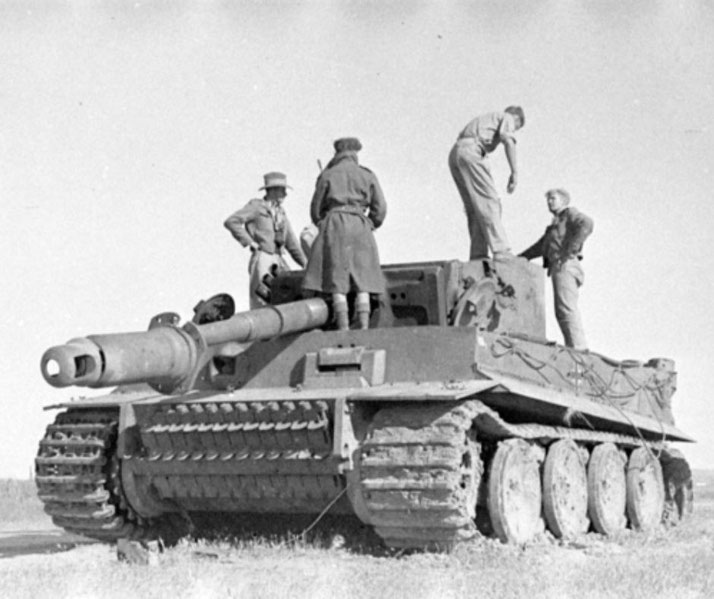
Later, the Panther and Tiger tanks brought significant improvements in firepower and protection.
Armed with long-barrelled 75mm or 88mm guns and covered with thick sloped armour, they could destroy most Allied tanks at long ranges.
Yet the technological improvements created new difficulties. For instance, the Panther suffered from transmission and engine failures during early operations, with rates of mechanical failure that reached up to 50 percent during the Battle of Kursk in 1943.
The Tiger, though feared and admired, was extremely heavy and slow, as well as costly to produce.
Both models required trained mechanics and reliable logistics, which Germany increasingly lacked after 1943.
Panther production had reached around 6,000 units, while only approximately 1,300 Tigers had been built during the war.
As the war dragged on, German industry struggled to replace losses and meet production targets.
Allied bombing campaigns disrupted supply lines, and fuel shortages forced the Wehrmacht to reduce the operational range of many Panzer units.
In response, the army reorganised some armoured formations as Panzergrenadier divisions, which had fewer tanks and placed greater reliance on motorised infantry.
In 1943, they also experimented with smaller Panzer Brigades in a bid to create more flexible strike forces, but these efforts rarely succeeded in changing the direction of the war.
By late 1944, even elite Panzer divisions often lacked sufficient fuel and spare parts, together with trained crews.
The Ardennes Offensive was launched that December and used the last reserves of armoured strength in a final attempt to split Allied lines.
Approximately 1,400 tanks from five Panzer divisions were committed, and this force included Kampfgruppe Peiper, which ran out of fuel during the operation.
Though the offensive achieved local success early on, it soon collapsed under pressure on supply lines and overwhelming Allied counterattacks.
By 1945, the myth of invincibility that had once surrounded Panzer divisions had largely vanished.
They continued to resist on both Eastern and Western fronts, and they often delayed Allied progress and inflicted serious losses.
However, without air support, sufficient supplies, or numerical superiority, they could no longer realistically alter the course of the war.
Their rise had significantly changed early conflict in Europe, but their decline illustrated the limits of operational success without strategic sustainability.