
Messerschmitt Me 262: How the world's first jet fighter was built by the Nazi Germany
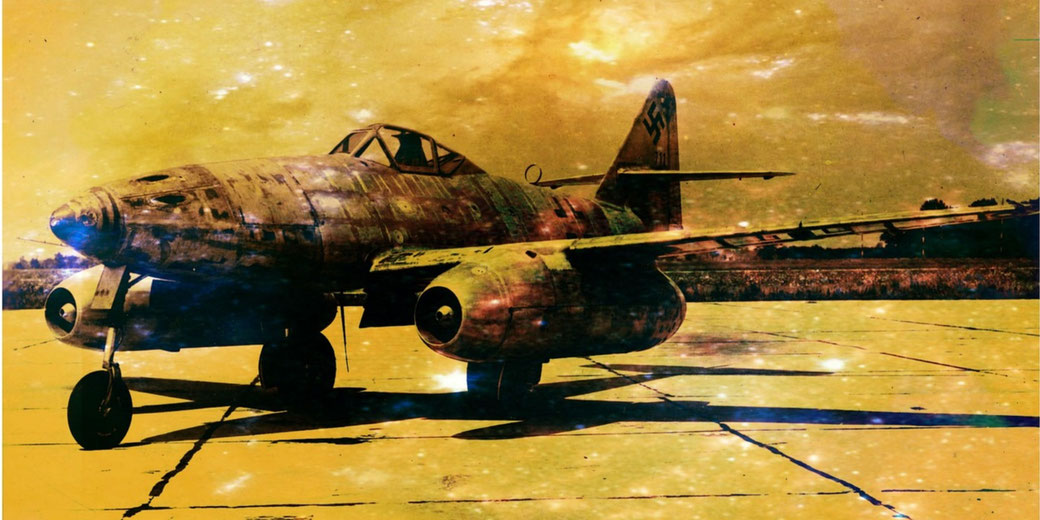
By 1944, Allied bombing raids had turned German skies into a battlefield where every technical advantage mattered.
Among the aircraft rushed into service by the Third Reich, the Messerschmitt Me 262 was widely regarded as the first jet-powered fighter ever flown in combat.
Designed years earlier but delayed by engineering problems and political interference, it eventually entered the war too late to have any realistic chance of reversing Germany’s defeat.
However, it changed the future of aviation by proving that jet propulsion could outperform piston-engine fighters, even in the middle of a war economy that was close to total breakdown.
Early design and the push for jet propulsion
By late 1938, Dr. Waldemar Voigt had begun drafting the design for an experimental jet aircraft under the internal designation P.1065.
Voigt worked at the Messerschmitt company, which Willy Messerschmitt directed, and developed a twin-engine layout with tricycle landing gear and wings swept at 18.5 degrees.
The angle addressed centre-of-gravity problems rather than giving better performance in the air, unlike the more sharply swept wings of postwar designs.
At first, engineers had fitted the prototype with a piston engine in the nose to allow for aerodynamic testing while the jet engines remained under development.
Though early plans had involved the BMW 003 engine, failures during ground tests prevented any actual flights with that model.
The first true jet-powered flight occurred only after engineers switched to Junkers' more promising Jumo 004 engine.
Meanwhile, turbojet research moved forward under Hans von Ohain at Heinkel and then shifted to Junkers, where Dr. Anselm Franz oversaw the Jumo 004 project.
He abandoned centrifugal turbines in favour of axial-flow compressors, which allowed for a narrower fuselage and more efficient airflow.
Despite that major improvement, engine parts suffered from material shortages.
As a result, engineers built turbine blades from substandard alloys that could not endure sustained heat and pressure.
They required constant replacement, and most engines failed within 25 flight hours.
Eventually, the third prototype equipped with twin Jumo 004 engines took off from Leipheim on 18 July 1942, flown by test pilot Fritz Wendel.
That flight was the Me 262’s first true jet-powered operation. At the time, no other operational military aircraft could match its speed or design, but many problems continued to delay its introduction to the front.
Delays and Hitler’s intervention
Soon after key development stages had been reached, technical failures began to multiply.
Engines remained unreliable, spare parts arrived unreliably, and fuel shortages across the Reich restricted flight testing.
At the same time, power struggles between Adolf Hitler and senior figures in the Luftwaffe and the Armaments Ministry further disrupted production and deployment.
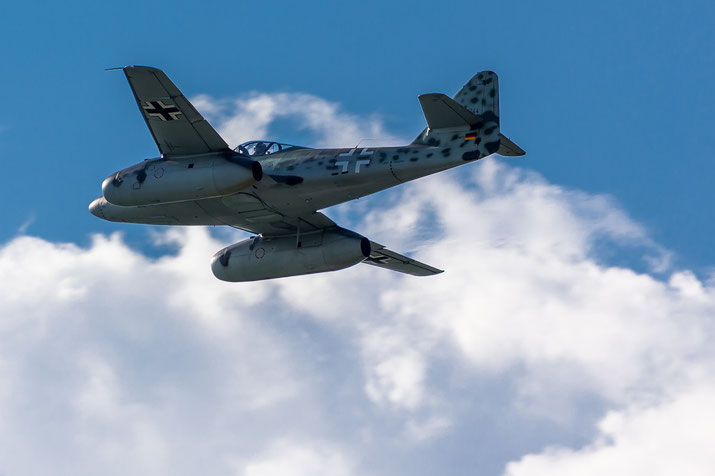
Then, in November 1943, Hitler viewed the Me 262 during a demonstration and became certain it should operate as a fighter-bomber.
He insisted the aircraft be modified to carry bombs for attacks against large groups of Allied troops or port facilities.
He began referring to it as the "Blitzbomber" and ordered its redesign accordingly.
As a result, the Me 262A-2a version was ordered into production with bomb racks under the fuselage and new targeting equipment.
The name "Sturmvogel" was occasionally used in propaganda and unofficial situations, but did not form part of a consistent Luftwaffe designation.
Previously, General Adolf Galland had urged the Luftwaffe to prepare the aircraft for use as an interceptor to challenge American bomber raids.
He warned that adapting it into a bomber would waste time and reduce its combat effectiveness.
Hitler dismissed Galland’s objections and redirected the aircraft’s role. That decision delayed operational use by months and forced engineers to divide resources between incompatible design goals.
How effective was it in combat?
By April 1944, test squadrons had begun limited operations. Soon after, the Luftwaffe formed Jagdgeschwader 7 (JG 7), the first fully operational jet fighter wing.
Major Walter Nowotny was one of the Luftwaffe’s most experienced pilots and received command of the unit, which deployed the Me 262 in small numbers against Allied bomber formations.
Before this, Kommando Nowotny had been formed in October 1944 as a combat testing unit to trial the aircraft under battlefield conditions.
At high altitude, the Me 262 could reach 870 kilometres per hour, which made it significantly faster than any piston-engine aircraft flown by the Allies.
Its nose-mounted armament included four 30mm MK 108 cannons, each capable of destroying a heavy bomber with only a few shells.
Later variants introduced R4M rockets under the wings so that pilots could attack bombers from a distance and reduce their exposure to defensive fire.
The aircraft achieved its first confirmed aerial victory on 26 July 1944, when Major Nowotny shot down a British Mosquito reconnaissance aircraft.
However, the jet required a long runway and careful throttle control, which made it especially easy to attack during takeoff and landing.
In response, Allied pilots began patrolling near known Me 262 airfields and waited for aircraft that were returning to their airfields to descend.
As a result, many were destroyed or damaged before they reached safe altitude.
Added to that, only a limited number of pilots received the specialised training needed to operate the aircraft, which reduced its effectiveness in sustained operations.
Pilot loss rates remained high during this phase, especially among those who were learning to handle the aircraft's unique flight characteristics.
The unit Erprobungskommando 262 had initially taken on the burden of developing a training programme from mid-1944 onward.
Production, sabotage, and strategic limitations
Soon after the Allied bombing campaign grew heavier, the Reich shifted aircraft assembly underground.
Factories like Mittelwerk became some of the main production sites, where prisoners from concentration camps worked under constant threat of death.
Mittelwerk relied heavily on forced labour from Dora-Mittelbau, where over 20,000 inmates died due to starvation, overwork, or execution.
Other facilities at Flossenbürg and Leipheim also assembled Me 262 parts under cruel conditions, and the B8 Bergkristall facility at St. Georgen/Gusen also assembled parts under the same cruel conditions.
Many of the aircraft produced in these facilities contained defects, either from rushed assembly or deliberate sabotage.
Even though records show that over 1,400 Me 262s were completed by war’s end, only around 300 flew combat missions, and most others lacked engines, fuel, or trained pilots.
In several cases, aircraft sat idle at airfields that Allied fighter-bombers targeted. A combination of engine breakdowns and supply failures, together with the collapse of German infrastructure, ensured that the Me 262 remained a scattered presence in many sectors, rather than a concentrated aerial threat.
Occasionally, skilled pilots succeeded when they brought down multiple Allied bombers in single missions, but these successes came too late to affect the larger course of the war.
Germany could not replace the fuel, pilots, or materials it had lost, and the Me 262, for all its promise, arrived as the Luftwaffe’s decline became irreversible.
Postwar influence and long-term impact
After Germany surrendered, Allied engineers recovered several intact Me 262s and began thorough testing programmes in Britain and the United States, and they also conducted trials in the Soviet Union.
The US recovered at least nine airframes under Operation Lusty, some of which were test-flown by pilots such as Chuck Yeager.
British tests occurred at Farnborough, while the Soviets studied the design to inform the MiG programme.
The combination of an axial-flow engine and swept wings, along with its high-speed performance, influenced postwar military aviation.
Aircraft such as the North American F-86 Sabre and the MiG-15 later integrated similar design features, though with improved reliability and superior materials.
Looking back, the Me 262 was an important step in aircraft development because what it made possible after the war mattered more than what it achieved during the conflict.
German designers had demonstrated in combat that jet-powered flight usually offered an advantage over piston-driven systems, and their work laid the foundation for the next era of aerial combat.
However, the programme also exposed the flaws of Nazi Germany’s war machine, where poor coordination and political interference, together with production chaos, wasted a weapon that could have changed the air war if it had been managed differently.
