
The tragic life of Eva Braun: Hitler’s secret mistress
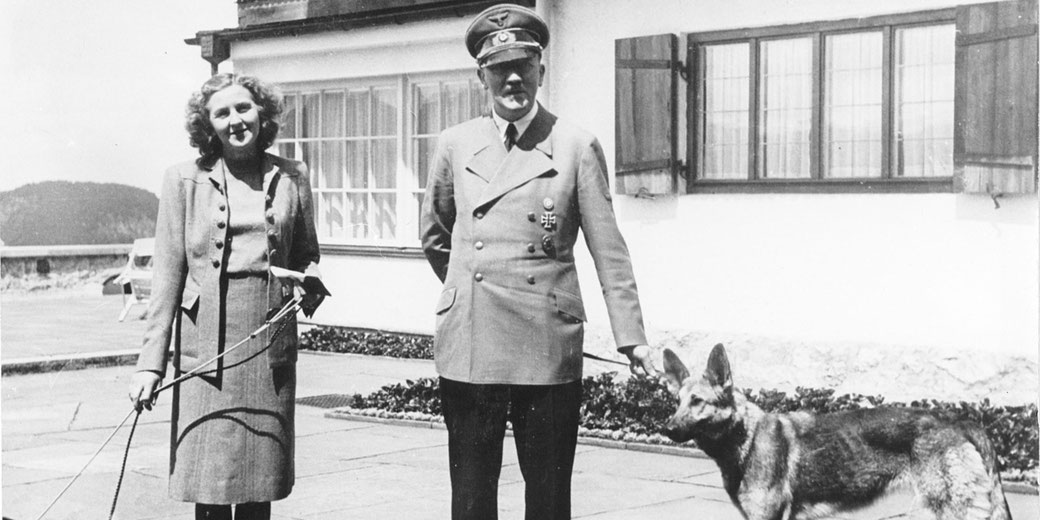
From a private villa in the Bavarian Alps to the cramped halls of Hitler’s Berlin bunker, Eva Braun's story is often reduced to a footnote in the Nazi era, but is actually full of the emotional emptiness which often lay behind the outer image of total power.
Even though she stayed invisible to the German public, she occupied Hitler’s inner world for over fifteen years, during which she surrendered her identity and, with it, her entire future for a man who refused to acknowledge her publicly.
Early years and meeting Hitler
Eva Anna Paula Braun was born on 6 February 1912 in Munich, a city that soon became a significant centre of Nazi unrest and street violence by armed Nazi groups.
Her father was Friedrich Braun, who worked as a schoolteacher, while her mother was Franziska Kronberger, who raised Eva and her two sisters in a modest household guided by Catholic traditional values.
After she had attended the Catholic Institute of the English Sisters in Simbach am Inn, which was part of a religious order that focused on girls’ education across southern Germany, where she studied French and music, along with other domestic subjects, Eva left school in 1928.
She found brief employment as a shop assistant before entering the photography studio of Heinrich Hoffmann.
By late 1929, while she had worked for Hoffmann, where she had assisted in the darkroom and had helped store photographs, she met Adolf Hitler, who used the nickname “Herr Wolff,” a term mainly used within his circle rather than a formal alias.
She was seventeen. He was forty and already the leader of the National Socialist German Workers’ Party.
Almost immediately, she began to receive his attention, though never consistently.
Her letters from the period show that he called rarely, visited unpredictably, and offered almost no emotional certainty.
Still, she attached herself to him, and as time passed, she adjusted to his deliberate distance.
Over the next few years, Eva’s connection to Hitler grew stronger in private but remained completely hidden from public view.
By 1932, she had become a regular, if hidden, part of his personal life, though only a few in his inner circle knew the true nature of their relationship.
When Hitler became Chancellor in January 1933, he insisted on keeping up the false image that he had no romantic relationships.
He believed his image as a celibate patriot helped sustain his authority. As a result, Eva never appeared by his side in any official capacity, nor did she expect her relationship to offer her status or security.

The difficulty of a life in the shadows
From her flat in Munich and, later, the Berghof estate near Berchtesgaden, Eva lived under the protection and watch of the SS.
Although Hitler often showered her with costly comforts such as clothing, cosmetics, travel, and servants, she never attended military meetings or policy discussions.
Even among Hitler’s senior staff, few saw her as anything more than a person who was allowed to stay nearby on certain occasions.
Martin Bormann distrusted her, and others, including Goebbels, viewed her as irrelevant to the real work of the Reich.
Often, she endured weeks of silence while Hitler remained in Berlin or on the front.
At the Berghof, she appeared in colour films taken by Hoffmann’s crew, who filmed her as she smiled for the camera and played with dogs on the nearby slopes where she spent hours on skis.
These recordings later became known as the 'Eva Braun Collection' and were seized by Allied forces after the end of the war.
However, her private letters showed a growing sense of hopelessness. She felt trapped in a role that denied her fulfilment or any feeling that her place in his life was secure.
It was widely understood that Hitler refused to marry her.
Eventually, the emotional strain broke her. In November 1932, after a long absence from Hitler, she attempted suicide in an event that involved a pistol.
However, she survived and, in response, Hitler increased his visits and arranged for greater physical comfort in her daily life, such as providing staff and transport.
Still, he maintained control. The following year, she took an overdose of sleeping pills but recovered again.
After this second attempt, Hitler brought her into his private life more fully, and even assigned her quarters at the Berghof.
Nonetheless, she still remained invisible to the German public.
The 'unacknowledged mistress'
During the Second World War, Eva lived in isolation at the Berghof and only travelled to Berlin infrequently.
She continued to receive expensive gifts and maintained an easy lifestyle that kept her among loyal staff and the wives of SS officers.
She reportedly passed time with romance novels and long letters, and she planned social events for Hitler’s private circle.
Those who knew her described her as cheerful and superficial, largely uninterested in political affairs, which likely appealed to Hitler’s desire to keep her as a non-political presence in his life.
Her public absence persisted, and even Hitler’s closest generals never referred to her in correspondence or meetings.
Privately, she continued to express jealousy and sadness. No matter what she did, Hitler remained distant, avoided displays of intimacy, and prioritised the war above all personal matters.
Eva complained of being ignored, yet she never confronted him directly. Perhaps her obedience became her only power, since she did not express opinions about the war, nor did she ask questions about Nazi policy.
According to postwar accounts from staff and associates, Eva likely heard reports about the deportation of Jews and the existence of concentration camps, yet she refused to acknowledge them, and told others that she found politics "unpleasant".
She focused instead on everyday things such as hairstyles, outfits, books, and photography.
She smoked in private because Hitler forbade it and hosted tea parties to break the boredom of the mountain estate.
Her final days and marriage to Hitler
By early 1945, Germany had collapsed as Allied armies invaded from the west and Soviet forces moved in from the east.
Despite growing danger, Eva refused to abandon Hitler. In mid-April, she left Munich and travelled to Berlin, where she joined him in the Führerbunker beneath the Reich Chancellery.
Others urged her to flee, and she declined. Her letters and behaviour showed that she intended to remain with Hitler until the end, no matter the outcome.
Even as the Red Army entered the city, she stayed calm in her behaviour and remained committed.
Inside the bunker, she lived in very small and crowded quarters next to Hitler’s room.
She wore her finest clothes, continued to do her hair, and assisted with minor domestic tasks.
On 29 April, she finally married Hitler in a civil ceremony that a minor Berlin city official named Walter Wagner carried out and that Joseph Goebbels and Martin Bormann attended.
However, the marriage came too late to offer any real change. Less than two days later, on the afternoon of 30 April, Eva bit into a cyanide capsule while seated next to Hitler, who shot himself.
Their bodies were carried outside, doused in petrol, and burned by aides. Soviet soldiers later recovered the charred remains, which were exhumed and reburied several times before being cremated and scattered into a tributary of the Elbe by the KGB in 1970.
She died at the age of thirty-three, but she had lived half her life in secret, without the acknowledgement of the country whose leader she had loved.