Long Tan: Australia's most bloody battle of the Vietnam War

Under the rubber canopy of Phuoc Tuy Province, in the middle of the pouring rain of the monsoon season, a group of 108 Australian and New Zealand soldiers fought against an estimated 1,500 to 2,000 Viet Cong troops.
On 18 August 1966, during a routine patrol near Nui Dat base, D Company of 6RAR came under a sudden and coordinated assault by a far larger enemy force.
The fighting raged for hours in ankle-deep mud as ammunition dwindled, so only artillery support prevented total destruction.
What followed became widely regarded as Australia’s costliest and most intense engagement of the Vietnam War.
Why Australia was involved in the Vietnam War
By 1966, Australia had increased its military commitment to Vietnam, and it had sent infantry and artillery units to Vietnam and had added armoured support to reinforce American efforts under the ANZUS alliance.
As part of this increase, the newly formed 1st Australian Task Force (1ATF) took control of its own area of operations in Phuoc Tuy Province.
The decision to base the task force at Nui Dat placed Australian forces in a region long controlled by Viet Cong forces, who knew the terrain well and relied on local support.
At first, intelligence reports significantly underestimated the strength and preparation of the enemy units.
Although scouting patrols and signals monitoring detected movement nearby, commanders viewed these as minor threats.
However, early on 17 August, Viet Cong forces launched a heavy mortar attack on the Nui Dat base, prompting a rapid response.
Patrols were ordered into the surrounding area to locate enemy positions, and D Company received the task of checking possible firing points near the Long Tan rubber plantation.
D Company moves out
By mid-morning on 18 August, Major Harry Smith had led D Company out from Nui Dat with orders to sweep the plantation.
The company included 105 Australian infantrymen and three New Zealand artillery observers from 161 Battery, Royal New Zealand Artillery, and it was divided into three platoons under the command of Second Lieutenant Dave Sabben and Second Lieutenant Geoff Kendall, while Warrant Officer Jack Kirby coordinated company support.
Sergeant Bob Buick was the platoon sergeant of 11 Platoon and assumed command during the battle after Kendall was wounded.
The men moved in open formation under humid skies, equipped with standard-issue L1A1 rifles and M60 machine guns, supported by light mortars.
Initially, they encountered only light resistance, which suggested that no large enemy formations occupied the area.
However, contact soon grew heavier, and at approximately 3:40 p.m., the lead platoons came under automatic fire from concealed positions.
Suddenly, the battle escalated. The attacking force included the 275th Viet Cong Regiment and D445 Battalion and began a series of coordinated attacks aimed at flanking and isolating the Australians.
Estimates placed their strength at up to 2,000 troops. Enemy soldiers advanced in waves as they used the trees for cover and unleashed intense rifle and machine-gun fire.
D Company quickly established defensive lines, but the rain intensified, so that the battlefield turned into deep, sticky mud and movement and visibility became limited.

Trapped in the storm
At this stage, radio communications became unreliable. Heavy rainfall interfered with radio signals, which forced radio operators to struggle for a clear connection while under direct fire.
As ammunition stocks dropped dangerously low, forward observers requested heavy artillery fire from the base at Nui Dat.
Gun crews from New Zealand’s 161 Battery, which used American M2A2 howitzers, and from Australia’s 103 and 105 Batteries, which operated L5 Pack Howitzers, fired over 3,000 rounds throughout the engagement and adjusted fire by radio as D Company called in support on enemy positions that edged closer with every attack.
Crucially, the artillery largely broke the drive of the Viet Cong assaults. Exploding rounds tore through the advancing units, which broke up enemy groups and forced repeated retreats.
Meanwhile, No. 9 Squadron RAAF scrambled Bell UH-1 Iroquois helicopters to conduct aerial resupply runs.
Despite the storm and the danger of ground fire, pilots flew at tree-top level and dropped crates of ammunition directly onto D Company’s position, many of which landed within metres of frontline troops.
Flight Lieutenant Frank Riley led the first resupply run under fire, an action later recognised as one of the most daring helicopter missions of the war.
Reinforcements break through
By early evening, the situation had become extremely serious for D Company.
Platoons, which had already suffered casualties, were beginning to run out of ammunition again.
The weight of enemy numbers suggested that the next wave could overwhelm the line.
At that point, relief forces from 1ATF finally reached the plantation. B Company of 6RAR was led by Major Noel Ford and moved forward with three M113 armoured personnel carriers from 3 Troop, 1st Armoured Personnel Carrier Squadron, as it broke through the enemy line around them and joined the hard-pressed soldiers just as night fell.
A Company followed behind in support.
Their arrival largely shifted the balance. The combined firepower of fresh infantry and armoured vehicles forced the Viet Cong to abandon their assault and begin to retreat into the jungle.
By the time the battle ended, D Company had lost 18 men and had suffered 24 wounded.
The enemy left behind 245 dead, with evidence of additional casualties indicated by blood trails and drag marks.
Some captured weapons, which included AK-47s and RPG-2 rocket launchers, confirmed the scale and seriousness of the attack.
Without the speed of artillery response and the accuracy of air resupply, together with the late arrival of reinforcements, the company would have faced destruction.
Political and public reactions
Back home, the battle attracted immediate national attention. Newspapers often highlighted the scale of the engagement, but the federal government responded with caution.
Although military leaders praised the actions of the soldiers, public recognition stayed limited, in part due to growing unease about conscription and the war’s direction.
At that stage of the conflict, official statements downplayed large victories to avoid stirring up domestic opposition to Australia’s involvement.
Over time, the story of Long Tan gradually received wider recognition. Veterans and journalists had worked to document the events of the day, and historians later pressed for appropriate honours.
Major Harry Smith was originally nominated for the Military Cross, and received only a Mention in Dispatches until the award was finally granted in 2008.
Several of his men faced similar delays. The long wait for recognition fuelled frustration among those who had survived the battle.
In 1987, the federal government declared 18 August as Vietnam Veterans’ Day, and the Battle of Long Tan became its centrepiece.
Remembering Long Tan
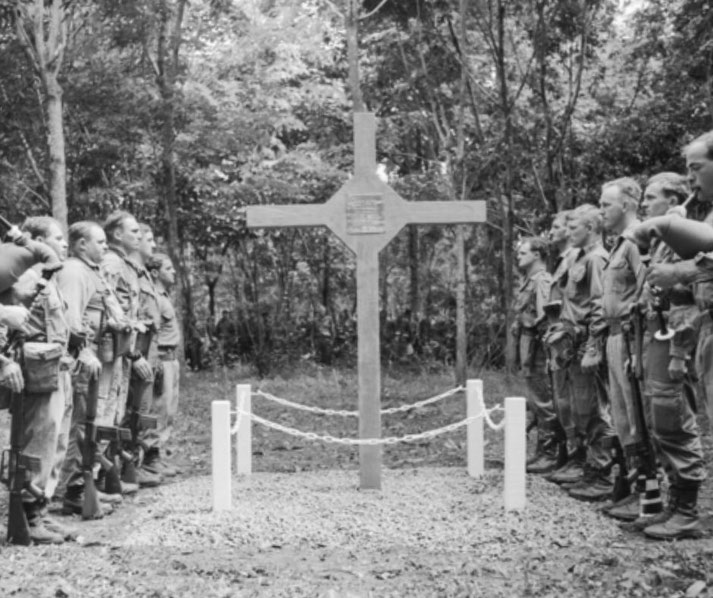
For many of the soldiers who fought, the battle remained a key experience. In 1969, Australian engineers put up a concrete cross at the site, marking the ground where their comrades had fallen.
Over the years, the cross became an important symbol of sacrifice and remembrance for Australian veterans and their families.
Although the Vietnamese government removed it in 1986, diplomatic pressure led to its restoration in 1989.
Today, the Long Tan Cross is housed in the Conflicts Gallery at Canberra’s Australian War Memorial, while a replica has been placed at the original site in Vietnam.
In 2016, public argument briefly returned when Vietnamese authorities blocked permission for memorial visits to the site on the battle's 50th anniversary, prompting renewed diplomatic negotiations.
The Battle of Long Tan clearly showed the dangers Australian forces faced during jungle warfare.
Sudden ambushes and unpredictable weather, together with an enemy who fought with determination, all combined to make the war quite unlike previous conflicts for Australian troops.
However, Long Tan also showed how successful well-trained troops could sometimes be when they acted with discipline under extreme pressure.
It was strong proof that even in isolation and under siege, coordinated artillery and air support, backed by ground reinforcement, could often determine the outcome of battle.