
The Cold War arms race: a dangerous game of brinksmanship
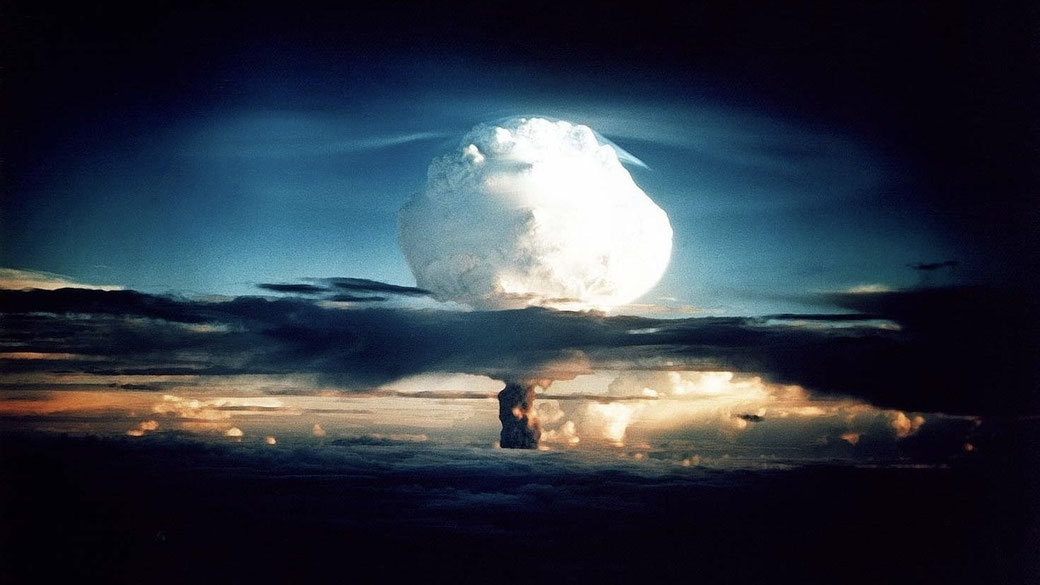
At 11:29 a.m. on 29 August 1949, the Soviet Union detonated its first atomic bomb at the Semipalatinsk Test Site, which ended the American monopoly on nuclear weapons and announced the start of a dangerous new era.
Just seven years earlier, the United States had introduced nuclear warfare to the world with the destruction of Hiroshima and Nagasaki.
As the Cold War unfolded, Washington and Moscow responded to each other’s growing arsenals with ever more destructive technology, and they relied on brinksmanship and the theory of mutual assured destruction to maintain a fragile peace.
What were the origins of hostility?
After the defeat of Nazi Germany, the wartime alliance between the United States and the Soviet Union collapsed into intense mistrust.
American officials believed that Soviet control of Eastern Europe threatened what they saw as democratic institutions and free markets, while Soviet leaders claimed that Western economic power posed a danger to socialist governments.
George Kennan’s 1946 "Long Telegram" helped to lay the basis for future containment policies, as it portrayed Soviet behaviour as expansionist and driven by communist ideas.
As early as March 1946, Churchill’s “Iron Curtain” speech openly warned of Soviet expansion in Europe, and this warning prompted Stalin to accuse the West of warmongering and aggression.
Mutual suspicion hardened quickly, and both sides adopted long-term strategies that prepared for future confrontation.
By 1947, Washington had outlined its commitment to containment with the Truman Doctrine and had launched the Marshall Plan to rebuild Western Europe under American guidance.
Meanwhile, Moscow had rejected these initiatives as imperialism in disguise and had moved to tighten its control across the Eastern Bloc.
It established the Cominform in 1947, which coordinated international communist movements, and expelled Yugoslavia from the organisation in 1948, after it defied Stalin’s authority.
It also pressured neighbouring states into alignment with communist ideas.
Instead of cooperating to secure peace, both governments believed they needed to deter each other through strength, and this belief gave rise to the first stages of the arms race.
The atomic bomb and its consequences
After Hiroshima and Nagasaki, American leaders had come to view nuclear weapons as a strategic tool that could, at least in theory, prevent future wars.
The initial monopoly gave the United States a very clear advantage, but Soviet intelligence had already placed spies inside the Manhattan Project, and figures like Klaus Fuchs, who passed critical information that allowed Moscow to speed up its own program.
On 29 August 1949, the successful Soviet test shocked American officials and forced them to reconsider their assumptions about long-term security.
In response, the United States began work on the hydrogen bomb, which relied on nuclear fusion rather than fission and produced yields hundreds of times more powerful.
On 1 November 1952, it detonated the first thermonuclear device, code-named "Ivy Mike," at Enewetak Atoll in the Pacific.
The yield was approximately 10.4 megatons. The Soviets tested their own hydrogen bomb on 12 August 1953, closing the gap once again.
Now both sides possessed weapons that could wipe out entire regions, and each government insisted that survival seemed to require the ability to strike back with equal or greater force.
Strategic doctrine began to shift toward the concept of mutually assured destruction, where any use of nuclear weapons would guarantee the death of millions and possibly trigger global collapse.
The technological escalation of delivery systems
After the development of warheads, both superpowers turned their attention to delivery systems, since weapons had to be mobile and accurate so they could strike before an opponent had time to respond.
Initially, long-range bombers such as the American B-52 Stratofortress and the Soviet Tu-95, which carried nuclear payloads across intercontinental distances, delivered these weapons.
However, they remained vulnerable to interception, and air defences improved rapidly.
In October 1957, the Soviet Union launched Sputnik, the world’s first artificial satellite.
Its successful orbit proved that Moscow had entered the space age and that it had developed intercontinental ballistic missile (ICBM) capabilities.
The first operational Soviet ICBM was the R-7 Semyorka, and it was officially deployed in 1959, though only a limited number were kept on standby due to practical limits.
This realisation caused panic in Washington, and both powers soon poured resources into missile technology.
The United States responded with the Atlas and Titan ICBMs, while the Soviets fielded the R-7 and later the R-16.
As deployment expanded, each government developed submarine-launched ballistic missiles (SLBMs), such as the American Polaris and Soviet R-21, which gave them the ability to launch strikes from hidden positions underwater.
This advancement made it nearly impossible to destroy a nation’s nuclear capacity in a first strike and helped to reinforce the second-strike doctrine.
By the mid-1960s, both superpowers had established a nuclear triad that combined bomber aircraft with both land-based and submarine-launched missiles.
This structure ensured that retaliation would remain possible even after a very destructive attack.
The triad relied on platforms such as Minuteman ICBMs and Polaris submarines, along with B-52 bombers, which the United States kept on continuous readiness on the American side.
As a result, military strategy prioritised survivability and speed over restraint, and engineers designed systems to launch under pressure with minimal human input.
Brinksmanship and the threat of nuclear war
From the 1950s, American policy largely adopted the principle of massive retaliation, which declared that any Soviet attack, conventional or nuclear, would result in a very large response.
President Eisenhower endorsed this strategy, and Secretary of State John Foster Dulles set out a vision of brinksmanship, which stated that only an open threat of total war could prevent conflict.
In theory, the approach guaranteed deterrence. In reality, it increased the chance of escalation during a crisis.
In October 1962, the Cuban Missile Crisis brought the world within hours of nuclear war.
After American reconnaissance flights identified Soviet missile installations in Cuba, President Kennedy ordered a naval blockade and demanded the removal of all offensive weapons.
Soviet ships sailed toward the blockade line, and both sides prepared their forces for war.
For thirteen days, communication between Washington and Moscow remained tense, and several incidents nearly triggered direct confrontation.
Soviet submarine officer Vasily Arkhipov refused to authorise the launch of a nuclear torpedo during one such episode, and this decision likely prevented full-scale war.
Eventually, Khrushchev agreed to dismantle the missile sites in exchange for a U.S. promise not to invade Cuba and a secret agreement to withdraw American missiles from Turkey.
The crisis showed the dangers of brinksmanship and convinced both superpowers of the need for direct communication and better crisis management.
In response, the White House and the Kremlin established a direct hotline in 1963 to allow immediate contact during emergencies.
Continuing suspicion between superpowers
After Cuba, both governments began to explore arms control as a way to manage the danger without any suggestion of weakness.
In 1963, the Partial Test Ban Treaty prohibited nuclear tests in the atmosphere and underwater, as well as those conducted in space.
Five years later, the Non-Proliferation Treaty attempted to restrict the spread of nuclear weapons, which encouraged peaceful nuclear energy development and set out disarmament goals in writing.
These steps aimed to reduce risk, but they did not significantly slow development.
During the 1970s, the United States and the Soviet Union signed two rounds of Strategic Arms Limitation Talks (SALT I in 1972 and SALT II in 1979), which imposed limits on certain types of delivery systems and established verification procedures that relied on national technical means such as satellite surveillance.
However, although SALT II was signed, the United States Senate never ratified it due to the Soviet invasion of Afghanistan.
Even so, both sides initially honoured its terms voluntarily. Under President Reagan, the United States launched the Strategic Defense Initiative (SDI) in 1983, which proposed a space-based shield against missile attacks.
Soviet officials saw the proposal as an attempt to undermine mutual assured destruction and gain a first-strike advantage.
By the mid-1980s, economic pressures that included military spending, which some Western analyses estimated to take up as much as 20 percent of Soviet GDP, had forced Moscow to reconsider its position.
General Secretary Mikhail Gorbachev had initiated reforms and had agreed to negotiate, and in 1987, the two powers signed the Intermediate-Range Nuclear Forces (INF) Treaty, which eliminated a whole category of missiles.
Though suspicion lingered, both sides recognised that uncontrolled escalation could no longer continue.