
The devastating legacy of Agent Orange: The human-killing herbicide of the Vietnam War
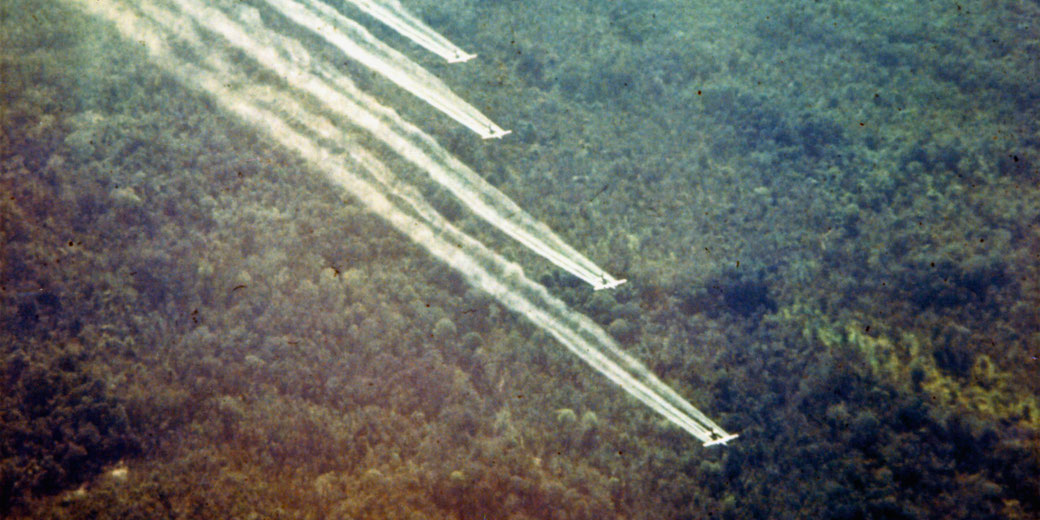
On 10 August 1961, the first U.S. aircraft released chemical herbicides over the Vietnamese countryside as part of Operation Ranch Hand.
The mission primarily aimed to deny enemy forces jungle cover and food through the deliberate destruction of forests and crops.
However, one substance in particular, Agent Orange, became the most infamous. It contained the highly toxic contaminant TCDD, which widely poisoned ecosystems and entered water supplies in ways that altered human DNA.
As a result, generations of Vietnamese civilians and foreign veterans had already suffered cancers and other chronic illnesses.
Although the war ended in 1975, Agent Orange never left. It remained in the soil and in the food chain, lodged stubbornly in the bodies of millions.
Chemical composition and military deployment
During the war, the U.S. military developed a group of defoliants, collectively known as “rainbow herbicides,” each named after the coloured stripes painted on their storage drums.
Agent Orange consisted of a 1:1 mixture of 2,4-D and 2,4,5-T, and it became the most heavily used.
Crucially, the 2,4,5-T component contained dioxin (2,3,7,8-Tetrachlorodibenzo-p-dioxin), a contaminant with severe biological toxicity.
The World Health Organization classified TCDD as a Group 1 carcinogen, and its half-life in human tissue was estimated between seven and eleven years, with some studies at the time suggesting that it might persist for up to two decades.
The manufacturing process was poorly regulated and rushed to meet demand, and it failed to control the formation of this compound.
Between 1961 and 1971, American forces sprayed more than 80 million litres of herbicides across Vietnam, of which approximately 43 million litres were Agent Orange.
Aircraft such as the C-123 Provider dropped the chemical in dense concentrations, particularly over regions where the Viet Cong operated.
Over 19,000 spraying missions took place under Operation Ranch Hand. Although the nickname "Operation Hades" appeared early in planning, it was never adopted as the official name.
In addition, American helicopters and trucks and riverboats sprayed it around bases and along key roads, often without any consideration of the long-term effects on civilians and local ecosystems.
Heavily affected zones especially included Quang Tri, A Luoi Valley, and areas around Bien Hoa and Da Nang, where storage and loading of herbicides also caused severe contamination.
Repeated spraying in some regions created persistent contamination. Dioxin entered the soil, where it often lingered for years, especially in clay-rich or waterlogged areas.
It did not break down quickly, which meant that people continued to encounter the poison long after spraying stopped.
Soldiers involved in the missions received heavy exposure, especially those who handled the chemicals without protective gear.
Civilians who lived in affected areas consumed contaminated food and water, and many developed symptoms that doctors could not easily explain at the time.
Human exposure and medical consequences
As exposure spread, symptoms frequently followed. Civilians who lived under sprayed zones began to report unexplained skin rashes, stomach pain, miscarriages, and respiratory issues.
American and allied troops developed illnesses years after they returned home, often without knowing what had caused them.
Dioxin moved silently through the body and accumulated in fat cells, then crossed the placental barrier in ways that disrupted hormonal systems.
In many cases, the compound remained in the body for decades.
Over time, research had identified clear connections between dioxin and a growing list of serious diseases.
The U.S. National Academy of Sciences and the Department of Veterans Affairs associated Agent Orange exposure with non-Hodgkin lymphoma, chronic lymphocytic leukaemia, soft tissue sarcoma, Parkinson’s disease, type 2 diabetes, and several other conditions.
In response, the VA created a list of “presumptive conditions” for Vietnam veterans who had been exposed.
The Agent Orange Act of 1991 formalised this recognition and required the Department of Veterans Affairs to support ongoing reviews by the National Academy of Sciences on the health effects of exposure.
In Vietnam, the health crisis had already reached devastating levels. Hospitals documented spikes in congenital deformities and neurological impairments.
Children were born with fused fingers, twisted limbs, missing eyes, and severe brain damage. Some were stillborn or died within months.
Tu Du Hospital in Ho Chi Minh City compiled large collections of medical case records and provided treatment to thousands of children who were affected by dioxin.
According to the Vietnamese Red Cross, over three million people suffered health problems connected to Agent Orange exposure, including at least 150,000 children born with major birth defects.
The Vietnam Association for Victims of Agent Orange (VAVA) estimated that as many as 4.8 million Vietnamese had been exposed to the toxin, though this figure remains disputed and has not been independently verified.
Environmental and agricultural destruction
The campaign to defoliate forests did not stop at military targets. Agent Orange stripped many entire ecosystems bare and often destroyed the agricultural base that many rural Vietnamese communities depended on.
More than three million hectares of forest were sprayed, and in many cases, the trees that had been destroyed never returned.
The natural regeneration of the jungle failed where the soil remained poisoned. In some regions, dioxin sank into mud and sand on river beds and moved through water systems, where it entered fish and amphibians and then contaminated livestock.
Mangrove forests such as those in the U Minh and Can Gio regions faced especially heavy destruction.
These coastal ecosystems provided critical breeding grounds for fish and shellfish and were targeted multiple times and lost nearly all vegetation cover.
Without plant life to hold the shoreline together, erosion increased, and fisheries collapsed.
Endangered species such as the Siamese crocodile and native wetland birds that relied on these habitats suffered significant habitat loss.
Replanting programs struggled to restore these areas, and the original range of plant and animal life almost never fully returned.
Farmers who returned to their land found that their crops had wilted and their animals were sick, as their children ailed constantly.
Contaminated rice paddies no longer produced reliable harvests. Rainfall washed dioxin into rivers, where it settled in sediment and passed into the food web.
Those who ate the fish or drank untreated water absorbed the poison into their own bodies. In many communities, families abandoned their homes and moved inland, leaving once-thriving villages empty and infertile.
Political and legal fallout
Over time, as veterans and civilians had suffered symptoms that grew steadily worse, pressure grew to hold those responsible to account.
In the United States, soldiers who returned from the war formed activist groups to demand recognition of their medical problems and to pressure the government into action.
By the early 1980s, the scale of the issue had become impossible to ignore. A class-action lawsuit was filed in 1979 in New York against seven chemical manufacturers, including Dow Chemical and Monsanto.
The companies denied wrongdoing, but agreed to a $180 million out-of-court settlement in 1984.
Although the settlement offered some financial support to U.S. veterans, it did not include Vietnamese victims, who received no compensation and initially no legal acknowledgment.
From 2007 onward, however, the U.S. government began to fund environmental remediation and limited health assistance programs in Vietnam but continued to avoid direct responsibility for health-related damages.
Legal protections in the United States made it almost impossible for foreign victims to file suit.
In 2004, Vietnam filed a lawsuit in U.S. courts, which was dismissed in 2005 and again on appeal in 2008.
In 2014, Tran To Nga, a Vietnamese-French activist, launched a civil case in France against the manufacturers, which brought renewed attention to the international legal struggle.
Eventually, limited assistance arrived. In 2007, the U.S. Congress approved funds for environmental clean-up work around Da Nang Air Base, a site where dioxin had accumulated at dangerous levels.
Later projects expanded to include Bien Hoa and Phu Cat. USAID funded major clean-up efforts, such as the use of thermal desorption to break down contaminated soil.
Teams removed polluted earth and sealed landfills, then installed treatment systems to reduce dioxin spread. However, large areas remained untouched.
A mix of funding shortages and practical obstacles, together with constant legal disputes, prevented broader efforts.
Victims who lived in remote areas received little or no support.
Long-term trauma and ongoing struggles
Across multiple countries, families continued to feel the ongoing weight of Agent Orange’s effects long after the last spraying mission ended.
In Vietnam, second- and third-generation birth defects appeared in regions where spraying had been most concentrated.
Families that had multiple disabled children often could not afford specialised care.
Many relied on overworked volunteers or local support centres that lacked medical supplies or trained staff.
In the United States, Australia, South Korea, and New Zealand, veterans passed on concerns to doctors and researchers, who began to suspect that dioxin had interfered with reproductive health.
South Korea later recognised over 100,000 soldiers who had been exposed during their service.
Approximately 39,000 Australian troops were deployed to Vietnam, and thousands reported symptoms linked to herbicide exposure.
The VA and several allied governments expanded their lists of compensable conditions, though inconsistently.
Many families waited years for approval or never received a clear diagnosis.
Parents blamed themselves, and children struggled with lifelong disabilities.
Governments moved slowly, and many victims died without receiving help.
In rural Vietnamese provinces, children born with severe deformities could not attend school or find work.
Some were hidden from public view to avoid stigma, and others depended entirely on ageing parents.
The emotional toll on families was immense. In cases where three or more generations lived under the same roof, care duties fell on siblings who had their own children to raise.
Without state intervention, these families remained trapped in poverty and isolation.