
What were the causes of the Vietnam War?

From the 1880s to the 1960s, Vietnam passed from French colonial rule to Japanese military occupation, then from revolutionary struggle to Cold War intervention.
Each shift often brought new forms of repression and political division, together with resistance that became stronger and over time changed Vietnamese society.
By the time the United States escalated its involvement in the 1960s, the war had already been influenced in many ways by decades of foreign interference and unresolved nationalist aims.
A brief history of Vietnam before the war
During the late 19th century, France expanded into Southeast Asia and added Vietnam to its colony of Indochina in 1887, which later included Cambodia and Laos.
French authorities imposed a tax system that often burdened the rural population and seized land for farming that produced crops for export, which placed much of industry and commerce under direct colonial control.
By the 1930s, French settlers and Vietnamese who worked with them had acquired large areas of good farming land in the Mekong Delta, which some sources estimated at up to 30 percent, while the majority of peasants had lost their farms and had been forced into tenant farming or subjected to the very unfair corvée system.
Over time, those economic and social conditions had steadily increased anger against colonial rule.
Early nationalist figures such as Phan Bội Châu and Phan Chu Trinh argued for different kinds of resistance.
Phan Bội Châu supported violent independence movements, while Phan Chu Trinh called for reform and education within the French system.
By 1930, Hồ Chí Minh had founded the Indochinese Communist Party on 3 February in Kowloon, British Hong Kong.
Hồ had earlier attempted to present a petition for Vietnamese independence at the 1919 Versailles Peace Conference and had drawn inspiration from international socialist movements.
However, French authorities carried out large-scale crackdowns, but the party expanded its influence in villages that had long been excluded from power.
Japanese Occupation and the Rise of Hồ Chí Minh
In 1940, Japanese forces entered Vietnam and allowed Vichy French colonial authorities to keep day-to-day control under Japanese supervision.
Japan kept French officials in place and largely used the existing colonial structure to support its war aims.
Japanese control of transport and rice supplies, along with tight control over military resources, often created serious shortages, particularly in many parts of the countryside.
The situation worsened during the 1945 famine in northern Vietnam, which killed between 400,000 and 2 million people, with most historians estimating the toll at about 1 million.
During this time, Hồ Chí Minh formed the Việt Minh, which united communist ideology with nationalist resistance and primarily focused on efforts to drive out both foreign occupiers.
As Japan’s position in the war collapsed, the Việt Minh launched the August Revolution in 1945.
On 19 August, they seized administrative buildings in Hanoi and took control of northern cities, then presented themselves as the main leaders of an independent Vietnam.
On 2 September 1945, Hồ Chí Minh read the Declaration of Independence in Hanoi, and he used language from the American Declaration to appeal to Western powers.
French officials were generally determined to take the colony back and returned to southern Vietnam with the assistance of British troops, and this move led to clashes that escalated into a full conflict by the end of 1946.
The First Indochina War had begun.

The Geneva Accords and the temporary division
By 1954, French forces had suffered a major defeat at the Battle of Điện Biên Phủ, where Việt Minh troops surrounded and defeated a heavily defended base in the northwest.
French forces surrendered on 7 May 1954. That loss forced the French government to negotiate, and this outcome led to the Geneva Conference, which brought together delegates from multiple nations to agree on a political agreement.
The conference produced the Geneva Accords, which called for a temporary division of Vietnam at the 17th parallel and proposed nationwide elections in July 1956 to reunify the country.
The Soviet Union and China pushed the Việt Minh to accept the division to avoid direct confrontation with the United States.
However, South Vietnam and the US did not sign the agreement, which meant that they were not legally bound by its terms, and they issued statements that recognised its general principles.
Soon after, the United States worried especially about the influence of communist governments in Asia and refused to support the planned elections.
American officials feared that Hồ Chí Minh would win by a large margin, given what they saw as his popularity in both the North and the South.
Instead, the US increased support for Ngô Đình Diệm, a Catholic Vietnamese nationalist who had returned from exile and presented himself as a firm anti-communist leader.
In October 1955, Diệm held a referendum to remove Emperor Bảo Đại and declared the formation of the Republic of Vietnam on 26 October.
Many observers saw the vote as unfair because of serious problems with the way it was run.
American involvement and the Domino Theory
By the mid-1950s, American strategy in Vietnam had shifted toward direct involvement in building and defending a non-communist state in the South.
US policymakers accepted the domino theory, which held that the fall of one nation to communism would lead to similar results in neighbouring countries.
That belief guided military and economic aid, which increased steadily under Presidents Eisenhower and Kennedy.
Under Diệm’s rule, South Vietnam relied on foreign support but faced unrest that over time became more widespread.
His regime excluded Buddhists and arrested suspected communists without trial, and in many areas it turned rural communities against the government through land policies and forced relocations.
One major policy was the Strategic Hamlet Program, which was launched in 1962, and which attempted to isolate rural populations from Viet Cong influence but often had the opposite effect and pushed support toward the insurgents.
Meanwhile, the North supported the formation of the National Liberation Front, commonly known as the Viet Cong, which organised armed resistance against the South Vietnamese government.
Their activities included assassinations and sabotage, along with a steady campaign of propaganda that eroded the authority of Diệm’s administration.
In many provinces, the Viet Cong targeted village chiefs and local officials, and they used terror and persuasion to undermine Saigon's control.
Eventually, growing internal unrest led to Diệm’s downfall. After violent crackdowns on Buddhist protests in 1963, South Vietnamese generals launched a coup and assassinated Diệm with silent approval from the United States.
What followed was a period of instability with frequent leadership changes and a collapse of central authority.
At the same time, the Viet Cong had expanded their operations with ever greater support from North Vietnam, and they used tunnel systems like those later discovered at Củ Chi.
Internal collapse and military escalation
By early 1964, South Vietnam no longer had a stable government, and large parts of the countryside had come under greater control of communist forces.
The Hồ Chí Minh Trail was a secret supply network that passed through Laos and Cambodia and enabled the North to send troops and weapons to the South and to move other supplies along the route without direct confrontation.
Despite continuing American efforts to support the South, the situation grew even worse.
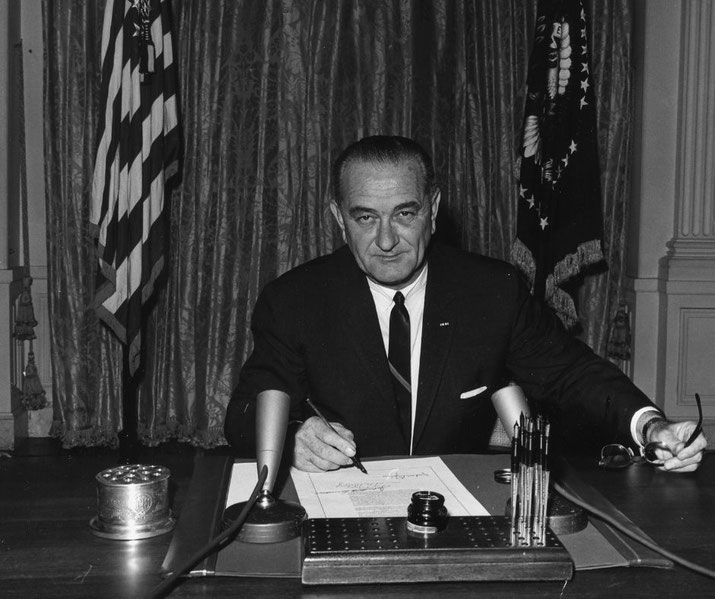
In August 1964, the Gulf of Tonkin incident gave President Lyndon B. Johnson the political chance to increase US involvement.
American reports claimed that North Vietnamese patrol boats had attacked US naval vessels, but later investigations showed that the second alleged attack on 4 August likely did not occur.
Congress responded by passing the Gulf of Tonkin Resolution, which allowed the use of force without a formal declaration of war.
The House approved it 416–0, and the Senate by 88–2. Soon after, Johnson approved airstrikes and began preparations for full military intervention.
By March 1965, US Marines had landed in Đà Nẵng, and ground combat units followed as the bombing campaign against North Vietnam intensified.
American officials believed that a very large military force could quickly defeat the communist insurgency.
However, the Viet Cong avoided open battles, relied on tunnel systems, and drew support from rural populations.
As a result, American forces became bogged down in a war that lacked front lines and clear military objectives.
By 1969, US troop numbers had surpassed 540,000, and the war had already cost the United States close to $100 billion.
The total cost would eventually exceed $168 billion.
Ideological confrontation and civil conflict
To a large extent, the Vietnam War involved two rival visions of national identity.
The North was led by Hồ Chí Minh and the Communist Party, and viewed reunification as the fulfilment of a long struggle for self-determination that had begun under French rule.
The South was backed by the United States and its allies, and claimed to defend freedom against totalitarianism, even as its leaders struggled to build a stable and widely accepted state.
On both sides, outside powers increasingly supplied weapons and money, as well as strategic guidance.
The Soviet Union and China supported the North through military aid and political training, with an estimated 3,000 Soviet advisers present in North Vietnam by 1967.
The United States was convinced that its reputation as a global superpower was at stake, and committed hundreds of thousands of troops, as well as billions of dollars.
Other US allies included countries such as Australia, South Korea, Thailand, and the Philippines that also sent troops.
Over time, the war increasingly became more than a Vietnamese civil conflict and turned into a test of Cold War determination, where ideological fears outweighed diplomatic alternatives.