
Why the Tet Offensive was the dramatic turning point of the Vietnam War

On the night of 31 January 1968, during Tet, the most sacred holiday in the Vietnamese calendar, Viet Cong commandos attacked the U.S. Embassy compound in Saigon with unexpected force.
As Americans watched news reports that had previously suggested that the war was close to a favourable end, communist forces struck more than 100 targets across South Vietnam, from cities and towns to key military outposts, such as Hue, Da Nang, Ban Me Thuot, and Kontum.
The scale and timing of the offensive were coordinated by North Vietnamese and Viet Cong commanders, and they undermined years of confident political claims and changed the war’s meaning both on the battlefield and at home.
Planning and launch of the offensive
For months, General Vo Nguyen Giap and the Central Office for South Vietnam (COSVN) had positioned forces across the country in preparation for a coordinated strike against urban and strategic targets.
The objective was one that communist planners believed was realistic and aimed to spark a general uprising among the South Vietnamese population and to cripple the Saigon government’s control over major cities.
To support this effort, they deployed weapons and troops through secret supply routes and disguised their mobilisation behind the expectation of a Lunar New Year ceasefire.
American and South Vietnamese leaders, who had come to interpret the enemy’s silence as weakness, reduced their alert status and, in many areas, allowed large numbers of troops to take leave.
In some regions, such as II Corps, the attack began on 30 January due to regional variations in the Tet calendar, which further caught Allied forces off guard.
Suddenly, in the early hours of 31 January, Viet Cong and North Vietnamese Army (NVA) forces launched attacks across the country at the same time.
The offensive involved an estimated 70,000 to 80,000 communist troops who struck 36 of the 44 provincial capitals and five of the six independent cities, along with most major U.S. and ARVN military bases.
In Saigon, the attack on the U.S. Embassy compound stunned American audiences.
Nineteen Viet Cong sappers, who used explosives, breached the outer wall and briefly occupied part of the compound before being killed or captured after six hours of fierce combat.
Although the attackers failed to enter the main embassy building, they held their position long enough to prompt global media attention and create the impression that security had collapsed.
Elsewhere, in the historic city of Hue, NVA forces captured large parts of the city within hours and held them for nearly a month.
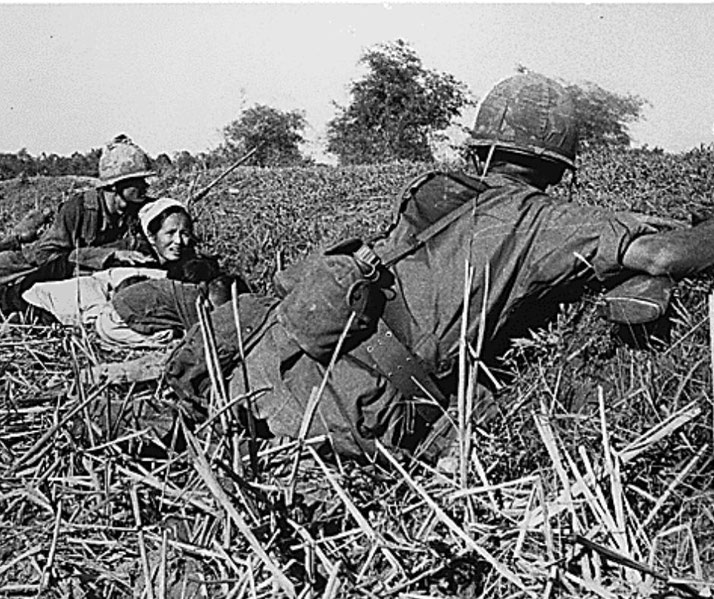
The Battle of Hue lasted from 31 January to 2 March and saw U.S. Marines and South Vietnamese airborne troops fight block by block against dug-in communist units.
As combat spread through temples and homes and then engulfed government buildings, thousands of civilians were displaced.
When the city was eventually retaken, mass graves showed that communist cadres had executed an estimated 2,800 suspected collaborators during their occupation, though historians still debate the exact number.
The scale of the violence, along with the special importance of Hue's history, deepened the sense of shock that many observers felt at the offensive.
Military outcome and strategic cost
By mid-February, the Tet Offensive had failed to achieve its immediate objectives.
Communist forces were driven out of every major city they had attacked, and the anticipated civilian uprising never happened.
U.S. estimates placed enemy casualties at over 40,000, with many of the Viet Cong’s most experienced fighters among the dead.
American forces suffered over 1,100 killed, and ARVN losses exceeded 2,000 during the course of the offensive.
On paper, it appeared that the United States and its allies had achieved a clear tactical victory.
However, the Viet Cong's network in the South never fully recovered from the losses, and North Vietnamese leaders increasingly relied on regular NVA troops and cross-border safe bases in Laos and Cambodia for future operations.
However, the strategic cost proved far greater. For more than a year, military leaders such as General William Westmoreland had reported steady progress and had claimed that the communists no longer possessed the ability to carry out coordinated large-scale assaults.
Shortly before Tet, Westmoreland had told the press that there was "light at the end of the tunnel," a phrase that Tet instantly discredited.
Television footage that showed firefights in Saigon and destruction in Hue contradicted previous statements and made it increasingly difficult for the administration to sustain public support.
Public scepticism grew rapidly.
Importantly, the impact began on the battlefield and then spread into American society and politics.
Walter Cronkite, the highly respected CBS News anchor, travelled to Vietnam in February and reported upon his return that the war appeared headed toward stalemate.
He concluded his broadcast by stating, "It seems now more certain than ever that the bloody experience of Vietnam is to end in a stalemate."
His words, which were delivered during a nationally televised broadcast, showed a wider loss of confidence.
By late February, opinion polls indicated that a growing number of Americans no longer believed victory in Vietnam could still be achieved at an acceptable cost.

Political fallout and shift in U.S. strategy
Inside the White House, the offensive forced a serious and immediate review of strategy.
Although the Johnson administration had previously resisted calls to de-escalate the conflict, the scale of the attacks and the speed at which public opinion turned made it impossible to ignore.
U.S. intelligence agencies had intercepted signs of a major offensive, such as captured documents and increased communist radio traffic, but senior commanders dismissed these warnings or misinterpreted them.
Senior advisers, such as Clark Clifford and George Ball, began to urge the president to reconsider the war’s long-term future.
Political pressure also intensified as Senator Eugene McCarthy announced his candidacy for the Democratic nomination, and Senator Robert F. Kennedy soon followed.
On 31 March, President Lyndon B. Johnson appeared on national television and announced a partial halt to bombing operations north of the 20th parallel.
He also declared that he would not seek re-election. The decision shocked both political allies and opponents and confirmed that Tet had shifted the war from a military contest to a political crisis.
Negotiations with North Vietnamese delegates began in Paris on 13 May, although preliminary contacts had occurred earlier and meaningful progress remained limited throughout 1968, as both sides argued over procedures and the role of the Viet Cong delegation.
Meanwhile, the U.S. Department of Defense adopted a new approach centred on transferring responsibility for combat operations to South Vietnamese forces.
Although the Nixon administration would later formalise this strategy as Vietnamisation in 1969, its foundations were laid in the months following Tet.
The process required the rapid expansion and training of ARVN units that were backed by American logistics and air support.
While U.S. troop levels initially increased in the months after Tet, the overall strategy had already begun to move toward withdrawal.
The long-term impact of Tet
Over time, the consequences of the Tet Offensive had changed the conflict in ways that could not be reversed.
North Vietnamese planners had suffered high losses among Viet Cong units in the South and had placed greater emphasis on conventional NVA forces and cross-border safe areas in Laos and Cambodia.
South Vietnamese leaders, who were under growing pressure to maintain domestic support, struggled to control territory in many rural provinces.
Although the ARVN received improved equipment and training, it became increasingly dependent on U.S. air power to hold key positions.
In areas such as Ben Tre, ARVN forces had held their ground under pressure, but uneven battlefield performance elsewhere continued to raise doubts about their long-term reliability.
In the United States, the political shift continued to unfold. Anti-war demonstrations expanded throughout 1968 in many American cities, and violent clashes between protesters and police at the Democratic National Convention in Chicago showed how serious the internal conflict had become.
Journalists became more critical of official reports, and congressional oversight increased.
Some historians later argued that the shock of Tet contributed to a worsening moral climate among U.S. troops, which may have influenced events such as the My Lai Massacre on 16 March 1968.
However, scholars still dispute the direct connection between the two events. By early 1969, the Nixon administration had taken office, committed to a strategy of gradual withdrawal and diplomatic resolution.
Eventually, in 1973, the United States completed its troop withdrawal under the terms of the Paris Peace Accords.
On 30 April 1975, North Vietnamese tanks rolled into Saigon, ending the war after the outcome had already been determined.
Tet had shown that battlefield victories could not, by themselves, secure political success, and that military superiority did not, by itself, guarantee stability.
By exposing the gap between official claims and battlefield realities, the offensive created a crisis of confidence that American leaders could never fully repair.