
The Prague Spring was a peaceful call for reform that was crushed by the Soviet Union
In January 1968, a relatively unknown Slovak politician named Alexander Dubček became the leader of communist Czechoslovakia, and within months he had ignited what was arguably the most significant challenge to Soviet authority in Eastern Europe since the Hungarian Uprising of 1956.
Dubček's programme of political liberalisation promised citizens freedoms they had not experienced in two decades of communist rule.
Reformers also insisted that they wanted “more democracy, more socialism,” which made clear that the movement aimed to reform communist rule rather than abolish socialism altogether.
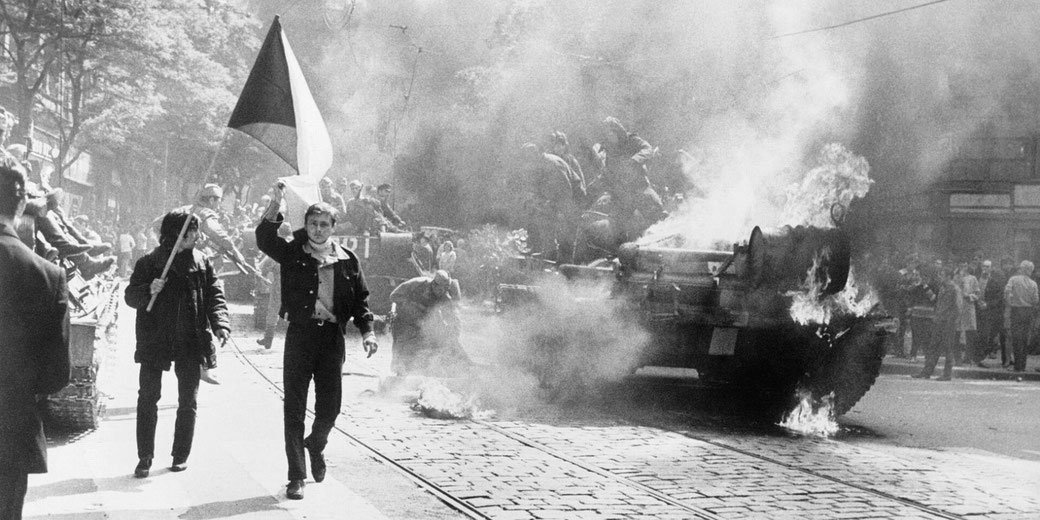
However, because Moscow could not tolerate such reforms spreading to other satellite states, the experiment lasted barely eight months before Warsaw Pact tanks rolled into Prague on 20 August 1968.
Why Czechoslovakia was ready for reform
By the early 1960s, Czechoslovakia was experiencing serious economic stagnation under President Antonín Novotný, who had held power since 1953.
As the centrally planned economy failed to keep pace with Western competitors, exports had become increasingly uncompetitive, and workers found themselves trapped in poor housing.
Farmers faced strict limitations on cultivation, which had prevented agricultural innovation and deepened rural dissatisfaction.
Growing frustration became public in June 1967, when delegates at the Writers’ Union Congress openly criticised the government.
Students demonstrated against Novotný in October, and the Strahov dormitory protests in Prague on 31 October 1967 had begun over repeated electricity cuts and quickly took on a political character.
Within the Communist Party of Czechoslovakia (KSČ), reformists such as the economist Ota Šik and Dubček began challenging Novotný at Central Committee meetings.
When Novotný invited Soviet leader Leonid Brezhnev to Prague in December 1967 to shore up his position, Brezhnev was surprised by the level of opposition and declined to help.
Dubček and the Action Programme
On 5 January 1968, the KSČ elected Dubček as First Secretary, largely because he appeared to be a safe compromise candidate.
Born in 1921, Dubček had studied in Moscow and had served as First Secretary of the Slovak Communist Party since 1963, and his commitment to communism reassured the party’s old guard.
By March, Novotný had resigned the presidency, and Ludvík Svoboda replaced him as head of state.
As public pressure intensified, Dubček lifted censorship, and from mid-March the Czechoslovak media operated freely for the first time since 1948.
In April 1968, on 5 April, the Central Committee adopted the Action Programme, which became the centrepiece of the Prague Spring.
Since the programme had been drafted to avoid direct criticism of the post-war regime, it framed its proposals as necessary modernisations rather than rejections of socialism.
It called for greater constitutional and legal restraint on party power, with the National Assembly and state institutions expected to play a more meaningful part, and it did not abandon the Communist Party’s leading position.
Courts would operate independently, and the programme promised civil liberties and the rehabilitation of political victims, as well as Slovakia’s promotion to equal federal status.
At the April Presidium meeting, Dubček famously described the programme as delivering “socialism with a human face.”
How the reforms transformed public life
Once censorship was abolished, Czechoslovak society experienced a dramatic awakening, as the press and broadcast media began openly debating government policy for the first time in twenty years.
Dubček also reduced the powers of the secret police, which limited their ability to arrest and detain people without trial.
Travel restrictions were eased, and agricultural policy gave co-operatives and farm enterprises greater independence within the socialist system.
By June 1968, when the formal abolition of censorship had been confirmed in law, the Social Democrats had begun re-establishing themselves as an independent party, and new political clubs that were independent of the KSČ were operating openly.
On 27 June 1968, writer Ludvík Vaculík published the manifesto “Two Thousand Words,” which urged citizens to push reform further and which had convinced Soviet leaders that the party was losing control of events.
Why Moscow viewed the reforms as a threat
For the Soviet leadership, the rapid pace of liberalisation posed a direct challenge to their control over Eastern Europe.
Walter Ulbricht of East Germany denounced Dubček’s programme as “antirevolutionary,” because he feared that reform would spread to his own country.
Władysław Gomułka of Poland and Todor Zhivkov of Bulgaria also pressed for intervention.
Throughout the summer, Brezhnev held meetings with the Czechoslovak leadership to slow the reforms, most notably at Čierna nad Tisou in late July and at Bratislava on 3 August 1968.
Dubček repeatedly assured Moscow that the KSČ would retain its leading position and that Czechoslovakia would not leave the Warsaw Pact.
Since Brezhnev did not trust these assurances, and since intelligence reports suggested that Dubček was losing control, the Soviet leadership began planning military intervention.
East Germany had pressed strongly for action, but East German troops did not enter Czechoslovakia due to memories of the Nazi occupation had made their participation politically dangerous.
Soviet leaders also later justified the invasion by referring to a supposed “letter of invitation” from hard-line Czechoslovak communists who had requested outside assistance.
The invasion and its aftermath
On the night of 20–21 August 1968, approximately 200,000 Warsaw Pact troops from the Soviet Union, Poland, Bulgaria, and Hungary crossed into Czechoslovakia in an operation codenamed “Danube.”
Romania and Albania refused to participate, and the force eventually grew to around 500,000 soldiers.
It encountered no military resistance because Dubček had urged the population not to fight.
Seventy-two Czechs and Slovaks were killed and hundreds were wounded in the initial invasion, and the death toll had risen to more than 100 by the end of 1968.
Around 70,000 people left the country immediately after the invasion, and many more followed in the years ahead.
Citizens responded with spontaneous nonviolent resistance. Villagers removed road signs and left only those that pointed towards Moscow, so that invading troops lost their way.
In Prague and other cities, civilians painted over street names and changed direction signs, and they argued with tank crews in Russian, which slowed troop movements and created confusion.
Radio Prague managed initial broadcasts before Soviet forces seized the building, and Dubček, along with several leaders, was then arrested and taken to Moscow, where they signed the Moscow Protocol under pressure to accept the occupation.
On 27 October 1968, a federalisation law created the Czech Socialist Republic and the Slovak Socialist Republic within a federal state, which came into effect on 1 January 1969, but this concession could not preserve the wider reform movement.
In January 1969, the student Jan Palach had set himself on fire in Prague to protest the end of reform and the country’s growing resignation.
In April 1969, Gustáv Husák replaced Dubček and reversed virtually all reforms under a policy of “normalisation.”
Dubček was first moved aside into other posts in 1969 and 1970, which included a brief diplomatic appointment, before his expulsion from the party and later assignment to work in the forestry administration.
The purge that followed had expelled almost two-thirds of the 1968 party membership.
The Brezhnev Doctrine and the long shadow of 1968
To justify the invasion, the Soviet Union developed the Brezhnev Doctrine. It was presented by Brezhnev in August 1968 and then published more formally in the Communist Party newspaper Pravda on 26 September, before further explanation on 13 November.
The doctrine declared that any threat to socialism in one socialist state constituted a threat to all, and therefore justified collective military intervention.
It effectively eliminated Eastern European sovereignty on questions of internal reform, and it discouraged liberalisation movements for nearly two decades.
The ideas of the Prague Spring, however, proved impossible to suppress entirely, as the movement had shown that many reformers in Eastern Europe wanted to change communism from within rather than destroy it outright.
When Mikhail Gorbachev introduced glasnost and perestroika in the late 1980s, he acknowledged that these policies owed a great deal to Dubček’s vision.
Asked what the difference was between the Prague Spring and Gorbachev’s reforms, a Soviet Foreign Ministry spokesman reportedly answered: “Nineteen years.”
During the Velvet Revolution of 1989, Dubček returned to public life and was elected chairman of the Czechoslovak Federal Assembly, and he died in November 1992, weeks before the peaceful dissolution of the country he had once tried to reform.