
Why it only took six weeks for Hitler to defeat France in 1940

How did one of the most powerful nations in Europe collapse in just six weeks? In May 1940, after Nazi Germany had launched its Blitzkrieg across the continent, France found itself caught in a storm of confusion and defeat that had unfolded with surprising speed.
The French army had believed that they were secure behind the Maginot Line and crumbled under the rapid German advance far sooner than many commanders had expected.
Cities that had withstood the battles of World War I fell one after another, often after short fights and rapid withdrawals. The French leadership struggled with uncertainty and fear.
Within weeks, Paris was occupied, and the government was forced to choose between surrender or destruction under urgent pressure.
So, what led to such a swift and damaging fall in 1940?
How France was lulled into a false sense of security
After Germany invaded Poland on the 1st of September 1939, Britain and France had declared war, which officially began World War II in Europe.
British military commanders had expected a rapid attack towards France, so they had sent the British Expeditionary Force (BEF) to help defend France and Belgium over the winter of 1939–40, at least in part to strengthen the northern front.
There was no clear sign of an immediate German attack. For the rest of the winter, the Allies had prepared their defensive strategy and had not invaded Germany.
Since there had been little major fighting during this time, this period had become known as the ‘Phoney War’.
In April 1940, German forces invaded Denmark and Norway. Denmark surrendered immediately. Norway fought back until it was conquered on the 10th of June.
The German invasion plans
Adolf Hitler had been surprised when Britain and France declared war in September 1939 and was not entirely prepared for battle.
During the 'Phoney War' period, he had to develop a military strategy for victory that could deliver quick results.
He planned a rapid German attack into the Netherlands and Belgium. This strategy was called Blitzkrieg, which meant ‘lightning war’.
It relied upon German forces that struck as fast as possible with as much power as possible, which often overwhelmed the defenders and forced them to retreat.
This would only work with coordinated movements of tanks, artillery, infantry and aircraft, which had to operate in step.
German military planners argued that Blitzkrieg would be successful if it could stop the enemy from reorganising and counterattacking.
To increase the chance of success, the Allies had to be caught off guard and attacked on multiple fronts at once.
Maurice Gamelin was the French commander-in-chief and had planned France's defence based upon a line of defensive positions and fortifications along France's border with Germany.
One structure was known as the Maginot Line, which was a concrete-enforced line of bunkers with artillery emplacements and extensive underground facilities that stretched for over 450 kilometres.
It was so heavily fortified that it was considered almost impossible for the Germans to capture without severe loss of life, at least through a direct assault.
The other was the Ardennes Forest, which was considered a less likely route for a major invasion mainly because the roads were rough and narrow and the forest was thick.
The Allies believed it would be difficult for a large, mechanised army to move quickly through the Ardennes in good order.
Since these locations were considered to be strong enough already, most Allied forces were located to the north, mainly in and around Belgium, which was where they expected the main fight.
How the German invasion caught France off guard
The German army finally launched its attack, known as the 'Manstein Plan' or 'Sichelschnitt', on the 10th of May 1940 when Nazi forces moved into the Netherlands and Belgium in force.
This was a trap, as Hitler had hoped that the Allies would move against this force.
As Germany had hoped, the Allied forces moved north in large numbers to stop them.
They had not moved fast enough to defend the Netherlands, and the country had surrendered on the 15th of May.
As the Allies were moving north, they did not notice a second German invasion force, located to the south of their position.
On the same day as the first German army had attacked, General Heinz Guderian commanded the second force and led a rapid armoured push through the Ardennes and into France.
They had moved with such speed that they had reached the river Meuse at Sedan in France on the 13th of May, which left little time for a coordinated response.
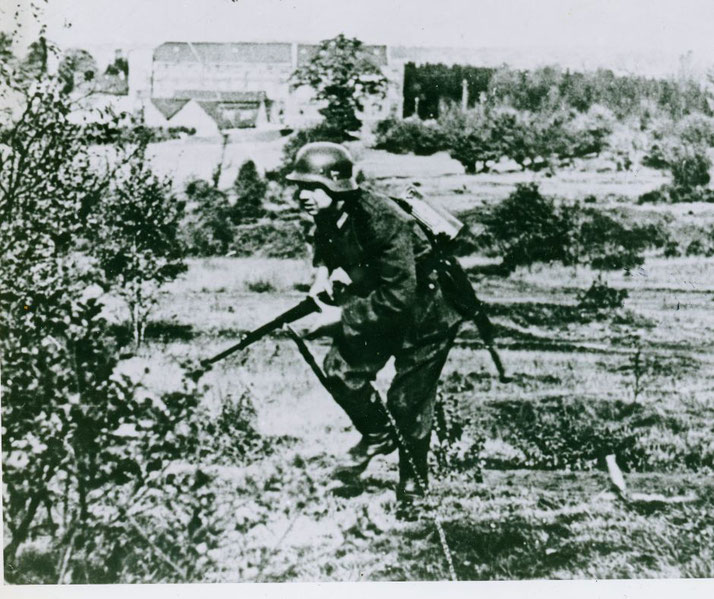
Before the Allies had time to respond, this second force moved towards the coast, which cut off the British and French forces from the rest of France.
The Allied army was now surrounded by the two German armies. The two Nazi invasion forces now moved towards the Allies from both directions. Their aim was to surround them and force them to surrender. This was called a 'pincer movement'.
The Allied troops continued to withdraw from the two enemy armies and tried to make their way to the coastline. They hoped that ships would evacuate some men before surrender became unavoidable.
By the 26th of May, all the key French and Belgian ports had been captured by the Germans, including Calais, except for Dunkirk.
And that is where the Allied forces headed.
The Dunkirk evacuation
By the end of May 1940, most of the BEF and the French army had been trapped in and around Dunkirk.
They set up defensive positions to hold off the Germans for as long as possible, as they waited for some kind of evacuation by sea that could save a substantial number of men.
Back in Britain, there had been a series of sudden changes in government. On the same day that the Germans launched their invasion of France and the Low Countries, Winston Churchill had suddenly been appointed as the new Prime Minister of the United Kingdom.
Churchill immediately realised that the entire British and French armies were close to surrender, and he came up with a plan to save as many as possible before the situation collapsed.
It was called 'Operation Dynamo', and it would involve using every ship available to save as many soldiers as possible. It was to be coordinated by the Royal Navy's Vice-Admiral Bertram Ramsay.
The operation began on the night of the 26th of May, under heavy pressure. The army managed to fight off the German advance for nine days, which allowed a constant flow of ships to travel between Dunkirk and England. Each trip carried as many men to safety as possible.
As the evacuations continued, the defensive lines around Dunkirk gradually gave way, and the German forces moved closer to the beaches.
Royal Navy ships were used, and privately-owned transport craft and smaller civilian boats also volunteered for the task.
In total, over 900 ships took part in the operation, by some counts. German artillery and aircraft repeatedly attacked the men on the beach and the ships, but were unable to stop the evacuation, which continued.
By the evening of the 4th of June, 338,226 soldiers had been successfully evacuated to England.
Of these, 198,000 were British and 140,000 were French troops.
It was far more successful than Churchill had expected, and it meant that the Allied forces did not have to surrender to Germany at that stage.
Operation Dynamo is still the largest sea evacuation carried out under wartime conditions.
The evacuation meant that the Allied forces did not have to surrender, which also meant that there was no longer an Allied army in France to fight back against the German forces.
France was left undefended, which made a renewed defence far harder.
The painful decision to surrender to Hitler
After the capture of Dunkirk, the German Army moved south into France on the 6th of June 1940 with renewed momentum.
One army headed into north central and west central France. The other moved against the Maginot Line.
Prime Minister Paul Reynaud led the French government, and it was divided over whether to continue fighting or to seek a peace deal.
The situation quickly worsened for France, and options narrowed, which pushed leaders towards an armistice. As the German forces moved south, the fortresses that made up the Maginot Line gradually fell one by one.
On June 14, 1940, German forces marched into Paris, and the French capital fell without much resistance.
So, France formally surrendered to Hitler on the 22nd of June 1940, when it signed an armistice.
It was a crushing defeat for France in military and political terms. It had suffered approximately 90,000 deaths during the six-week campaign, and over 2 million French soldiers were taken prisoner by the Germans.
As a result of the armistice, France was allowed to keep control of the southern half of the country from the city of Vichy, which is why it is often known as the 'Vichy government'.
Marshal Philippe Pétain was appointed as Head of the French State of the new regime, which claimed to speak for the defeated country. It declared itself to be independent. In reality, it was a regime that collaborated under German influence.
This split left France divided. Germany held substantial control and influence over the country in practice.
After the surrender, French civilians and evacuated French forces continued to fight for their freedom until the end of the war in 1945.