
Settling Jamestown: The audacious start of America's first permanent English colony
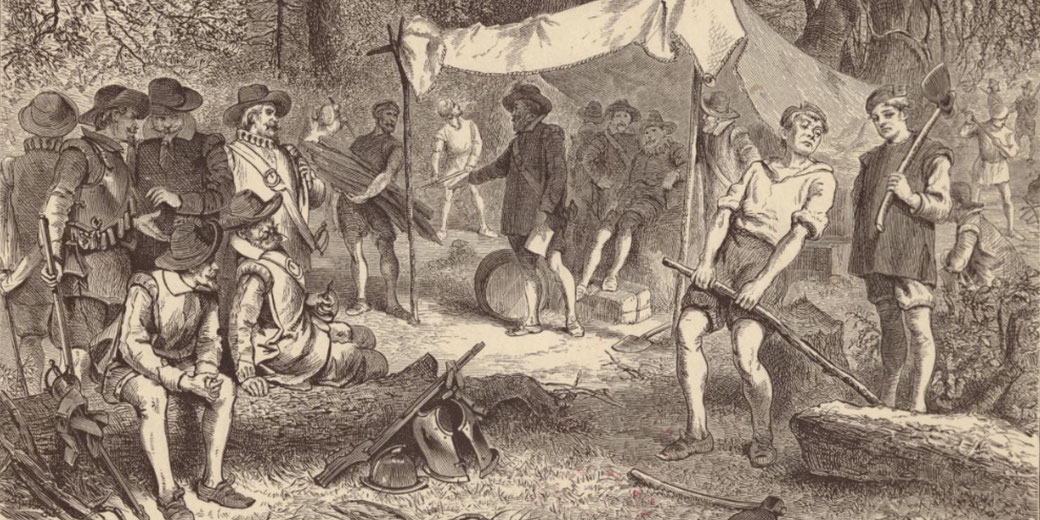
On 14 May 1607, a group of English settlers established a well-protected outpost on the muddy banks of a river they had named for their king.
They called it Jamestown, and though it would not be the first colony England attempted in North America, it would become the first to last.
Over time, they failed to find gold and struggled to survive, and they also came to rely unexpectedly on local Indigenous knowledge, which forced them to abandon many of their original goals as they built a settlement that would outlast repeated crises of disease and hunger as well as periods of open warfare.
The European race to colonise the Americas
At the turn of the seventeenth century, English leaders and investors became increasingly focused on the idea of building an empire, especially as Spanish wealth from the Americas flooded Europe.
After defeating the Spanish Armada in 1588, England had secured its naval strength and its control of important sea routes, but it still lacked colonies and the access to raw materials and markets that Spain had controlled for nearly a century.
Supporters of colonisation such as Richard Hakluyt insisted that expansion could enrich the crown and help to address domestic problems by offering land and opportunity to the growing numbers of poor and unemployed.
In his 1584 Discourse of Western Planting, Hakluyt urged Queen Elizabeth’s advisors to invest in overseas settlement as a moral and economic necessity.
England’s failed attempt to establish a colony at Roanoke between 1585 and 1590 had also provided hard lessons that shaped the planning for Jamestown.
In 1606, James I granted a charter that created two companies, the Virginia Company of London and the Virginia Company of Plymouth, with separate zones of operation in North America.
The London Company financed and directed the commercial venture that would become Jamestown.
Unlike state-run missions of empire, this expedition relied on private investment and promised high returns based on expectations of gold deposits, exotic trade goods, and a sea route to Asia.
The company organised its first expedition as a joint-stock enterprise, offering settlers shares in future profits.
Many among the first group of colonists were merchants and artisans, along with younger sons of gentry who had little experience with manual labour, but they still hoped to enrich themselves in Virginia.
Although the charter included language about converting Indigenous populations to Christianity, religious motives received little serious attention in the colony’s first years.
The establishment of Jamestown
After several months of preparation, three ships, the Susan Constant and the Godspeed, along with the smaller Discovery, departed London on 20 December 1606.
Their journey, which was slowed by seasonal winds and the need to resupply, followed a southern route past the Canary Islands and into the Caribbean before turning north.
On 26 April 1607, they anchored off the coast of present-day Virginia and spent the next two weeks scouting inland waterways.
Eventually, they sailed up a tidal river, which they named the James, and selected a site that was easy to defend, approximately 40 miles from the Chesapeake Bay.
Captain Christopher Newport, who commanded the voyage, oversaw the exploration and initial landfall.
The chosen site appeared ideal for defence, as it was surrounded on three sides by water and shielded from the open sea.
However, it lay on low, swampy ground where fresh water proved difficult to access, where the soil was poor for farming, and where disease-carrying mosquitoes bred in large numbers.
Around 104 male settlers disembarked and constructed a triangular palisade fort, naming their settlement Jamestown.
Initially, they found the environment strange and apparently resource-rich, but they quickly discovered that they had underestimated the challenges.
Their failure to plant enough crops, combined with poor sanitation and reliance on uncertain supply shipments from England, left them vulnerable to hunger and disease.
Permanently on the edge of starvation and death
Within just a few months of settling, the colonists faced the reality of starvation and contaminated water together with a range of widespread illnesses.
Many of them, who had arrived largely unprepared to farm, hunt, or fish, found that their dependence on limited imported food quickly proved that the situation could not last.
Under the Virginia Company’s communal labour system, colonists worked for the colony’s benefit rather than for individual profit, but this created confusion and anger, especially among those who felt entitled to leadership rather than toil.
As labour shortages worsened, men refused to perform basic survival tasks, and work levels collapsed.
By September 1607, around half the original settlers had died from dysentery, typhoid, and malnutrition.
For a time, trade with the Powhatan had provided essential food, but as demands increased and the colonists grew more aggressive, those exchanges broke down.
During the winter of 1609–1610, which colonists later described as the “Starving Time,” the population fell sharply.
Cut off from supply lines, unable to leave the fort for fear of attack, and with no crops to harvest, the settlers resorted to eating dogs, snakes, leather, and eventually corpses.
Contemporary reports stated that only about 60 colonists survived until spring, though modern estimates suggest the pre-winter population had already declined to about 300.
George Percy documented the terrible experience and described scenes of desperation and cannibalism in his journal.
In June 1610, the remaining survivors attempted to abandon the colony entirely, but were intercepted at the mouth of the James River by a newly arrived relief fleet.
Eventually, in May 1610, help arrived with the return of Lord De La Warr, who had been appointed as the new governor.
He brought supplies and fresh settlers, along with a new code of military discipline.
Under his direction, the remaining colonists rebuilt Jamestown’s defences, reorganised labour, and imposed stricter punishments for theft, desertion, and insubordination.
The colony began to stabilise, but survival continued to depend on rigid order and occasional supply shipments.
Relations with the Powhatan
At the time of English arrival, the region fell under the influence of the Powhatan Confederacy, a network of more than 30 Algonquian-speaking tribes ruled by Wahunsenacawh, whom the English referred to as Chief Powhatan.
His capital at Werowocomoco, which was situated along the York River, was the political centre of his alliance.
Initial contact involved formal greetings and cautious trade, along with occasional displays of power from both sides.
The English depended on the Powhatan for food, while Powhatan leaders remained curious about English tools and weapons.
Although trade helped both groups during early interactions, tensions soon replaced cooperation.
John Smith was one of the few settlers with experience in military service and diplomacy, and he became central to English relations with the Powhatan.
According to his later account, after Powhatan warriors had captured him in late 1607, he was spared execution by the chief’s daughter, Pocahontas.
While scholars have debated the story’s accuracy, the child did appear at Jamestown with gifts and messages during the early years of settlement.
She later became a public symbol of peace, though her actual role remained shaped by careful political decisions.
After the English had captured Pocahontas in 1613 during a raid led by Captain Samuel Argall, she was held as a hostage and encouraged to convert to Christianity.
She was baptised as Rebecca and married John Rolfe, a tobacco planter, in 1614.
That marriage, which Powhatan sanctioned, secured a temporary period of relative peace known as the “Peace of Pocahontas.”
Governor Sir Thomas Dale supported the match and promoted it in England as a political alliance.
Pocahontas died during a visit to England in 1617 and was buried at Gravesend.
However, her death did not resolve the underlying conflict. English expansion into Indigenous territory continued, and Powhatan resistance grew after Wahunsenacawh’s death in 1618.
His brother, Opechancanough, adopted a harder stance, preparing for war against the English settlers who had become permanent intruders.
Economic transformation and expansion
Beginning in 1612, John Rolfe introduced a strain of Nicotiana tabacum tobacco that had likely been obtained secretly from Spanish colonies in the Caribbean.
It grew well in Virginia’s soil and quickly found favour in English markets, at least from the perspective of many English consumers.
This agricultural breakthrough gave the colony its first reliable export product and transformed it from a failing outpost into a profitable venture.
By 1624, Virginians were exporting over 200,000 pounds of tobacco annually. By exporting cured tobacco in large quantities, the Virginia Company recovered some of its earlier losses and encouraged further migration to the colony.
As demand for tobacco rose, the need for labour and land intensified. The company expanded the system of indentured servitude, offering contracts to English men and women who agreed to work for five to seven years in exchange for passage.
Many of them died before completing their terms, but enough survived to support growing plantations.
In 1619, the arrival of around 20 Africans, who had been captured by Portuguese slavers and sold by a Dutch privateer, introduced a new source of labour.
These Africans had originally been taken from Ndongo in present-day Angola aboard the São João Bautista before being seized by English privateers.
The White Lion was one of the two ships that intercepted the vessel, and it brought them to Virginia.
Initially treated in a variety of ways, some similar to indentured workers, Africans soon faced legal restrictions that turned temporary servitude into permanent enslavement.
To encourage investment, the company also introduced the headright system, which promised 50 acres of land to any Englishman who paid for his own passage or that of another settler.
As wealthy planters used this policy to their advantage to accumulate land and workers, they displaced Powhatan villages, cleared forests, and built a plantation economy based on growing tobacco as almost the only crop.
Although Jamestown had survived its early trials, it now depended on forced labour and land seizure for continued growth.
Jamestown's legacy on American democracy
While the colony’s economy expanded, its political systems also began to change.
In July 1619, the Virginia Company established the General Assembly, which met at Jamestown and included representatives known as burgesses, elected by free male freemen.
John Pory was the appointed Speaker, and he led the session. This assembly made local laws and advised the governor, and it created the first formal structure for self-government in the English colonies.
Although voting remained restricted and the governor retained veto power, it laid a foundation for colonial legislative practices that would spread across British North America.
Nevertheless, Jamestown’s survival remained far from secure. On 22 March 1622, Opechancanough launched a carefully planned attack against English settlements along the James River, killing more than 300 colonists, nearly one-quarter of the English population in Virginia.
Though the English hit back with a violent campaign of revenge attacks, the attack exposed the fragile hold they maintained on the region.
As a result of the massacre, the Virginia Company’s poor management, and growing debts, James I cancelled the company’s charter in 1624 and made Virginia a royal colony.
Over the next several decades, Jamestown lost political importance, and after a fire in 1698 destroyed key buildings, colonial officials moved the capital to Williamsburg the following year.
By then, Jamestown had largely become a quiet outpost, its role as a power centre replaced by new towns and expanding plantations.
Its symbolic importance continued for later generations, and as the site of the first permanent English colony in North America, Jamestown became a place where English settlement, forced labour, Indigenous resistance, and representative government first came together.
In the 1990s, archaeologist William Kelso’s rediscovery of the original fort site further renewed scholarly interest in Jamestown’s early years and hardships.