
How Xanthippus of Sparta almost won the First Punic War for Carthage
During the winter of 256 BC, Carthage faced near ruin. After it had suffered consecutive defeats in North Africa, Carthage's armies had largely collapsed and its countryside lay exposed to Roman raiders as its political leaders dismissed one general after another.
To avert total defeat, they turned to a foreign military instructor named Xanthippus, a Spartan who had the one quality their previous leaders lacked: an understanding of how to counter Roman tactics using Carthage’s own strengths.
Within weeks, he rebuilt their army and devised a new strategy that allowed him to destroy a Roman invasion force that had seemed almost unstoppable.
Why Carthage was in crisis
At the midpoint of the First Punic War, Roman leaders decided to bypass the slow grind of the Sicilian campaign by striking directly at the Carthaginian homeland.
Early in 256 BC, they assembled a very large fleet of more than 330 warships and approximately 30,000 men, which included around 15,000 infantry and 500 cavalry.
All of them set sail under the joint command of Marcus Atilius Regulus and Lucius Manlius Vulso, who led the expedition.
After a major naval battle at Cape Ecnomus, in which roughly 680 ships clashed in one of the largest naval engagements in ancient history, the Romans cleared the waters of Carthaginian resistance and made landfall near the fortified town of Aspis on the North African coast.
Soon after they had established a base, the Romans launched aggressive raids across the countryside and captured local towns as they crushed a disorganised Carthaginian force at Adys.
Encouraged by the speed of their advance, Regulus pushed deeper inland and sent terms of surrender to Carthage, assuming that the war would soon be over.
At the same time, widespread panic spread within the Carthaginian government, which struggled to agree on a clear response.
While rival factions blamed each other for the defeats, several commanders were dismissed or executed.
As a final measure, the Carthaginian leadership granted authority to Xanthippus, a Spartan mercenary who had previously trained their cavalry but had never led an army in battle.
Who was Xanthippus?
Although hired only as an instructor, Xanthippus quickly earned the attention of many senior Carthaginians by pointing out tactical errors in their recent battles.
After he had witnessed the flawed deployments at Adys, he argued that Carthaginian commanders had failed to use their elephants and cavalry to their full advantage.
Trained in the strict military traditions of Lacedaemon, he recognised the value of well-organised formations and careful positioning on the battlefield.
Under strong pressure to recover lost ground, the Carthaginian Senate placed him in charge of almost all available forces and gave him freedom to reform the army as he saw fit.
Without delay, he reshaped the army into a much more effective fighting force. He distributed up to 100 elephants across the front line, where they could break up Roman formations, and he restructured the infantry into a Greek-style phalanx as he drilled the Numidian cavalry in coordinated flanking manoeuvres.
The Numidians were highly skilled light horsemen from the interior of North Africa who excelled at fast-moving skirmishes and could harass enemy lines with javelins before retreating at speed.
Crucially, Xanthippus chose a battlefield near the Bagradas River where the terrain suited speed and open fighting.
While Roman commanders preferred narrow and uneven ground to protect their flanks, the level plain near the river would allow Xanthippus to deploy his cavalry and elephants to full effect.
The Battle of Bagradas River
By the time Regulus accepted battle, he had very little awareness of how much the Carthaginian army had improved.
Although his infantry still outnumbered that of Carthage, he had lost much of his cavalry during earlier campaigns, and he underestimated the size and training of the enemy force now marching against him.
He placed his legions in the centre and positioned the small cavalry force that remained on the wings, expecting a direct infantry battle in the Roman style.
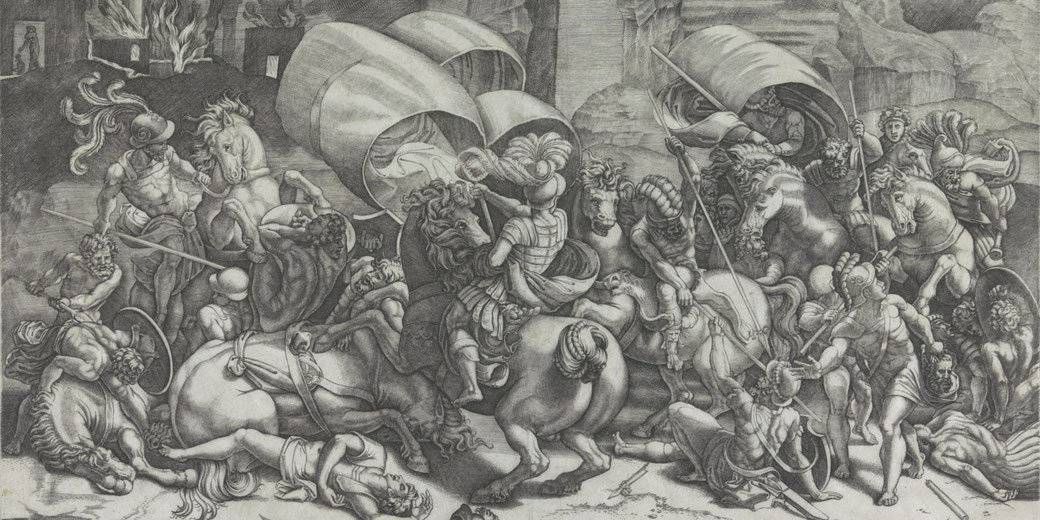
At dawn, Xanthippus opened the battle with an elephant charge that tore into the Roman front lines and broke their order before the legionaries could engage properly.
Meanwhile, Numidian horsemen swept around the Roman flanks and drove off the cavalry as they cut off any chance of retreat.
As the elephants continued to cause disorder, the Carthaginian infantry advanced in close formation.
Caught between heavy infantry and encircling cavalry, with rampaging elephants adding further chaos, the Romans could not hold.
Polybius was a Greek historian of the second century BC who consulted Roman sources, and according to him, more than 12,000 were killed and another 500 captured, including Regulus himself.
When he delivered such a crushing defeat, Xanthippus ended Rome’s African campaign in a single afternoon.
He restored Carthaginian confidence and proved that Rome’s battlefield methods could be countered with discipline and preparation, and from that moment the war’s direction changed.
The surprising reason Xanthippus was then dismissed by Carthage
In the weeks after the battle, Carthage, which had faced near ruin only months earlier, gradually reclaimed territory and resecured its borders as it refortified vulnerable towns.
At Rome, the Senate reacted by giving up any further plans for conquest in Africa.
Roman focus returned to Sicily, where the conflict settled once again into a series of slow and costly sieges.
The Romans also began to rebuild their fleet, which had suffered terrible losses during storms that came after the withdrawal from Africa in 255 BC, and later victories such as the Battle of the Aegates Islands in 241 BC would eventually bring the war to a close.
The immediate threat of a final defeat had passed, and Carthage owed that period of relief entirely to Xanthippus.
Despite his success, he did not remain for long in Carthaginian service. Some ancient accounts suggest that political factions feared his growing popularity and influence, while others claim that he departed willingly once his work was complete.
According to some Roman traditions, Regulus was eventually returned to Rome in a prisoner exchange and then sent back to Carthage, where he was allegedly tortured and executed, a story many historians view as Roman propaganda.
Regardless of the reason, Xanthippus sailed for Greece shortly after the campaign, and he was not mentioned again by any reliable contemporary sources that have survived.
Later writers had often guessed about his fate and had told stories of execution or shipwreck, but none were based on first-hand evidence, and his departure left a gap that no later Carthaginian commander managed to fill.
As the war dragged on, Carthage largely went back to older ways of military command, where noble families and political supporters often selected generals with little battlefield skill.
Without Xanthippus to guide the Carthaginians, their forces failed to repeat anything like the success at Bagradas.
The war would continue for another fifteen years, during which Rome’s persistence gradually and steadily wore Carthage down.