
Ancient Greece's most famous oracle: The Oracle of Delphi
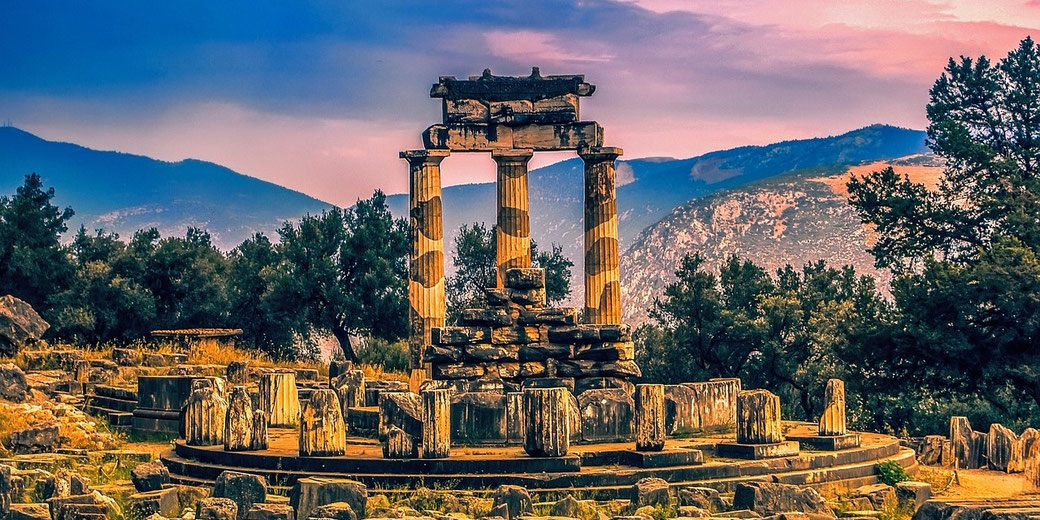
On the southern slopes of Mount Parnassus, near a fault line above the Gulf of Corinth, the ancient sanctuary of Delphi attracted attention across much of the Mediterranean world.
From the eighth century BCE, Greek poleis sent official embassies and sacred envoys who carried costly offerings so they could seek answers from the Pythia, the priestess who claimed to speak for Apollo.
Her responses were often puzzling and open to interpretation, and they influenced decisions about war, colonisation, and religious law across hundreds of city-states for over a millennium.
What was the Oracle of Delphi?
According to Greek religious tradition, Zeus released two eagles from the edges of the world, and they met at Delphi, which identified it as the omphalos, the centre of the earth.
A carved stone omphalos that symbolised this event is still kept in the museum at Delphi.
Earlier myths identified the site as sacred to Gaia, the earth goddess, and described how Apollo took control of it by killing the monstrous Python.
This myth explained the sanctuary’s transfer to Olympian control and established Apollo’s association with prophecy.
Archaeological finds provide evidence for habitation and religious activity at the site from at least the 14th century BCE, during the Mycenaean period, though the prophetic role that people later linked to Apollo appeared much later.
By the eighth century BCE, Delphi had attracted the interest of Greek poleis, and religious activity had become more organised.
The Amphictyonic League was a council of central Greek tribes that had earlier associations with the sanctuary of Demeter at Anthela, and it took charge of running the sanctuary and developed Delphi into a pan-Hellenic centre.
They coordinated major building projects and supervised rituals, and the council also managed disputes that involved access and offerings.
Over time, the sanctuary’s influence gradually spread outside the borders of Phocis.
Cities such as Corinth and Athens, along with Sparta, sent dedications and built treasuries along the Sacred Way to secure favour and assert their presence among rivals.
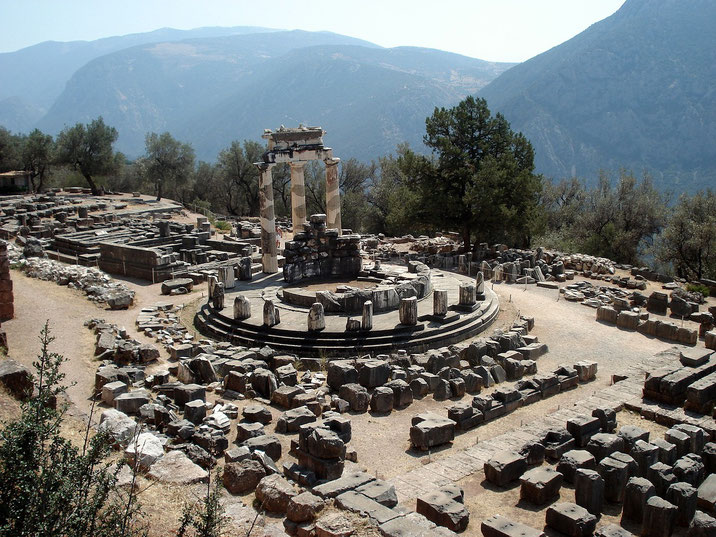
More than twenty city-states constructed treasuries there, including the Siphnian treasury and dedications from other regions, and each treasury was decorated with distinctive design details and inscriptions.
The power of the Pythia
At the core of much of the Delphic experience stood the Pythia, a woman who, after ritual purification, entered a trance to deliver oracular statements believed to originate from Apollo.
Some ancient accounts describe how she sat on a bronze tripod within the Temple of Apollo, inhaling vapours and speaking in inspired speech.
Although ancient sources did not explicitly mention a chasm, some modern geological studies, such as those by de Boer and Hale, together with Spiller, suggest that ethylene or hydrocarbon gases that rose from fault lines may have contributed to her altered state.
Her words, which were often delivered as fragments or as words that were hard to understand, were interpreted by temple priests, who shaped them into verses or official answers.
Usually, consultations followed a fairly set process. Petitioners had to purify themselves and offer a sacrifice, and then they submitted their question to temple officials who worked at Delphi.
After she entered her trance state, the Pythia would respond in a manner that left room for multiple meanings.
In many cases, the priests helped decide the final wording of the oracle’s reply, so it still allowed for uncertainty.
For example, when King Croesus of Lydia asked whether he should attack the Persians, the oracle replied that if he did, he would destroy a great empire.
Croesus launched his campaign with confidence, unaware that the empire she referred to would be his own.
Religious authority and political weight
Over time, the sanctuary’s authority rested on its religious importance and on its ability to influence political decisions.
Before launching colonies or engaging in war, Greek poleis often consulted the oracle to secure the gods' approval.
The Delphic oracle advised several major colonial projects, including the foundation of Cyrene in Libya, where settlers hoped to secure the gods' approval for their new settlement.
For instance, when Athens faced the threat of a Persian invasion in 480 BCE, its leaders received a puzzling warning about destruction and salvation behind “wooden walls.”
Themistocles persuaded the city to interpret this as a reference to its fleet, and the decision to rely on naval strength led directly to victory at Salamis.
In many cases, cities competed for recognition when they constructed impressive treasuries, and each treasury was filled with votive offerings and decorative details that showed wealth and religious devotion.
The Treasury of the Athenians had probably been constructed after the Battle of Marathon and included inscriptions and sculptures that reinforced the city’s claim to support from Apollo.
By locating these monuments within the sanctuary, poleis reinforced their political reputation while appealing to Apollo’s favour.
Occasionally, the oracle became drawn into disputes between different city-states.
Leaders sought rulings that could defend their decisions or weaken rivals, and Delphic decisions could influence public opinion or even help start wars.
Since the Amphictyonic League guarded the sanctuary’s independence, it sometimes used military force to punish those who interfered with the site.
The so-called Sacred Wars were fought between the seventh and fourth centuries BCE and began as conflicts over access to Delphi’s resources and escalated into large-scale campaigns.
The First Sacred War occurred around 595–585 BCE, while subsequent conflicts, the Second in 449–448 BCE, the Third from 356 to 346 BCE, and the Fourth in 339–338 BCE, saw increasing involvement from major powers such as Thebes and Macedon.
Decline under the Roman Empire
After the rise of Macedon and later the Roman conquest of Greece, Delphi’s influence gradually declined.
Macedonian kings such as Philip II used the sanctuary to show their power across the Greek world, and Roman emperors took similar interest in its symbolic importance.
Hadrian funded repairs and renewed festivals, while Nero removed hundreds of statues during his visit.
By the second century CE, oracles were given less often, but elite Romans continued to visit, and Plutarch had worked as a priest at Delphi for many years and described its rites and procedures in detail.
He also wrote The Obsolescence of Oracles, a work that reflected on the declining power of prophecy.
Eventually, the growth of Christianity under imperial support helped traditional cults fade away.
In 394 CE, Theodosius I issued orders that banned pagan rituals, and Delphi’s sanctuary lost its legal protection.
Without its priests and patrons, and without the annual games, the site deteriorated.
Earthquakes damaged the Temple of Apollo, and local villagers repurposed the stone for houses and barns, as well as village churches.
Delphi was once one of the most influential oracles in the ancient world and disappeared from public life.
Centuries later, interest revived, and during the 1890s the French School at Athens began careful archaeological digs that uncovered temples, treasuries, inscriptions, and artefacts that supported the accounts of ancient authors.
Foundations of buildings matched descriptions found in Pausanias, who visited the site in the second century CE and left a detailed record of its structures in his Description of Greece.
Records of oracular consultations can show how Delphi’s advice influenced decisions from Sicily to Syria.
Cultural memory
Although Delphi no longer influences foreign policy or religious life, its influence still has a place in the historical memory of Greece and the wider Western world.
Ancient dramatists such as Aeschylus and Sophocles worked Delphic pronouncements into their tragedies, and they used them to explore human folly and fate, and also the limits of knowledge.
Many philosophers cited the Delphic maxim gnōthi seauton, meaning “know thyself”, as the foundation of self-examination and questions about right and wrong, especially within the schools of Socrates and Plato.
This phrase appeared among 147 maxims traditionally attributed to the Seven Sages of Greece and inscribed at the Temple of Apollo.
Today, many visitors walk among the ruins to think about a place where human decisions once balanced on a priestess’s puzzling words, rather than to ask questions of the gods.
Delphi’s influence did not rely on the clarity of its answers, because its power lay in the obligation it placed on individuals and cities to interpret those answers carefully, to weigh their options with caution, and to act with full awareness of judgement from the gods.
Through that demand, it influenced religion and politics, and it also guided the Greek understanding of choice and consequence, as well as responsibility.