
Was Marcus Aurelius, the 'philosopher emperor', the greatest ruler in Roman history?
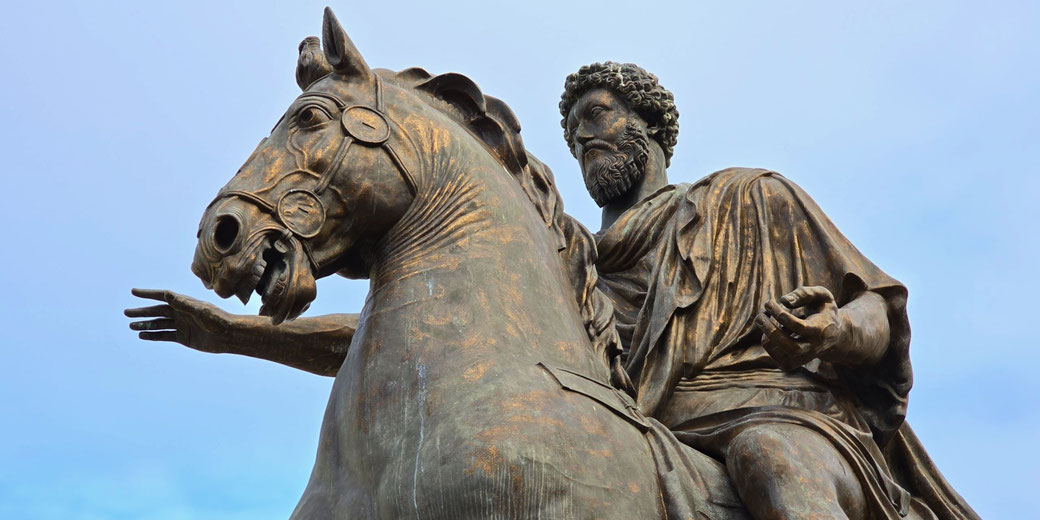
During the brutal wars along the Danube frontier, as soldiers died from wounds and from a disease that wiped out whole legions, Marcus Aurelius wrote about justice and restraint, as he constantly noted the shortness of life in his private diaries.
At a time when emperors often pursued glory through conquest or cruelty, he largely directed his thoughts inward and ruled by a philosophy that valued self-control more than victory.
In one passage, recorded in Book II of the Meditations and possibly written during his time at Carnuntum, he urged himself to avoid wasting life on the actions of others, writing, "Do not waste what remains of your life in speculating about your neighbours."
How Marcus Aurelius became emperor
Marcus, who was born on 26 April 121 AD as Marcus Annius Verus to the powerful Annii Verus family, entered the world already connected to the highest levels of Roman aristocracy.
After his father’s death, his grandfather, who was a respected senator, became his guardian and made sure Marcus received formal lessons in literature and rhetoric, during which he received structured teaching in philosophy from some of the leading tutors in the capital.
Eventually, his quiet diligence and natural seriousness had impressed Emperor Hadrian, who had initially chosen Lucius Aelius as heir before turning to Antoninus Pius after Aelius’ early death.
In AD 138, Hadrian adopted Antoninus Pius, who was then instructed to adopt Marcus along with Lucius Verus (born Lucius Ceionius Commodus).
This arrangement helped ensure a transfer of power across generations. As a result, Marcus had been prepared for high office throughout Antoninus’ long reign, and he acquired direct experience in law and finance as he took on administrative duties that taught him about imperial government.
Over the next two decades, he held increasingly senior positions, including quaestor, consul, and princeps iuventutis, a ceremonial title that showed his status as heir-apparent and future leader of Roman youth.
He had frequently appeared alongside Antoninus in public ceremonies and had attended Senate meetings as an observer.
When Antoninus died in AD 161, Marcus was expected to rule alone. Instead, he insisted that Lucius Verus be granted co-imperial authority.
That decision, presented as a gesture of equality, showed his preference for consensus and shared responsibility during a period of emerging crisis.
The horrific outbreak of the Antonine Plague
Soon after Marcus and Lucius began their joint rule, disaster struck the empire in the form of a deadly epidemic.
The Antonine Plague probably arrived with Roman troops who had returned from campaigns in Parthia and spread rapidly across urban centres and military camps.
Ancient writers, including the physician Galen, described symptoms that match smallpox: high fever, skin eruptions, and long periods of physical weakness.
For over a decade, from AD 165 to roughly AD 180, the disease swept through the population.
Estimates suggest the death toll may have reached 5 to 10 million people, although modern scholars caution that such numbers are uncertain.
Some towns reported entire households wiped out within days. In the provinces, farming communities collapsed as field labourers died in large numbers.
Grain shipments from Egypt slowed, trade routes narrowed, and inflation weakened coinage as the state struggled to maintain revenue.
During this crisis, Marcus remained visible and active as he issued public statements that reinforced the importance of discipline, not fear, and he continued to lead military operations rather than retreat to the capital.
He could not fully prevent the spread of disease, but he kept public confidence as he maintained government services, supplied armies in the field, and ensured that grain reached the capital.
On coinage and imperial art, he promoted an image of stable rule and used symbols associated with care and health to reassure a shaken population.
How did his Stoic philosophy help him?
Throughout his adult life, Marcus Aurelius practised Stoicism as a code of conduct rather than as an intellectual exercise.
As a young man, he studied under Junius Rusticus, who introduced him to the teachings of Epictetus and likely encouraged his reading of earlier Stoic thinkers such as Zeno and Seneca.
Under Rusticus’ influence, Marcus had developed a habit of daily reflection, which eventually resulted in the personal writings now known as Meditations.
There, he reminded himself that anger leads to irrational judgment, that fate governs events outside human control, and that rulers should remain mindful of the shortness of life.
Since Stoic ethics taught that virtue meant living by reason and accepting one's place in the world, he approached imperial responsibility as a moral burden, not a privilege.
Even in illness and grief, he maintained an internal composure that was shaped by constant self-reminders about the shortness of life and his duties.
He chose to write Meditations in Greek, not Latin, a deliberate intellectual act that reinforced his commitment to philosophical thought.
Publicly, he governed with a clear preference for fairness and moderation, and he insisted that officials practise careful thought.
He avoided major building projects, refused to execute senators without trial, and punished corruption within his own ranks.
At times, his mercy drew criticism, especially from those who expected harsher responses to treason or bad management.
However, he viewed cruelty as a failure of reason, not a tool of control. He expected his magistrates to uphold justice without unnecessary violence, and he believed that his duty lay in example, not performance.
How successful was he as emperor?
By the standard of imperial Rome, success often meant expansion, shows of wealth, or fear.
Marcus Aurelius, instead, achieved continuity in the face of disintegration. From AD 161 to 180, his reign endured multiple wars, a lethal plague, financial strain, and a sharp fall in population.
Yet under his leadership, the state survived intact, and key frontiers remained defended.
The main threat came from the north. Germanic tribes, including the Marcomanni, Quadi, and Sarmatians, pushed aggressively into Pannonia and Raetia, raiding towns and pressing against Roman defences.
Marcus responded by organising a series of campaigns, known collectively as the Marcomannic Wars, that took him away from Rome for over a decade.
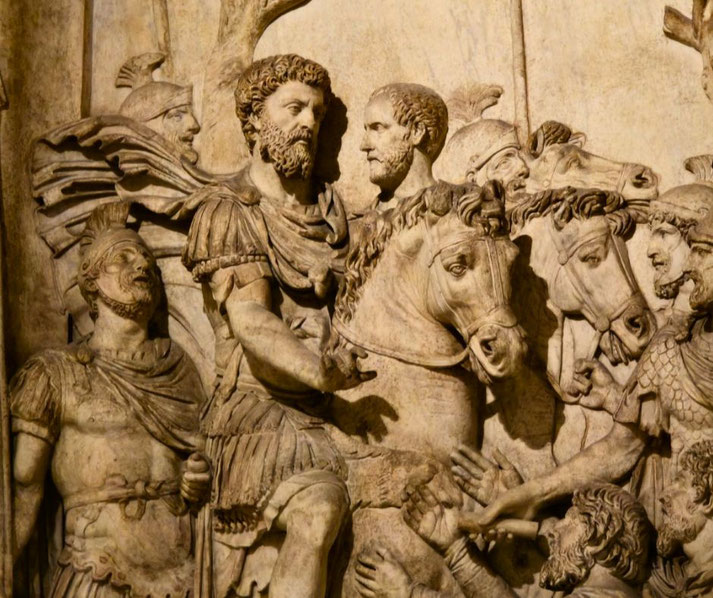
He lived in military camps, travelled with the legions, and met enemy leaders in both battle and negotiation.
As he oversaw these operations, he also reorganised the Danube frontier and established new bases, roads, and supply lines.
He allowed recruitment from non-traditional sources when necessary, including gladiators, freedmen, and slaves, particularly as the legions had been severely weakened by plague.
Meanwhile, he worked with provincial governors such as Claudius Pompeianus to bring order to local populations and apply Roman law in contested regions.
The pressure of war never allowed for total victory, yet by the end of his life, the invasions had largely been contained and Rome’s northern provinces remained within imperial control.
Domestically, he passed legal reforms to clarify guardianship rights, adjust inheritance laws, and place limits on cruelty toward slaves.
He gave more power to city councils where possible, simplified tax collection, and avoided unnecessary displays of imperial wealth.
In many decisions, he measured outcomes by principle rather than by popularity, and he applied his Stoic ideals to the management of public institutions.
What we know about his personal life
Although Marcus lived most of his reign in military camps, his private letters and surviving inscriptions show the emotional weight he carried in his family life.
He married Faustina the Younger, who was the daughter of Antoninus Pius, in AD 145, and their marriage produced at least thirteen children, tragically only a few survived into adulthood, including Commodus and Lucilla.
The death of so many children affected him deeply, and references in his Meditations suggest that he wrestled with sorrow without losing his sense of purpose.
Faustina accompanied him on campaigns and received numerous honours during her lifetime, including public statues and the title Mater Castrorum.
After her death in AD 175, Marcus arranged her deification and established a charitable foundation, which he called the Puellae Faustinianae, to support the education and dowries of young girls across the empire.
Rumours about her faithfulness circulated among Rome’s political class, but Marcus ignored them, either because he rejected them outright or because he considered them irrelevant to his other responsibilities.
Privately, he lived with restraint, and he ate plain food, wore simple clothing, and maintained a lifestyle that avoided extravagance.
He read philosophy, he issued legal correspondence, and he wrote his reflections by lamplight.
His personal staff respected him for his discipline rather than fear. He corresponded with tutors about his surviving children, whom he tried to prepare for adulthood by example, not command.
Marcus Aurelius' death and the problem of succession
By March AD 180, after nearly two decades on the throne, Marcus fell ill and died at Vindobona, near the Danube frontier.
He had spent the last years of his life, during which he stabilised the northern provinces, drafted new military settlements, and made preparations for a campaign season that he would not live to see.
At his death, power passed directly to his biological son, Commodus.
That decision, more than any other, has raised criticism about Marcus’ record.
Commodus, already elevated to co-emperor in AD 177, had demonstrated neither political judgment nor philosophical discipline.
Once in full control, he abandoned his father’s administrative reforms, focused on spectacle and court intrigue, and alienated both Senate and army.
His rule contributed significantly to the conditions that led to the imperial crisis of the third century, which most historians date from the assassination of Severus Alexander in AD 235.
He was assassinated in AD 192.
Why Marcus chose him remains unclear. He may have believed that formal adoption posed political risks, or he may have hoped that close advisors could control Commodus after his death.
Regardless of motive, the result proved disastrous. Ancient historians such as Cassius Dio and Herodian criticised the transition, and the Senate declared Marcus a god after his death.
While it continued to recognise Commodus as emperor until his assassination, many senators later attempted to distance the memory of Marcus from that of his son.
Stability gave way to mistrust, and the work of his reign quickly fell apart. His one departure from Stoic clarity, the choice to prioritise blood over merit, left the empire vulnerable to the very instability he had resisted for so long.