
The Lighthouse of Alexandria: an ancient engineering marvel

On the island of Pharos, off the coast of Alexandria in Egypt, a remarkable tower rose in the 3rd century BCE. Designed to guide sailors into one of the busiest harbours in the ancient world, the lighthouse became a representation of practical skill and invention.
Its fame lasted for centuries as one of the Seven Wonders of the Ancient World.
What was the Lighthouse of Alexandria?
The Pharos of Alexandria stood on a small island that had been joined to the mainland by an artificial causeway called the Heptastadion.
This large engineering project, which helped enclose the eastern harbour, also altered the shoreline and contributed to long-term silting of the area.
The city of Alexandria had been founded in 331 BCE by Alexander the Great, and it rapidly grew into an important centre of trade and learning.
The construction of the lighthouse likely enhanced both its practical maritime importance, since ships approaching the harbour often required a fixed point of navigation due to sandbars and shifting coastal terrain.
Ptolemy I Soter, who was one of Alexander’s former generals and the founder of the Ptolemaic dynasty in Egypt, had begun the project late in his reign.
After Ptolemy I had died, Ptolemy II Philadelphus took up the project and hired the Greek architect Sostratus of Cnidus to design and supervise its construction.
Sostratus, who also acted as a diplomat and royal adviser, had close ties to the court and likely drew on earlier Greek work on optics and building design.
According to later accounts by Strabo and Pliny the Elder, the tower reached a height estimated between 100 and 110 metres, though some exaggerated later sources claimed it rose as high as 130 metres.
That made it the tallest structure in Alexandria and the second tallest man-made structure in the world, after the Great Pyramid of Giza.
Later sources estimated the total cost of the lighthouse at around 800 talents of silver, an enormous sum equivalent to many thousands of kilograms of precious metal, though no primary record of the expenditure survives.
As Alexandria’s population and commercial activity expanded, so too did the importance of the lighthouse.
From an early point in its history, the tower gained fame across the Mediterranean, as sailors recognised it as a fixed marker that could be seen from many kilometres away, both by day and by night.
Hellenistic rulers used architecture to show their power and stability. Therefore, the lighthouse fulfilled a political purpose and also provided a real service to merchants, sailors, and naval commanders who depended on safe access to the harbour.
Over time, its architectural style became the model for similar towers built by the Romans and later by Islamic builders.
Roman engineers, for instance, incorporated elements of its design in later towers, such as the surviving lighthouse at La Coruña in Spain, known as the Tower of Hercules.
Its construction
Construction had likely begun around 280 BCE and continued for more than a decade, probably finishing around 247 BCE during the reign of Ptolemy II.
Workers had cut and assembled large limestone blocks that had been quarried from nearby regions.
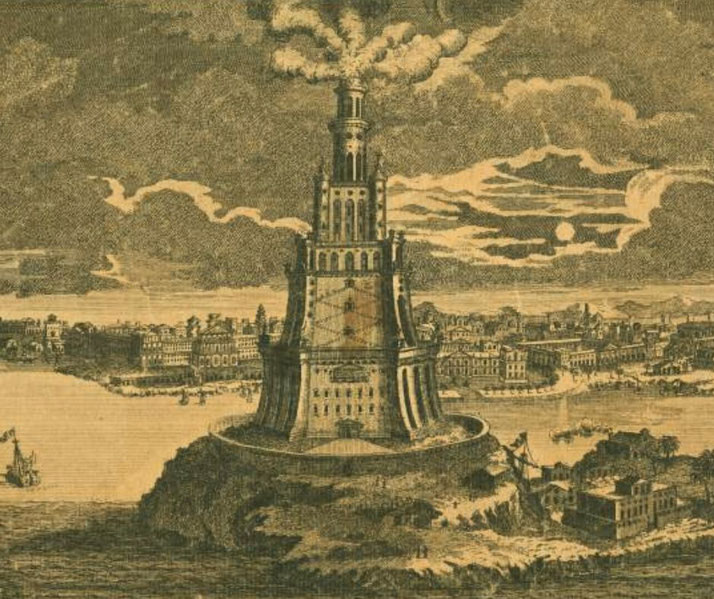
The completed tower stood on a rectangular platform fortified against the sea, and its layout followed a tiered design that rose in three separate stages: first a square base, then an octagonal midsection, and finally a cylindrical column topped with a beacon chamber.
Modern reconstructions suggest the base rose to about 60 metres, the midsection added another 30, and the cylindrical beacon contributed an additional 15 to 20 metres.
Inside the tower, a ramp or stairway allowed workers to carry fuel, possibly wood or oil, to the beacon chamber.
During daylight, large polished metal mirrors, probably bronze, reflected sunlight across the sea, although no archaeological remains of these devices have been found.
At night, a large fire acted as a constant signal. Arab geographers wrote that the beam could be seen from up to 50 kilometres offshore under ideal conditions, but modern scholars judged a more realistic visibility range of about 30 to 50 kilometres depending on the tower’s height and the weather.
Sostratus reportedly inscribed his own name onto the foundation in dedication “to the gods, for the safety of those at sea.”
According to one version of the story, Ptolemy II insisted that the inscription bear his name instead, and Sostratus cleverly concealed his own under a plaster layer that eventually wore away.
Because Alexandria lies near the Hellenic Arc, a tectonic zone where the African and Eurasian plates interact, some modern theories suggest that lead may have been poured between blocks in certain joints to cushion the tower against earthquakes.
Earthquakes posed a constant threat in the eastern Mediterranean. As a result, this added reinforcement may have helped prevent collapse and prolonged the lighthouse’s functional life.
Builders selected materials that could resist both coastal erosion and periodic flooding.
The base rested on wide foundations that distributed weight evenly and reduced the risk of sinking in the sandy soil beneath the island.
An engineering marvel
No other lighthouse of the ancient world matched the Pharos for scale and effectiveness, and the tower stood for over 1,500 years.
Engineers and architects during the Islamic Golden Age studied accounts of the lighthouse.
In fact, several described mechanisms that amplified the light beam across the sea, well before the invention of optical lenses.
Some tales even suggested that the Pharos employed a giant lens or mirror capable of burning enemy ships, a medieval legend that originated in Arabic sources and shows the awe the structure inspired rather than any proven historical mechanism.
Alongside the Library and the Museum, the Pharos symbolised the Ptolemaic kingdom’s wealth and power in the eastern Mediterranean.
Travellers wrote about the structure over many generations. For example, Ibn Battuta visited Alexandria in the 14th century and described the lighthouse as awe-inspiring, though partially ruined.
Earlier writers such as Josephus and Lucian also referred to the Pharos in their accounts.
Later societies adapted the tower’s design to suit their own needs. Roman engineers built towers in Ostia and other coastal cities based on the Alexandrian model.
Its destruction
A powerful earthquake had struck Alexandria in 956 CE, followed by another in 1303 that had caused severe structural damage.
A final quake in 1323 brought down much of what remained above ground.
Afterward, the tower no longer acted as a lighthouse. By contrast, only the base and foundation remained visible by the end of the 14th century.
In 1477, Sultan Qaitbay ordered the construction of a fortress on the site, and the project was completed two years later in 1479.
He reused stone from the ruins of the lighthouse to build what became the Citadel of Qaitbay.
The new fortress, which is still present today on the eastern harbour, sits on the original foundation of the Pharos.
Therefore, the site continued to act in a defensive role, even though the tower itself had vanished.
However, underwater archaeology in the 20th century renewed interest in the site.
Beginning in the 1990s, teams led by Jean-Yves Empereur had located and mapped hundreds of underwater stone blocks, statues, and columns on the seabed in Alexandria’s eastern harbour.
Many of the blocks likely came from the lighthouse or the surrounding structures.
Their size, shape, and material suggest that they once formed part of the base and façade of the tower.
Today, the site forms part of Egypt’s tentative list for UNESCO World Heritage recognition under underwater cultural heritage.