
What were the 7 Wonders of the World?
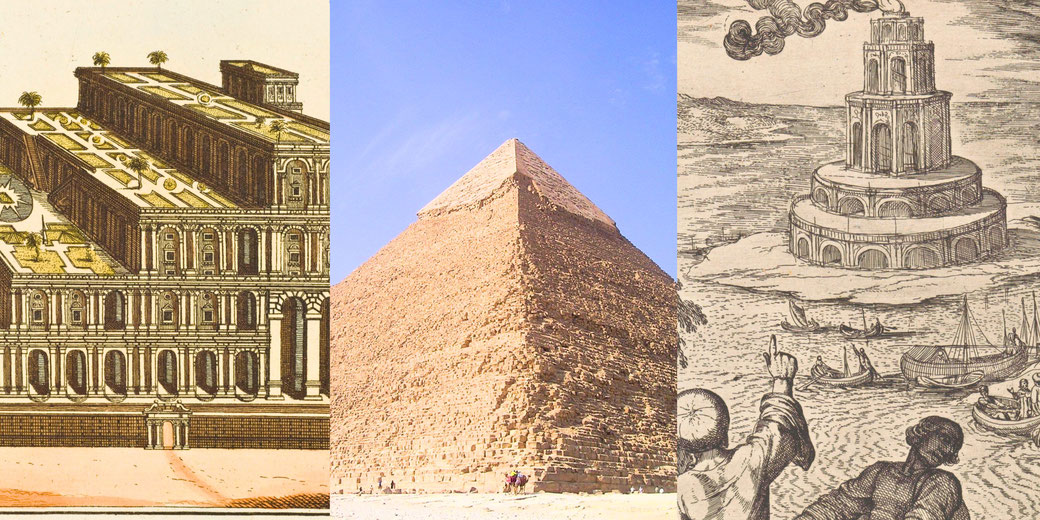
From the third to the first century BC, Greek writers identified seven structures that they believed were among the greatest works of architecture and artistic skill in the known world.
Drawn from regions that spanned Egypt and Mesopotamia as well as parts of Asia Minor, the list showed the geographic range of Hellenistic influence and the admiration Greeks held for monuments that showed very careful engineering and impressive religious splendour.
Although only one of the original wonders still survives today, ancient descriptions, combined with archaeological evidence and artistic reconstructions, have preserved their memory.
Who decided what was on the list?
Greek travellers and scholars, who were interested in the scale and clever design of non-Greek architecture, began documenting structures that they considered remarkable.
Herodotus wrote in the fifth century BC and commented on Egyptian temples and Mesopotamian palaces, but he did not compile a list.
Instead, later writers in the Hellenistic period developed systematic approaches to ranking what they saw as the world’s most impressive man-made achievements.
Importantly, the Hellenistic world had expanded following the conquests of Alexander the Great, allowing Greek authors to explore territories once closed to them.
At the Library of Alexandria, scholars such as Callimachus produced large catalogues of literature and geography.
The earliest preserved list comes from Antipater of Sidon in the second century BC, who included it in a poem that has survived from antiquity and that began, “I have gazed on the walls of lofty Babylon...” and concluded that nothing surpassed the Temple of Artemis at Ephesus.
Philo of Byzantium was a slightly earlier contemporary from the late third century BC and also authored a treatise titled On the Seven Wonders, although only later fragments survive.
Greek numerology placed special meaning on the number seven, which symbolised completeness and order.
For that reason, the authors limited their selection to seven sites, even though they were aware of other significant structures.
Their choices showed a fascination with symmetry and proportion, together with an interest in architectural innovation, rather than age or religious importance, and they focused on monuments that inspired admiration for their technical complexity or artistic scale.
In Greek, the term used for the list was "theamata," which meant "things to be seen," and this term stressed their visual and artistic qualities rather than miraculous properties.
1. The Great Pyramid of Giza
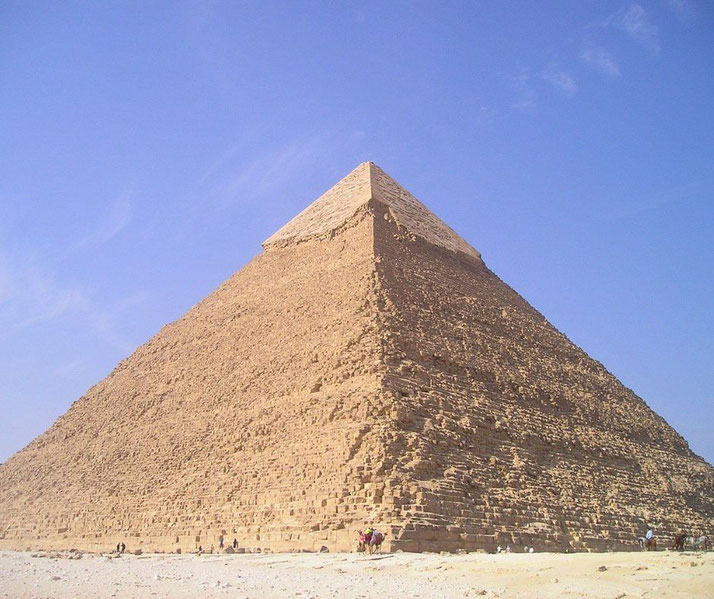
Originally constructed as the tomb of Pharaoh Khufu around 2560 BC, the Great Pyramid of Giza dominated the western Nile floodplain near the ancient city of Memphis and later Cairo.
It formed the centrepiece of a larger funerary complex that included mortuary temples and subsidiary pyramids for queens, with long causeways that linked the pyramid to ceremonial harbours on the river.
The pyramid measured over 230 metres on each side at the base and originally reached a height of approximately 146.5 metres, and it remained the tallest man-made structure in the world for over 3,800 years.
Crucially, the construction relied on local limestone, transported using sledges and barges, and granite from Aswan, which lay hundreds of kilometres upstream.
Labourers arranged over two million stone blocks with copper tools and wooden levers, together with ramps designed to move material up the structure as it rose higher.
The estimated workforce may have included 20,000 to 30,000 seasonal labourers.
The internal chambers featured polished granite beams placed with extraordinary care, and the structure aligned precisely with the cardinal points.
By the time Greek travellers visited Egypt, the pyramid had already stood for two millennia and appeared ancient even to them.
As the only one of the original wonders to survive into the modern era, it benefited from durable construction methods and arid conditions, along with the continued respect of successive rulers who regarded it as a source of national pride or religious significance.
Later caliphs and sultans had allowed stone to be stripped from the casing but had left the core intact, a decision which allowed archaeologists to study its structure in detail.
The original white Tura limestone casing, now missing, would have made the pyramid gleam brightly in the sun.
2. The Hanging Gardens of Babylon
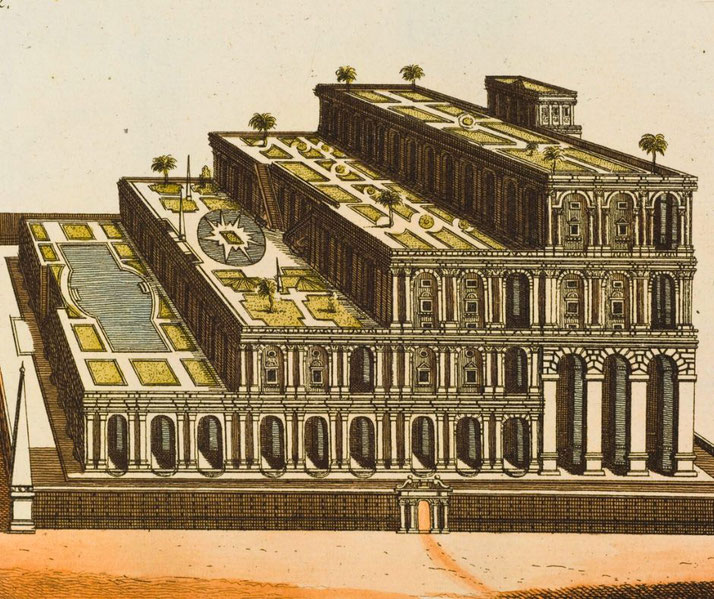
According to Greek and Roman accounts, the Hanging Gardens supposedly rose above the flat plains of Babylon and resembled a mountain covered in greenery, with trees and shrubs arranged on a series of terraced platforms, along with flowering plants that completed the effect.
Writers claimed that King Nebuchadnezzar II ordered their construction in the sixth century BC to comfort his wife, Amytis of Media, who longed for the forested hills of her homeland.
The structure supposedly relied on vaulted stone foundations and waterproofed walkways, supported by advanced irrigation systems that lifted water from the Euphrates to nourish the plants above.
Ancient authors such as Strabo and Diodorus Siculus described mechanisms that used chain pumps and screw devices, operated by slaves or engineers, which carried water upwards along concealed shafts.
However, these descriptions reflect later interpretations and may not correspond to historical reality.
Significantly, they noted the technical challenge of supporting soil deep enough for full-grown trees and praised the balance of artifice and nature that was required to keep the gardens alive in a desert climate.
The concept echoed engineering achievements attributed to the Assyrian king Sennacherib at Nineveh, who described terraced gardens and aqueduct-fed irrigation systems in seventh-century BC inscriptions.
Today, archaeological work has not confirmed the existence of the gardens at Babylon, although tablets and foundations linked to Nebuchadnezzar’s palace have been found near Hillah, Iraq.
Some historians propose that the Greek sources may have confused Babylon with Nineveh, where Sennacherib's well-documented gardens more closely match the descriptions.
Regardless of the location, the idea of a man-made paradise suspended above the earth remained appealing enough to keep its place among the wonders.
3. The Statue of Zeus at Olympia
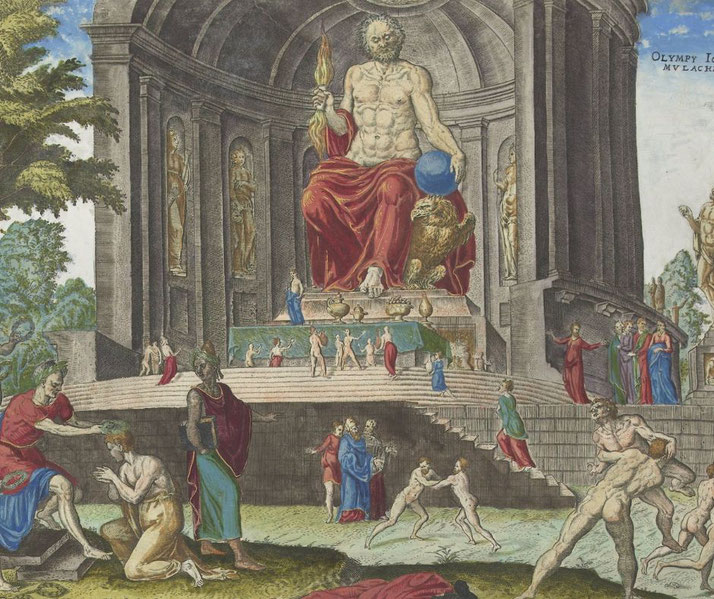
Commissioned around 435 BC and crafted by the famous sculptor Phidias, the Statue of Zeus once stood within the Temple of Zeus at Olympia, the sanctuary that hosted the Olympic Games.
Phidias used a wooden frame overlaid with ivory and gold to create a chryselephantine image of the god, who sat on a grand throne and held a sceptre and a figure of Nike.
Measuring over 12 metres in height, the statue occupied nearly the entire interior of the temple and gave visitors the impression that the god might rise and break through the roof.
Ancient sources commented on the emotion the statue inspired, suggesting that even those familiar with other great works found themselves overcome by the god’s calm and powerful expression.
The throne, adorned with carvings and precious materials, contributed to the sense of majesty and showed Zeus’s role as ruler of gods and men.
Pausanias was a traveller and geographer in the second century AD and provided one of the most detailed descriptions of the statue and its setting.
Later Roman emperors preserved the sanctuary and allowed it to continue operating into the early imperial period.
However, by the fourth century AD, Christian authorities began closing pagan sanctuaries.
The statue may have survived into the fifth century, and some reports suggest that it had been moved to Constantinople, where it was possibly destroyed by fire in 475 AD.
Although the original no longer survives, coins and literary accounts, together with sculptural fragments, offer valuable evidence for understanding its impact on ancient viewers.
4. The Temple of Artemis at Ephesus
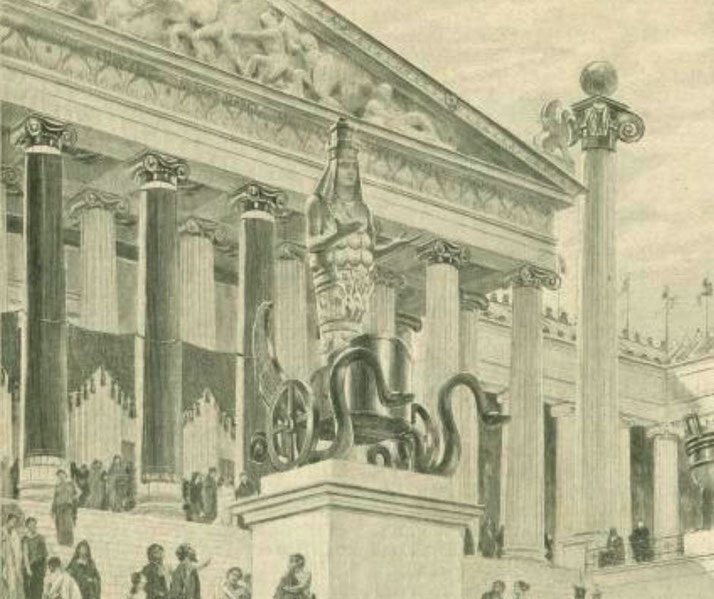
Located near the modern town of Selçuk in western Turkey, the Temple of Artemis acted as the main sanctuary for one of the most widely worshipped deities in the ancient Greek world.
Originally destroyed by flood in the seventh century BC and rebuilt form around 550 BC, the temple was the result of the joint effort of the Lydian king Croesus, local architects Chersiphron and Metagenes, and numerous sculptors and artisans from across the Aegean.
Its marble columns, arranged in double rows, reached heights of over 18 metres and created a space larger than any Greek temple of its time.
The final version measured approximately 137 metres in length and 69 metres in width, with over 120 Ionic columns.
Significantly, the cult of Artemis at Ephesus differed from the more familiar Greek version, as the Ephesian Artemis bore eastern features and symbolised fertility and protection, along with material abundance.
The temple was used as a religious site, and it also worked as a bank and public meeting place, and it developed into an artistic hub.
Sculptures lined the walls, and foreign rulers donated treasures to the sanctuary to demonstrate piety and gain favour.
It also offered a place of asylum and provided legal protection for those who sought shelter within its walls.
On 21 July 356 BC, arsonist Herostratus set fire to the temple, hoping to immortalise his name.
The Ephesians sentenced him to death and banned the mention of his act, but later writers such as Strabo and Plutarch recorded the story.
The temple was rebuilt shortly afterward with even finer decorations, although it eventually fell into ruin following attacks by the Goths and later Christian suppression of pagan worship.
Only a few column bases and scattered ruins are still visible today.
5. The Mausoleum at Halicarnassus
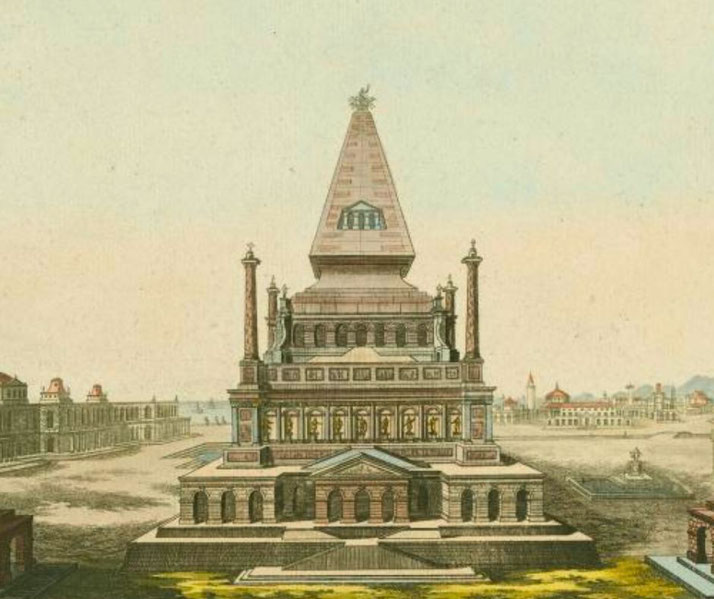
After Mausolus had ruled as satrap of Caria and then died in 353 BC, his sister and wife Artemisia II ordered the construction of a very large tomb in his honour at Halicarnassus, near the modern Turkish resort town of Bodrum.
The design, attributed to architects Satyros and Pythius, combined a large rectangular base and a stepped pyramid roof, crowned by a four-horse chariot statue at the top, reaching an estimated height of 45 metres.
The base itself measured roughly 33 by 39 metres. Sculptural decoration covered each side, with major Greek sculptors, Scopas, Bryaxis, Leochares, and Timotheus, each working on a different façade.
The structure appears to have brought together Greek and Egyptian influences together with Lycian elements.
Also, the detailed friezes depicted battles and processions, together with mythological scenes that celebrated both the deceased ruler and his cultural heritage.
Visitors praised its symmetry, fine workmanship, and creative design, which fused traditional architectural elements into a unique whole.
Vitruvius was a Roman architect and later praised the Mausoleum for the harmony of its proportions.
Over the following centuries, the Mausoleum slowly fell apart. Repeated earthquakes damaged the structure, and by the fifteenth century, the Knights Hospitaller dismantled much of it so that they could use the stone when they built the nearby castle.
Excavations in the nineteenth century uncovered several of the sculptural panels, which now reside in the British Museum, where they provide a rare glimpse into the artistic quality that made the tomb a wonder.
The word "mausoleum" later became a general term for monumental tombs in honour of its namesake.
6. The Colossus of Rhodes
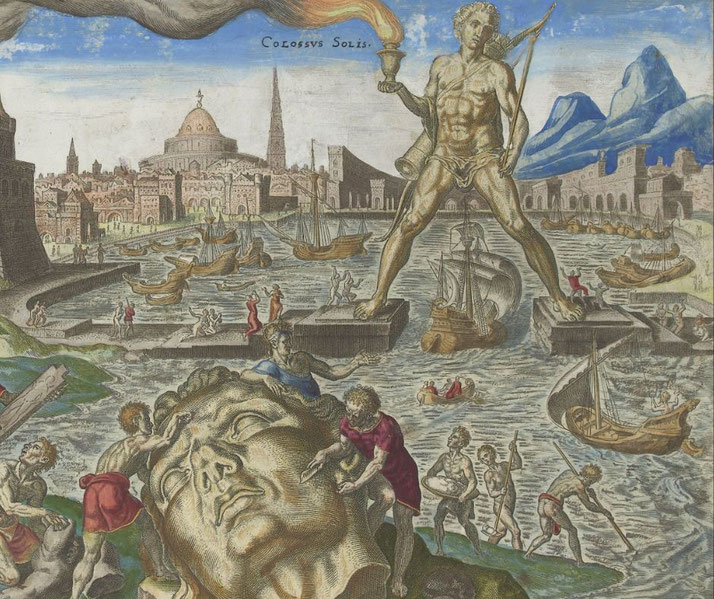
Following their victory over Demetrius I of Macedon in 305 BC, the citizens of Rhodes had decided to erect a monument to Helios, their patron deity, as a symbol of lasting strength and favour from the gods.
They chose Chares of Lindos, a student of the sculptor Lysippos, to oversee the project.
Between 292 and 280 BC, workers constructed the bronze statue with an internal stone and iron framework over which they riveted sheets of hammered bronze.
The Colossus stood approximately 33 metres tall, likely positioned on a pedestal near the harbour entrance.
According to ancient accounts, it did not span the harbour as later myths suggested but instead stood beside it, greeting incoming ships and displaying the strength of the Rhodian state.
Engineers had to overcome major challenges, such as lifting heavy materials and securing the joints, and the statue’s completion required recycled weapons and siege engines left behind by Demetrius’s defeated army.
Tragically, an earthquake in 226 BC snapped the statue at the knees, and although Egyptian rulers offered to fund repairs, the Rhodians declined, seeing the collapse as a sign from the gods.
The fallen statue lay in place for over 800 years and drew admiration from later Roman writers, including Pliny the Elder, who marvelled at its scale.
According to later Arab accounts, invaders sold the remains as scrap in AD 653, and they reportedly required 900 camels to transport the bronze fragments, and this sale removed the last physical trace of the wonder.
7. The Lighthouse of Alexandria
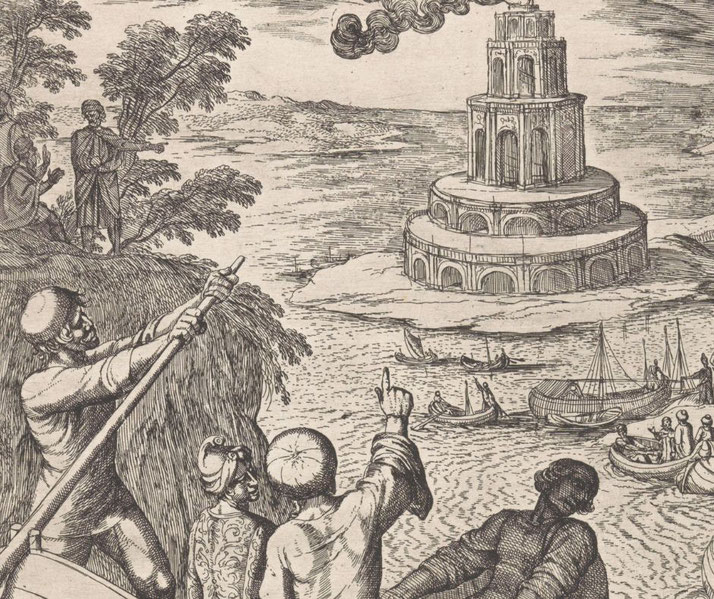
Constructed between 280 and 247 BC under the Ptolemaic rulers of Egypt, the Lighthouse of Alexandria stood on the island of Pharos and provided a vital guide for ships approaching the city’s twin harbours.
The architect Sostratus of Cnidus designed a three-tiered tower of limestone blocks, which included a square base and cylindrical middle, crowned by a small lantern topped with a statue.
Estimates place its original height between 100 and 120 metres, making it one of the tallest buildings of the ancient world.
Importantly, the lighthouse used mirrors to reflect sunlight during the day and fires at night, and this system allowed vessels to avoid reefs and navigate safely to shore.
Ancient geographers such as Strabo and Pliny the Elder frequently referenced it in their descriptions of Egypt, and mariners across the eastern Mediterranean relied on its beacon.
The tower also featured ramps and staircases, along with service quarters, which showed that it combined symbolic and practical purposes.
Arab sources later described the use of molten lead to secure stone blocks, and Roman coins depicted the structure, attesting to its fame.
Over the centuries, repeated earthquakes damaged the structure. Major seismic events in 956, 1303, and 1323 caused a slow collapse, and by the time Ibn Battuta visited Alexandria in 1326, only ruins remained.
Sultan Qaitbay later constructed a fortress on the site using recycled masonry from the ruined lighthouse.
In recent decades, underwater archaeologists have identified many of its blocks and sculptures, together with other architectural elements, on the seabed, and this evidence has largely confirmed ancient descriptions and allowed partial reconstructions.
The modern city of Alexandria still preserves the location through the citadel that now roughly marks its place.