
The Karnak temple complex: the epicenter of Ancient Egyptian religion and power
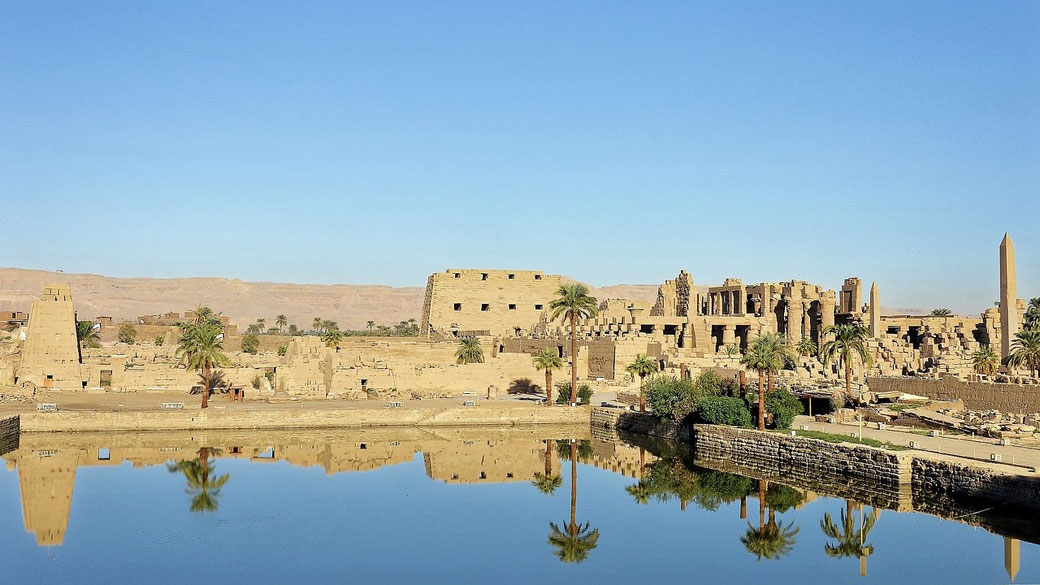
The Karnak temple site in Thebes covered over two square kilometres and was built across nearly nineteen centuries, and during that time it developed into one of the largest and most important religious sites in ancient Egypt.
Located on the east bank of the Nile, the site contained temples and chapels, together with a network of shrines, which expressed the authority of Amun-Ra, whose cult rose alongside Egypt’s imperial expansion.
Since it connected the favour of the gods to political legitimacy, Karnak became the principal venue where kings demonstrated piety and where priests used ritual to enforce theological order and uphold the cosmic balance of ma'at.
Amun-Ra and the rise of Thebes
After the reunification of Egypt under the Eleventh Dynasty, Thebes grew into a strategic and spiritual centre, especially under Mentuhotep II, who reigned from c. 2061 to 2010 BC and first endorsed the local deity Amun.
Soon after, the theological merger of Amun with the sun god Ra created a supreme deity whose influence often grew rapidly under sustained royal sponsorship.
As a result, the Twelfth Dynasty rulers expanded Amun’s sanctuary, and they started the first major construction phases at Karnak that laid the sacred foundations for later kings to embellish.
By the beginning of the New Kingdom around 1550 BC, pharaohs of the Eighteenth Dynasty had begun to treat Karnak as a place of worship and also as a statement of royal authority grounded in the will of the gods.
Ahmose I reigned from c. 1550 to 1524 BC and had expelled the Hyksos to restore native rule, and he donated wealth and prisoners of war to the temple in gratitude for Amun’s support.
Then, Amenhotep I (c. 1525–1504 BC) and Thutmose I (c. 1504–1492 BC) enlarged the sacred enclosure by adding new pylons and courts and by constructing additional shrines alongside obelisks and new processional routes.
Their work had fixed the main axis of the temple, which would define all future expansions.
The reign of Hatshepsut and Thutmose III
During Hatshepsut’s reign from c. 1479 to 1458 BC, Karnak underwent a period of building and religious renewal that improved both the building and its meaning.
She acted as king in her own right, and she ordered the Red Chapel to narrate her birth as a child of Amun, her coronation, and her relationship to the god, ensuring her legitimacy through religious means.
She also installed two pink granite obelisks near the Fourth Pylon, inscribed with texts declaring her eternal devotion to the god.
One still rises today and now towers over the ruins as a record of her authority.
Soon after her death, Thutmose III (c. 1479–1425 BC, sole reign from c. 1458 BC) began a large-scale building program that continued the expansion of Karnak while also presenting it as the centre of imperial power.
He constructed the Festival Hall, also known as the Akhmenu, to host his Sed jubilee, and filled it with columns shaped like papyrus plants and inscriptions that honoured Amun’s role in his conquests.
Adjacent to this hall, he had his campaign records carved onto the walls of what became known as the Hall of Annals.
Within these reliefs, he portrayed the god giving him military success and listed the defeated territories as proof that Egypt’s empire had Amun’s approval.
These inscriptions preserved a narrative of victory that secured imperial power through the will of the gods.
As a result, Karnak had become both a central sacred space and a record of how far the empire spread.
The Hypostyle Hall and the Ramesside kings
Under Seti I (c. 1290–1279 BC) and his son Ramesses II (c. 1279–1213 BC), Karnak received its most impressive new addition, the Great Hypostyle Hall, whose construction redefined the architectural language of Egyptian sanctuaries.
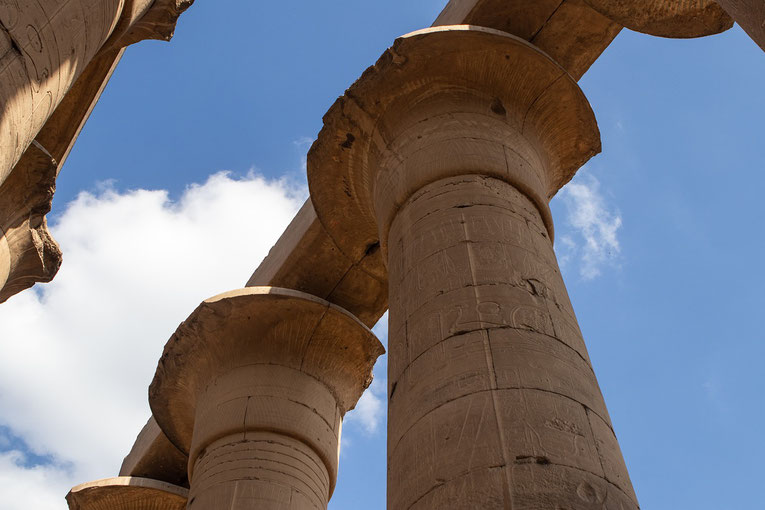
The space, which covered over 5,000 square metres and contained 134 columns, created a very intense visual and spiritual experience.
As priests carried out daily rituals within its dim interior, shafts of sunlight filtered between the columns and illuminated carved hymns and reliefs depicting the king in communion with Amun.
During his lengthy reign, Ramesses II worked his political and religious messages into nearly every part of the temple he changed.
He completed the Hypostyle Hall with inscriptions that proclaimed his victories and raised monumental statues of himself as a ruler chosen by Amun.
While the most detailed depictions of the Battle of Kadesh appear at the Ramesseum and Luxor Temple, Ramesses included references to the campaign on Karnak’s northern walls to reinforce his image as a protector of order.
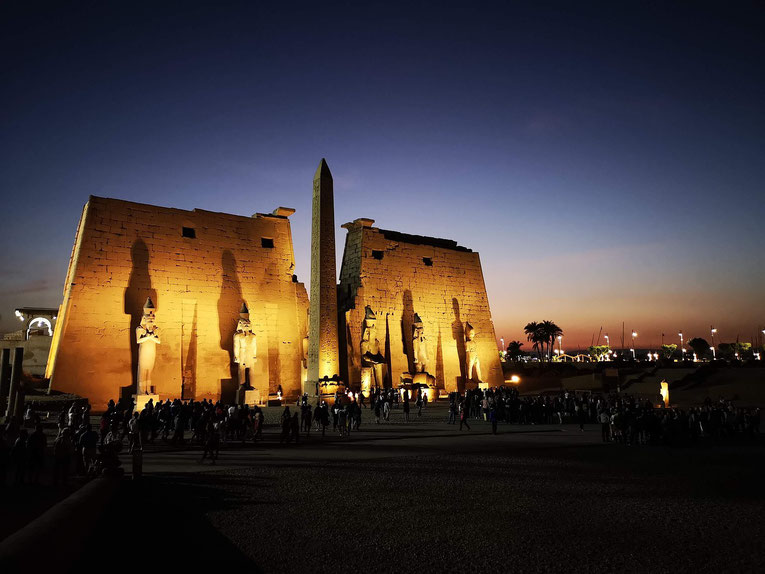
He also built the First Pylon and reinforced the entrance to the temple, and this work created a very large gateway that matched his plans for power.
In doing so, he turned Karnak into a statement of sacred kingship, military triumph, and priestly order.
Religious authority and the God’s Wife of Amun
Over time, Karnak also had become the seat of one of the most powerful priestly offices in Egypt, the God’s Wife of Amun.
From the Third Intermediate Period onwards, royal women had assumed this title and controlled large temple estates and income sources as well as key ritual functions.
Shepenwepet I, who was the daughter of Osorkon III, held the office during the early Twenty-fifth Dynasty, and she held power that rivalled the king’s in Upper Egypt.
During earlier stages of this period, the High Priests of Amun, including figures such as Herihor and Pinedjem I, also held semi-royal authority, and this blurred the line between temple and throne.
During the Twenty-sixth Dynasty, Nitocris I, who was adopted by Shepenwepet II in 656 BC, entered Karnak in a ceremony recorded on an inscribed stela.
Her role granted her control over temple income and property as well as responsibility for ceremonial duties, and her authority reached across the southern priesthood.
The position eventually required ritual celibacy and the adoption of successors, and this ensured continuity in temple leadership.
Since central authority had often weakened in this period, the high priests of Amun and the God’s Wife together governed Thebes with a level of independence from the king.
As a result, Karnak retained political weight well into the Late Period, long after its original builders had passed into history.
Rituals, festivals, and sacred architecture
Each morning, temple priests typically conducted a strict sequence of rites to awaken the god’s statue, bathe it, clothe it in fresh linen, and present offerings of incense, bread, fruit, meat, and beer.
These acts, performed in private within the sanctuary, ensured that the god stayed pleased and, by extension, that the cosmic balance of maat continued.
Without daily ritual, the spiritual and political order risked eventual collapse.
Among the most detailed events was the annual Opet Festival, during which the image of Amun travelled by barque to the Luxor Temple along an avenue lined with ram-headed sphinxes.
The procession covered approximately 2.5 kilometres and lasted up to 27 days in later periods.
The king joined the procession to receive sacred confirmation of his role from Amun, while priests paused at stations along the route to recite prayers and offer sacrifices.
Each stage of the festival strengthened the connection between temple ritual and royal renewal, and it embedded the king’s identity within the cult of Amun.
Architecturally, Karnak largely formed a symbolic map of the cosmos. Its pylons marked sacred thresholds and its obelisks captured sunlight in honour of the gods.
The sacred lake, which measured roughly 120 by 77 metres, allowed ritual purification for priests.
The largest district was the Precinct of Amun-Re, which contained many of these features, and it included monumental pylons such as the Second Pylon, completed by Horemheb, and the Eighth, which was initially commissioned by Thutmose II and later adorned by Hatshepsut.
Every wall and floor surface carried inscriptions, and even the columns carried carved texts, ensuring that each space worked as both ceremonial ground and a text carved in stone.
Taken together, the design of the site reinforced a worldview in which the pharaoh mediated between gods and humanity within a sacred order preserved by ritual precision.
Decline and rediscovery
As Christian rule spread across Egypt in the late Roman period, traditional temples gradually lost their state support, and Karnak gradually ceased to operate as a centre of worship.
By the fourth century AD, its sacred rites had ended, and over the next centuries, its structures fell into disuse.
Mudbrick dwellings spread into the ruins, and sandstone blocks were stripped from pylons for use in local buildings, and over time, earth and debris buried entire precincts.
During the nineteenth century, European expeditions and Egyptian scholars had begun to uncover Karnak’s ruins.
Explorers such as Jean-François Champollion and Karl Richard Lepsius had documented its inscriptions and architecture, and this work laid the foundation for modern study.
The French-led teams produced architectural drawings and catalogued reliefs as they strengthened damaged structures, while the Egyptian Ministry of Antiquities directed restoration efforts and made new discoveries.
Today, the Open Air Museum displays reconstructed chapels from blocks recovered during excavation, while conservation teams from the Centre Franco-Égyptien d’Étude des Temples de Karnak continue to document and interpret what is left.
Despite the loss of much of its upper structure, Karnak still clearly shows the remarkable scale of Egyptian religious vision.