
The 3 greatest ancient Egyptian queens
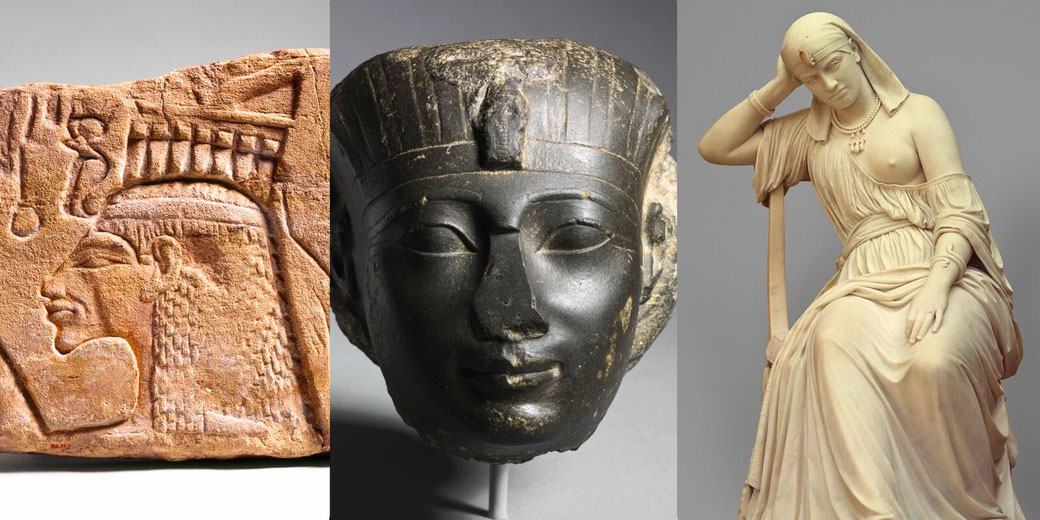
Over the course of three millennia, Ancient Egypt produced countless rulers, but only a small number of royal women managed to grasp real power and rule as kings.
Among them, three queens, Nefertiti and Hatshepsut, along with Cleopatra, arguably achieved rare authority through their mastery of political alliances, state religion, dynastic claims, and the careful control of public image.
Each ruled in a different period, with distinct challenges, but all three left behind monuments and texts, along with historical puzzles, that continue to attract scholars and artists as well as archaeologists.
1. Nefertiti
Around 1350 BC, during the reign of Akhenaten in the 18th Dynasty (c. 1353–1336 BC, though alternative dates such as 1351–1334 BC are also used), Nefertiti rose to power in a royal court that had begun dismantling Egypt’s traditional religious structure.
From the outset, she appeared as more than a consort, since inscriptions and reliefs from the capital at Akhetaten portrayed her as a figure who stood beside the king during official ceremonies and who received offerings from priests.
At the same time, they showed her as she raised her arm to the sun disk Aten in ritual worship.
She often appeared in the same scale and poses as Akhenaten, which suggested that her role also covered government and religious leadership.
In visual depictions across the city, artists represented her as she struck enemies with a mace and rode in chariots, actions that indicated kingly duties once limited to the reigning pharaoh.
For example, at Karnak, a relief fragment from the Hwt-benben temple showed her wearing the blue crown associated with military power, which no other known queen had worn in such scenes.
Many scholars now believe that she probably held formal power under the name Neferneferuaten, either as Akhenaten’s co-regent or as an independent ruler during the final years before Tutankhamun came to the throne.
Most Egyptologists now distinguish Neferneferuaten from Smenkhkare, who appears to have been a separate, short-lived male ruler.
The famous painted limestone bust, which German archaeologists discovered in 1912 inside Thutmose’s workshop at Amarna, has shaped modern perceptions of her.
That sculpture is now housed in the Ägyptisches Museum in Berlin (Inventory No. 21300), and it shows a careful balance of symmetry and realism and has become one of the most reproduced artefacts of ancient Egypt.
It may have been a model that the sculptor used in his studio, though some argue that it was a finished display piece.
Archaeological traces of her burial are still hard to find, and debates continue about whether she was interred in a now-lost chamber of the Amarna royal tomb or later reburied elsewhere during the restoration of the old religious order under Tutankhamun.
She is widely believed to have been the mother of Ankhesenamun, Tutankhamun’s queen, though this is still unconfirmed.
Over time, Nefertiti’s public role, combined with her frequent depiction in royal rituals, led Egyptologists to reconsider her status.
Rather than being a passive queen beside a controversial king, she appears to have acted as an architect of the Atenist religion and a political figure with wide authority during one of Egypt’s most radical periods in religious ideas.
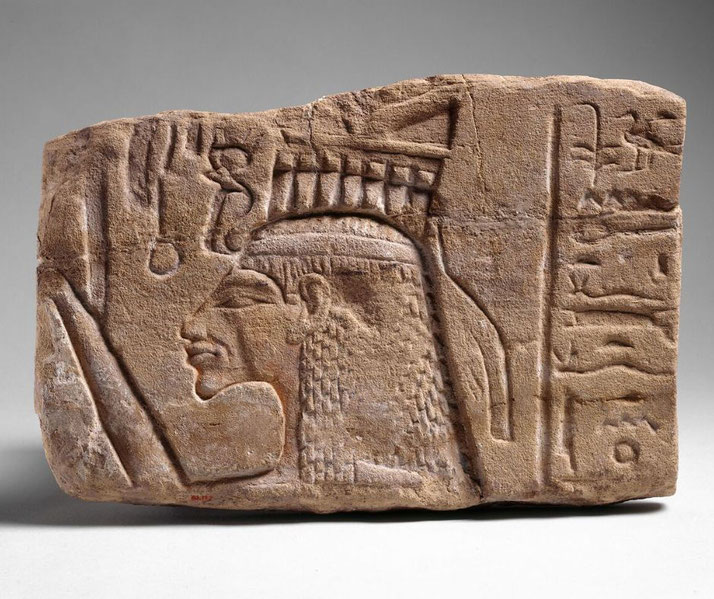
2. Hatshepsut
Roughly a century before Nefertiti, during a transitional period after the death of Thutmose II, Hatshepsut claimed the throne first as regent to a young heir and later as pharaoh in her own right.
Her reign lasted from c. 1479 to 1458 BC and began in order to protect the succession of Thutmose III.
After she had assumed royal titulary and had adopted male iconography, she redefined her public identity through a mix of traditional ritual and sacred birth myths, supported by massive architectural projects.
She commissioned reliefs in the temple of Deir el-Bahri that presented her as the daughter of Amun, whose sacred union with Queen Ahmose had granted her the right to rule Egypt as a god’s chosen vessel.
Soon after, she initiated ambitious building works that helped restore the sacred status of Amun’s cult after it had been suppressed during the Hyksos period.
The colonnaded terraces of Deir el-Bahri still bear painted scenes of her expedition to the land of Punt, which brought back incense trees and exotic goods, along with other valuable trade items.
Scholars generally identify Punt as a region that corresponds to parts of modern Eritrea or Somalia.
These images worked as records of success in relations with foreign lands, and they also acted as propaganda that helped to elevate her status as a ruler who presented herself as someone who restored Egypt’s prosperity and religious order.
Her chief architect was Senenmut, and he played a key role as he carried out these ambitious projects and held multiple court titles that suggested close involvement in royal affairs.
At Karnak, she had obelisks erected with inscriptions that proclaimed her devotion to Amun and her role in keeping ma’at, the sacred balance that upheld Egyptian kingship, stable.
One of these was the Lateran Obelisk, and it was later transported to Rome and became the tallest surviving ancient Egyptian obelisk.
Her inscriptions followed the language of traditional pharaohs, but many also still retained grammatical signs of her identity as a woman.
That careful balance allowed her to present herself as both a female heir of Thutmose I and a king equal to her male predecessors. In addition to her major monuments, the Red Chapel (Chapel Rouge) at Karnak preserves scenes that show her kingship and ceremonial activity.
After her death around 1458 BC, state officials attempted to erase the memory of her rule.
They removed her name from king lists, smashed her statues, and replaced her inscriptions with those of Thutmose III.
For a long time, that effort had succeeded, and only in the late 19th and early 20th centuries did archaeologists recover enough evidence to reconstruct her reign, and this evidence included her sarcophagus in KV20 and a possible identification of her mummy from KV60, which scholars matched to a tooth that they found in a canopic box inscribed with her name.
Zahi Hawass later announced the identification had been confirmed when his team used CT scans and DNA analysis, but this conclusion is still disputed by some specialists.
As excavations progressed, Hatshepsut’s reputation shifted from that of an opportunistic usurper to a ruler who stabilised Egypt and led with confidence as she constructed some of the most admired monuments in the Theban necropolis.
3. Cleopatra
By the mid-first century BC, the Ptolemaic dynasty had ruled Egypt for nearly three centuries, but it faced internal instability and Roman interference.
Into that crisis, Cleopatra VII Philopator ascended the throne in 51 BC. Unlike her predecessors, she mastered the Egyptian language, identified herself with native religious deities, and conducted public ceremonies in Egyptian temples, all of which helped reinforce her legitimacy.
She adopted the image of Isis and positioned herself as both a traditional pharaoh and a modern ruler prepared to navigate foreign politics.
Shortly after her accession, conflict erupted with her younger brother and co-ruler Ptolemy XIII, and this conflict led to her exile.
Soon after, she secured an alliance with Julius Caesar, who had arrived in Alexandria during his pursuit of Pompey’s assassins.
Their alliance restored Cleopatra to power, and by 47 BC she had given birth to Ptolemy XV Philopator Philometor Caesar, known as Caesarion, whom she presented as Caesar’s heir and a future king.
She ruled with him as co-regent from 44 BC, continued to appear in both Roman and Egyptian ceremonial roles, and this pattern strengthened her presence in two political worlds.

Following Caesar’s assassination in 44 BC, Cleopatra allied with Mark Antony, a Roman general whose eastern campaigns gave him authority over Egypt’s region.
She hosted him at her court, had three children with him, Alexander Helios together with Cleopatra Selene II and Ptolemy Philadelphus, and appeared with him in processions and royal audiences that portrayed them as rulers honoured as gods.
Together, they distributed territories to their children in a ceremony known as the Donations of Alexandria.
Many Roman senators viewed this as a violation of Roman political customs and as a clear insult to Roman supremacy.
In 31 BC, Octavian confronted them at the Battle of Actium. After their defeat and retreat to Alexandria, Antony died by suicide, and Cleopatra followed shortly after, possibly by poison.
Ancient sources such as Plutarch and Dio Cassius claimed she used an asp, but modern scholars have questioned how likely that method was.
With her death, Roman annexation of Egypt followed, and Octavian executed Caesarion to prevent any rival claim to Caesar’s position.
Her tomb has never been discovered, though excavations at Taposiris Magna have been proposed as a potential site.
Roman authors later portrayed her as a dangerous seductress whose pursuit of power destabilised Rome, but coins minted during her reign showed a ruler with sharp features and confident inscriptions in Greek, which showed her control over foreign and domestic policy.
Inscriptions from her reign survive in Egyptian temples that described her as a patron of the gods and a protector of Egyptian tradition.
Why it's important to know about these queens
By studying Nefertiti, Hatshepsut, and Cleopatra, it becomes possible to recognise that female authority in Ancient Egypt was tolerated and at times even necessary for political stability.
In moments when dynasties fractured, heirs proved too young, or external threats grew, each queen filled a void that required more than symbolic leadership.
They ruled with clear political and religious intent, invested in reform or restoration, and left permanent marks on Egypt’s cultural and political history.
Their reigns provide material evidence, such as temples, inscriptions, stelae, sculptures, and coins, that can challenge the claim that power in antiquity belonged exclusively to men.
Each used religion, diplomacy, construction, and state ceremony to strengthen her legitimacy.
Over time, these efforts produced results that could not be easily erased, even when later rulers attempted to destroy their names or images.
In classrooms and museums today, as well as in research, their stories offer understanding of Egypt and explain how public memory survives efforts at historical erasure.
Their names have been recovered through excavation and linguistic reconstruction, supported by comparative analysis, which together have shown rulers who governed as part of a system that had room, even if only rarely, for women who could seize and maintain power, rather than as exceptions to the rule.
What they tell us about female power in ancient Egypt
Egyptian kingship relied on religious legitimacy more than sheer heredity or military conquest, and that flexibility could allow royal women to assume power when they invoked descent from the gods or upheld ritual obligations.
Myths such as the birth of Hatshepsut by Amun, the motherly identity of Isis, and the queenly image of Cleopatra as a living goddess all illustrate how women could occupy the throne without dismantling the structure of pharaonic rule.
Each queen aligned herself with symbols of the favour of the gods, public order, and dynastic continuity, which gave her rule strong political and religious meaning.
In each case, she adopted the regalia of kingship, commissioned monumental art and architecture, and positioned herself within the official historical narrative of her time.
They did not replace the male framework, since they operated within it and at certain times redefined it.
Modern interpretations of their reigns continue to reshape discussions around women and leadership in antiquity.
Evidence from tombs and temples, together with material from archives, strongly suggests that female power in Ancient Egypt, though rare, was real, visible, and at times more stable than the rule of many of their male counterparts.
They remind us that the boundaries of power in the ancient world were never fixed, and that strategy and belief, together with appeals to descent from the gods, could open the door to queens who ruled as kings.