
The Great Sphinx: exploring the enigma of its creation and purpose
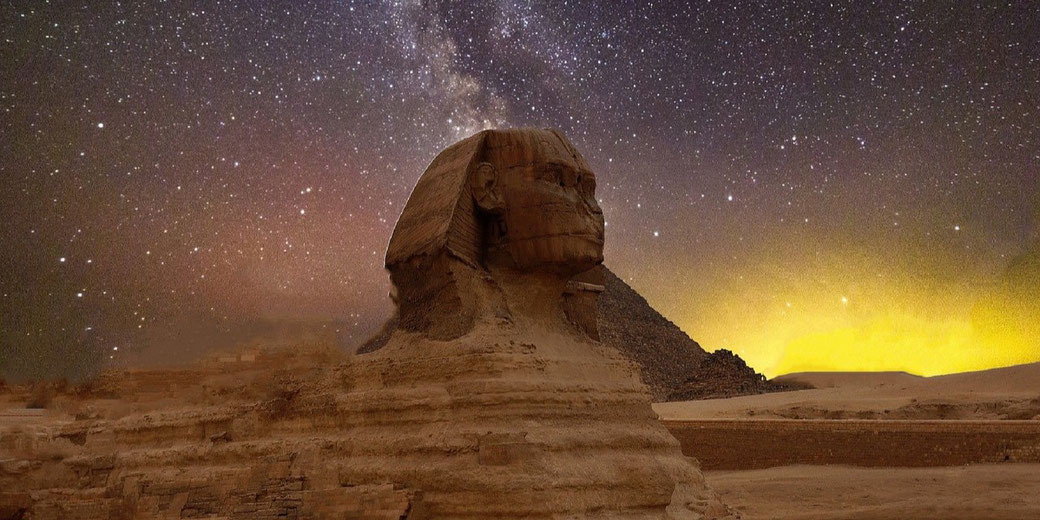
At the eastern edge of the Giza Plateau, the Great Sphinx has kept watch for over four thousand years. With a lion’s body and a human face believed by many to resemble Pharaoh Khafre, the statue stretches over 73 metres and rises 20 metres high, and this size makes it one of the largest carved statues made from a single block of stone ever created.
Although most modern scholars attribute its construction to the Fourth Dynasty, disputes over its origin and erosion patterns, along with arguments about its religious role, have produced a great deal of speculation.
Construction and physical features
Carved from a single mass of limestone, the Great Sphinx follows the natural shape of the plateau, which allowed its builders to sculpt a lying lion with realistic proportions.
The statue extends 73 metres from paw to tail and reaches a height of around 20 metres.
Workers used copper chisels and dolerite pounders to remove several thousand tonnes of stone, and their efforts created a monument of impressive size without advanced tools.
The quarry from which the Sphinx was cut forms the enclosure trench, and blocks that workers removed during excavation were likely used in the construction of the nearby Sphinx Temple.
Originally, the Sphinx displayed colours that emphasised its features. Red pigment appeared across the face, while faint traces of yellow were once visible along the body.
A pigment analysis that was carried out in recent decades has helped to confirm these colours through the presence of iron oxide residues and other mineral traces.
Its head measures over 4 metres wide and still wears the nemes headdress worn by pharaohs.
The nose is now missing and likely broke off during the late medieval or early modern period, although early damage may have occurred under the Mamluks.
Popular claims that Napoleon’s troops destroyed the nose lack credible historical evidence, and sketches by Frederick Lewis Norden from his 1737 journey, published in 1755, already depict the nose missing.
The uraeus cobra that was once attached to its forehead has also disappeared, though its socket remains visible.
Over time, erosion has caused deep cracks along the sides of the statue and has created patterns that some have taken as signs of long-lasting water damage rather than damage from wind-blown sand.
Some researchers have pointed out that the head seems too small compared to the body, and they have suggested that it may have been recarved at a later time, but this idea has never been proved.
Linking the sphinx to pharaoh Khafre
According to the main view held by most Egyptologists, the Sphinx was constructed during the reign of Pharaoh Khafre, who ruled from 2558 to 2532 BCE during Egypt’s Fourth Dynasty.
The closeness of the Sphinx to Khafre’s pyramid and causeway, together with the neighbouring valley temple, supports this view.
The alignment of the Sphinx with Khafre’s group of buildings strengthens the case that they were planned and built at the same time.
Herodotus wrote in the fifth century BCE, and he described the pyramids but made no mention of the Sphinx, a silence that has added to later debates about its date.
Excavations that Selim Hassan led in the 1920s suggested that the construction methods used around the Sphinx enclosure probably matched those used in Khafre’s valley temple.
In addition, a diorite statue of Khafre discovered within that same temple strengthened the association.
Scholars argue that the Sphinx may have been used as a guardian or as a symbol of Khafre’s sacred authority as king, especially given its alignment with the rising sun and its proximity to sacred structures.
Theories of alternative origins
At times, researchers have proposed earlier construction dates for the Sphinx, challenging the idea that it belonged to Khafre.
Geologist Robert Schoch and writer John Anthony West argued in the 1990s that the deep fissures found on the enclosure walls resulted from water erosion, which would indicate a much older date, possibly earlier than 7000 BCE.
According to their hypothesis, heavy rainfall during the late Pleistocene caused the weathering, which could not have occurred during the arid climate of the Old Kingdom.
Supporters of this theory point to the rounded vertical erosion patterns as evidence, which differ from the horizontal striations produced by wind and sand.
However, most Egyptologists maintain that a combination of natural weathering and repeated burial in sand explains the damage, and that irregular restoration also changed how it looks today.
Since no archaeological evidence in the form of inscriptions or artefacts has so far supported a pre-dynastic origin, and structural layers provide no such support either, the theory has stayed outside the mainstream.
The Dream Stele and Thutmose IV
Placed between the Sphinx’s forepaws stands the Dream Stele, a granite slab erected by Thutmose IV during the Eighteenth Dynasty around 1400 BCE.
According to the inscription, while still a prince, Thutmose slept beside the Sphinx and received a message from the god in a dream.
The statue was half-buried in sand at the time and promised to make him pharaoh if he would clear it of debris and restore its body.
The inscription reads, in part, "Look upon me, contemplate me, O my son Thutmose... I shall give you kingship over the living."
After he became pharaoh, Thutmose honoured the vision by restoring the statue and recording the meeting on the stele.
Although it dates to a much later period, the inscription helps historians understand how Egyptians of the New Kingdom saw the Sphinx as the living presence of a god rather than as a forgotten monument.
The stele also worked as a political tool, and it helped Thutmose IV justify his rule by claiming support from the god, which was especially valuable in dynastic succession disputes.
Religious and symbolic role
By design, the Sphinx combined a lion’s body, associated with strength and defence, with a human head, which often depicted the ruling king.
Positioned on the eastern boundary of the Giza necropolis, it faced directly toward the rising sun, which created a strong connection with the solar gods.
The alignment suggested that the statue embodied Ra-Horakhty, a combination of Ra and Horus, whose role in Egyptian cosmology linked the pharaoh to the sun’s daily rebirth.
The nearby Sphinx Temple, constructed from limestone blocks quarried during the Sphinx’s carving, shares similar solar alignments and may have supported ceremonies, although its exact ritual role is uncertain.
During the New Kingdom, religious interest in the Sphinx increased significantly.
Inscriptions and restoration works indicate that the monument received renewed attention, and some priests identified the statue as “Horus in the Horizon.”
Festivals held in its honour showed a belief that the Sphinx possessed supernatural powers of protection and prophecy.
Amenhotep II, among other rulers, commissioned inscriptions and restorations near the monument.
Temples and altars that were built in the area during this period show that it continued to be used as a sacred site.
The growing association between the Sphinx and solar theology helped to preserve its status across dynasties, long after its original purpose had been forgotten.
Restoration and rediscovery
Over the centuries, the constant movement of the desert sands has repeatedly buried the Sphinx.
Thutmose IV’s clearance effort in the fifteenth century BCE was probably one of the earliest restoration projects, although it proved temporary.
By the Saite Period and into the Ptolemaic era, only the head may have remained visible above the sand.
Small statues and graffiti that later pilgrims left show that the Sphinx kept its religious importance even when largely submerged.
In modern times, careful excavation began under Giovanni Battista Caviglia in 1817, and it reached as far as the chest, but it remained limited.
Later work by Auguste Mariette and Gaston Maspero expanded the cleared area and has provided more detailed records, yet the full body of the Sphinx stayed buried until the 1920s, when Émile Baraize oversaw a major clearance and documentation project.
Since then, teams of archaeologists and conservationists have carried out numerous restoration campaigns to address structural cracks and surface weathering, as well as environmental damage caused by tourism and pollution.
One of the largest efforts took place between 2006 and 2010 under the direction of Egypt’s Supreme Council of Antiquities, which stabilised parts of the headdress and chest.