
Deir el-Medina: The mysterious ancient village where the Egyptian tomb builders lived
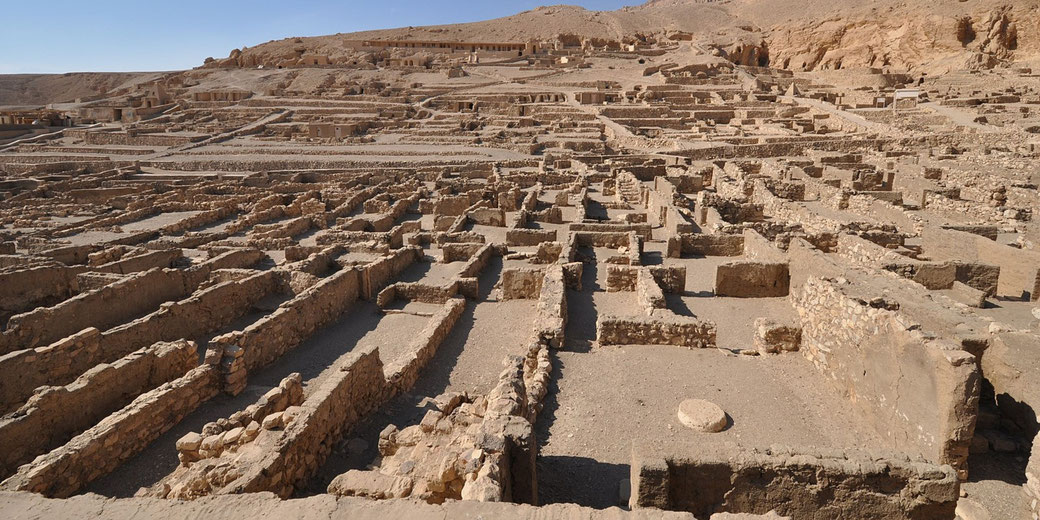
Between the cliffs of western Thebes and the dry plateau that leads toward the Valley of the Kings, a small walled village stood under the control of Egypt’s royal administration.
Its residents usually worked as draughtsmen, masons, painters, and scribes who constructed the carefully decorated tombs of New Kingdom pharaohs.
Unlike farmers along the Nile or priests in temple areas, the people of Deir el-Medina lived apart from the wider population and formed a literate and tightly organised group of workers whose records kept one of the most detailed descriptions of ancient Egyptian life ever found.
The origins and purpose of the village
During the early 18th Dynasty, officials created Deir el-Medina, which was likely established sometime after the reign of Amenhotep I between c. 1525–1504 BCE, to house the tomb-builders responsible for royal burials.
Although later inscriptions credit Amenhotep I with its founding, no records from his time confirm this, and the earliest levels of settlement suggest the site had become active during the reign of Thutmose I.
The settlement’s location, tucked into a narrow valley west of Thebes, ensured both nearness to the royal necropolises and clear separation from ordinary Egyptians.
As a settlement paid for and controlled by the state, the village had a single purpose, which was to allow workers to build pharaonic tombs in secret and under controlled conditions.
The workers commonly referred to their home as Set Maat, or “Place of Truth,” and identified themselves by the official title sḏm-ṥ m st mẓẓt, meaning Servants in the Place of Truth.
Under government supervision, they received rations instead of wages, and their work took place within a clearly defined system of levels and duties.
They carved funerary passages and applied sacred texts on walls filled with sacred imagery designed to secure the king’s passage into the afterlife.
Tomb architecture followed strict religious expectations, so each workman needed knowledge of religious ideas as well as practical skill.
The village remained occupied for roughly 350 to 400 years, from the reign of Thutmose I through to the collapse of the 20th Dynasty around 1070 BCE.
Life inside the walled village
Along a central dirt path that divided the village, rows of tightly packed houses faced one another behind high outer walls.
Built with mudbrick and usually whitewashed to keep out the heat of the sun, each dwelling included a front room and one or two internal chambers, with a rear storage space or cellar at the back.
Many houses also featured roof access, which allowed families to perform tasks or sleep outdoors during hot nights.
Interior altars and painted stelae found inside strongly suggest that residents had practised private worship alongside public rituals.
Excavations indicate that the village had included around seventy houses and had supported a population that may have ranged from about two hundred up to about five hundred people, and this number changed according to the period and surrounding households.
Within this home environment, women supervised the home, prepared food, brewed beer, and raised children.
Some possessed enough education to write basic records or recite prayers, as evidenced by ostraca with female handwriting or content that was directed toward female recipients.
When men rotated into the valley for several-day shifts of labour, women maintained order within the village and took part in both public and religious routines.
Written evidence confirms that female residents made requests to local gods and resolved minor disputes, and they also engaged in community decision-making.
Religious life appears to have remained central to the villagers’ sense of purpose.
They built small chapels and household shrines to gods such as Ptah and Meretseger, together with the goddess Hathor.
Each deity held special importance: Ptah as a patron of craftsmen, Meretseger as a guardian of the mountains, and Hathor as protector of women and rebirth.
Offerings left at these sites included votive figures and food items, along with inscribed prayers.
As a result, religious activity occurred in parallel with official work, and it blended professional duties with personal devotion.
One ostracon records a woman’s prayer to Meretseger in which she asked for relief from illness after a dream showed the cause.

Work in the tombs of the kings
Each worker typically belonged to a defined team responsible for a specific part of tomb construction.
Some carved walls with copper chisels and dolerite pounders, as bronze remained expensive and saw limited use, while others drew outlines or applied pigments to finished surfaces.
Supervisors coordinated schedules, while scribes recorded attendance and supplied tools as they monitored progress.
The workweek followed a regular pattern, with eight days on site followed by two days of rest at home, although officials granted extra time off for illness, funerals, or religious events.
Pigments came from carefully sourced minerals: red and yellow ochre for skin and background, carbon black for outlines, calcium carbonate for white, and azurite for blue.
Before painting, artists applied a thin layer of plaster, then traced red gridlines to preserve proportion.
They followed a standard style that ensured consistency across generations, with each figure drawn in profile, gods placed in a set order that showed their rank, and scenes arranged according to sacred spatial rules.
Tombs attributed to the Deir el-Medina workmen include some of the finest in Egypt, arguably.
The tomb of Seti I is known as KV17 and displays intricate ceiling decorations and extensive inscriptions.
KV5 was designed for the sons of Ramesses II and contains over 120 chambers that are arranged across multiple corridors and pillared rooms, making it the largest known tomb in the Valley of the Kings.
Meanwhile, the tomb of Queen Nefertari is located in the Valley of the Queens and preserves delicate and bright wall paintings that show the highest level of skill achieved by the village’s artisans.
Graffiti that workmen left in tombs such as KV9 show moments of humour and daily commentary, and they offer rare views of their personalities.

Evidence of literacy, legal disputes, and daily concerns
Deir el-Medina’s written material is probably greater than that of all other ancient Egyptian settlements in both quantity and range.
Archaeologists have recovered over ten thousand ostraca, along with dozens of papyri that include administrative records, private letters, legal texts, and religious writings.
These texts show that writing was an essential tool in both work and daily life. For instance, scribe diaries detail who reported for duty and which workers fell ill, and they also indicate how much time each task required.
Individuals such as the scribes Amennakht and Paser appear repeatedly in these records, giving names to the people behind the work.
More personally, villagers used writing to communicate with family and neighbours.
One letter accuses a neighbour of borrowing a cloak and failing to return it.
Another records a complaint about unfair treatment during a festival. Some ostraca contain love poems or satirical drawings, while others carry prayers to deities asking for healing, protection, or justice.
Among the most remarkable finds is a series of texts that contain explanations of dreams, where residents explained signs or messages from the gods based on nightly visions.
Certain dreams were attributed to messages from gods such as Hathor or Meretseger.
During the reign of Ramesses III, the village workers staged Egypt’s first recorded strike.
After food rations had been delayed during the 29th regnal year, around 1155 BCE, the workforce refused to continue tomb construction.
They marched to nearby temples and voiced their demands in public protest. One recorded statement from the strike describes the workers as “hungry and thirsty” and says that they lacked clothing and fish, with vegetables also absent.
Officials, eventually forced to act, delivered the missing supplies. This incident strongly suggests that even in a rigid hierarchy, state workers possessed ways to demand fair treatment.
Legal disputes within the village often involved inheritance, accusations of theft, adultery, and property boundaries.
Local scribes often led investigations, gathered testimony, and gave verdicts.
Oaths sworn before the gods held serious weight. False claims, if exposed, brought social shame as well as punishment from the gods.
As a result, law and religion operated together, maintaining order in a community that valued fairness and spiritual balance.

Decline and rediscovery
By the end of the 20th Dynasty, internal problems and the gradual loss of central control weakened royal building projects.
Tomb construction slowed as grain deliveries became unreliable. Treasury officials sent resources to other places.
In response, some residents left the village, while others turned to tomb robbery.
Because they had detailed knowledge of tomb locations and entry points, former workers could strip gold and valuables from the very chambers they once built.
Deir el-Medina had faded from memory by the time European scholars identified the site in the 19th century.
Italian Egyptologist Ernesto Schiaparelli had carried out initial excavations in 1905–1906.
Later, French archaeologist Bernard Bruyère began major excavations in 1922, uncovering homes, chapels, rubbish dumps, and nearby tombs.
He catalogued thousands of artefacts, such as tools, furniture, religious items, and writing materials.
His careful method showed not only the village layout but the rhythms of its daily life and cultural values.
Tombs that villagers built for themselves included wall paintings and burial goods, along with ritual scenes similar to those found in royal tombs.
In many, depictions of Osiris judging the soul and the weighing of the heart ceremony fill the interior space, along with images of protective deities.
Such similarities confirm that the workers embraced the same religious expectations as the kings they worked for, believing their own passage into the afterlife depended on proper ritual and personal conduct.