Did Commodus really fight and die as a gladiator?
In Ridley Scott's 2000 film Gladiator, Emperor Commodus dies on the sands of the Colosseum, struck down by the fictional general Maximus in front of a roaring crowd.
It is a dramatic and memorable scene, but it is largely made up. The real Commodus did not die in a public arena, and there was no honourable final duel.
What makes the true story so fascinating is that Commodus genuinely did fight as a gladiator on hundreds of occasions, and his actual assassination involved a conspiracy far more chaotic than anything Hollywood put together.
The emperor who wanted to be Hercules
Lucius Aurelius Commodus was born on 31 August 161 AD at Lanuvium, near Rome, and he was the son of the Stoic philosopher-emperor Marcus Aurelius and Faustina the Younger.
He had a twin brother, Titus Aurelius Fulvus Antoninus, who died in 165 AD. On 12 October 166 AD, Marcus Aurelius gave Commodus the title of Caesar, and then elevated him to co-emperor as Augustus in 177 AD, when the young man was only sixteen years old.
After Marcus Aurelius died during a military campaign on the Danube frontier in March 180 AD, Commodus took sole control of the Roman Empire at the age of eighteen.
From the very start, Commodus showed little interest in the administrative and military work that had defined his father's time in power.
According to the senator and historian Cassius Dio, who personally witnessed many of the events he described, the new emperor ended the Danubian war soon after coming to power, accepted a peace deal, and returned to Rome.
There, he preferred the company of entertainers and gladiators over senators and generals.
Commodus developed an intense fascination with Hercules, the mythological hero known for his strength and his famous twelve labours.
He began appearing in public dressed in a lion skin and carrying a wooden club, claiming to be a living incarnation of the demigod.
Statues commissioned during his reign showed him with Herculean features, and several of these survive today.
A famous marble bust held in the Capitoline Museums in Rome, dated to 192 AD, shows him wearing a lion skin and holding a club, with the apples of the Hesperides placed in his hands.
How Commodus actually fought in the arena
Ancient sources consistently confirm that Commodus took part in gladiatorial combat, and historians generally accept that this part of his story is true.
Cassius Dio, writing in his Roman History, provides detailed firsthand accounts of the emperor's performances in the Colosseum.
Herodian, another historian who lived around the same time, backs up much of Dio's account.
The Historia Augusta, a later and less reliable collection of imperial biographies, adds further details that broadly agree with the earlier sources.
According to Cassius Dio, Commodus fought as a 'secutor', a type of gladiator who carried a short sword, a rectangular shield (scutum), and heavy protective gear such as a manica on the sword arm and greaves on the legs.
The secutor's helmet had a smooth, rounded profile with small eye openings, which made it harder for a net to catch on it.
The secutor was traditionally matched against a retiarius, a lightly armed fighter who used a trident and a weighted net.
Dio also reported that Commodus held his shield in his right hand and used a wooden sword in his left, and that the emperor took pride in being left-handed.
The secutor role apparently appealed to Commodus because of its association with heavy armour and aggressive fighting, which suited his desire to look powerful in front of the crowd.
Importantly, the emperor's arena fights were carefully staged to protect him. Dio wrote that Commodus often faced an athlete or a gladiator armed only with a wand (rudis), which made serious injury very unlikely.
Some accounts describe opponents deliberately falling before the emperor or surrendering at the first opportunity, since injuring or killing the ruler of the Roman Empire would certainly have meant immediate execution.
Dio also described attendants staying close to Commodus during his bouts, and he treated the whole thing as a spectacle designed to keep the emperor safe.
The Historia Augusta later claimed that Commodus fought in the arena on 735 occasions, and neither Dio nor Herodian described him receiving a serious wound during any of these appearances.
What did his performances look like?
Aside from the gladiatorial duels, Commodus staged animal hunts, known as venationes, inside the Colosseum.
Cassius Dio described watching from the senatorial seats as the emperor slaughtered animals from a raised, protected platform, which removed any real danger to himself.
Dio explained that the arena was divided by cross-walls and a raised gallery that kept the animals separated and the emperor out of reach.
On one occasion, Dio wrote that Commodus killed a hundred bears on the first day of the show, shooting down at them from the railing of a raised balustrade and later spearing beasts at closer range.
He also killed ostriches, a tiger, a hippopotamus, and an elephant during those arena days, all in controlled conditions before crowds numbering in the tens of thousands.
Senators were required to attend these spectacles, and Dio recorded the uncomfortable atmosphere among them.
During one particularly disturbing moment, Commodus decapitated an ostrich and walked toward the senatorial seating, holding the severed head in one hand and his bloodied sword in the other.
Dio admitted that many senators had to bite down on laurel leaves pulled from their wreaths to stop themselves from laughing nervously, because they feared that showing any reaction might draw the emperor's deadly attention.
Moments like this showed the kind of fear that hung over the relationship between Commodus and the Roman Senate.
After each arena appearance, Commodus charged the imperial treasury a massive fee, reportedly one million sesterces per performance.
A common estimate puts a legionary's annual pay at about 1,200 sesterces before deductions, which gives you a sense of just how ridiculous the emperor's fee sounded to anyone paying attention.
Because he was paying himself with public funds, this drained the already struggling finances of the empire.
He also insisted on being announced with a long string of titles, including "the Roman Hercules" and "the vanquisher of a thousand gladiators," titles that Dio and Herodian both recorded with barely hidden contempt.
Dio also recorded an inscription attached to a colossal statue that boasted of Commodus as a champion of secutores and the "only left-handed fighter" who conquered "twelve times one thousand" men.
Why did Roman society view his behaviour as scandalous?
For a Roman emperor to personally enter the arena as a gladiator was deeply shocking to the senatorial class, because gladiators occupied one of the lowest social positions in Roman society.
Gladiators were typically enslaved people, prisoners of war, or condemned criminals, and the infamia (social disgrace) attached to their profession placed them outside respectable society.
A free citizen who voluntarily became a gladiator suffered permanent legal and social penalties, losing many of the rights that came with Roman citizenship.
By performing in public, Commodus was effectively lowering himself to the status of a slave in the eyes of Rome's aristocratic elite.
The emperor held the highest office in the Roman world, possessing the imperium (supreme executive authority) and the tribunicia potestas (the power of a tribune, making his person sacrosanct).
For such a figure to strip down and fight with a sword in an amphitheatre was an act of self-degradation that senators and writers like Cassius Dio found almost impossible to understand.
The common people of Rome appear to have had a more mixed reaction, since many of them genuinely enjoyed the spectacles and admired the emperor's physical strength, even if the contests were obviously rigged.
How Commodus actually died
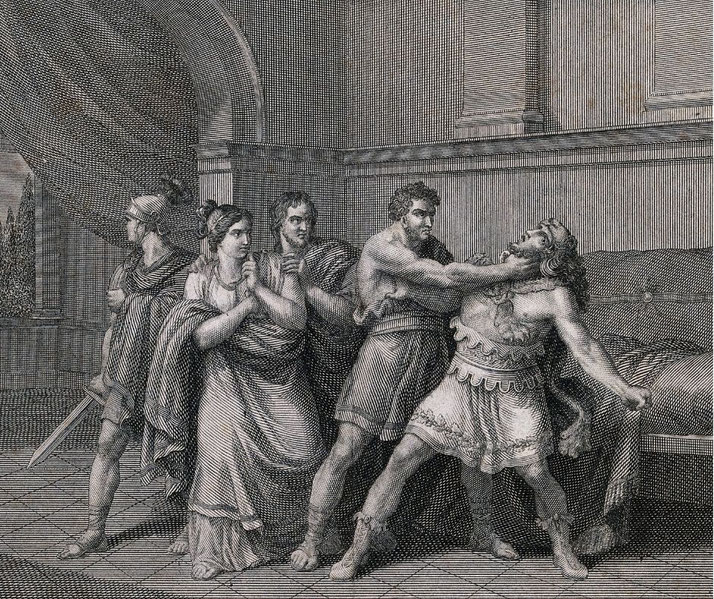
Commodus did not die in the arena. His death came on 31 December 192 AD, and it was the result of a conspiracy organised by people within his own inner circle.
The plot was triggered by a specific event: Commodus's concubine, a woman named Marcia, discovered that her name appeared on a list of people the emperor planned to have executed.
Herodian wrote that Commodus left the tablet on his couch, and the boy Philocommodus carried it into the palace, after which Marcia took it from him and read the names.
When she shared the information with Eclectus, the emperor's chamberlain, and Quintus Aemilius Laetus, the prefect of the Praetorian Guard, all three realised they had to act quickly or face certain death.
They also feared what was coming the next day, because Commodus planned to inaugurate 1 January 193 AD as consul and as a secutor in the arena, meaning he intended to appear in public in gladiator gear.
On the evening of 31 December, Marcia attempted to poison Commodus. In Dio's account, she mixed the poison into beef.
In Herodian's version, she laced his wine. Commodus vomited shortly afterwards, and Dio explained that his survival was likely due to heavy wine drinking and frequent baths.
Fearing that the emperor would recover and discover the assassination attempt, the conspirators sent Narcissus, an athlete, to strangle him as he bathed.
Narcissus killed him, ending a reign of twelve years, nine months, and fourteen days that had grown increasingly erratic and authoritarian.
Commodus was thirty-one years old.
After his assassination, the Senate declared a damnatio memoriae against Commodus, ordering his name to be chiselled from public inscriptions and his statues to be torn down or reworked.
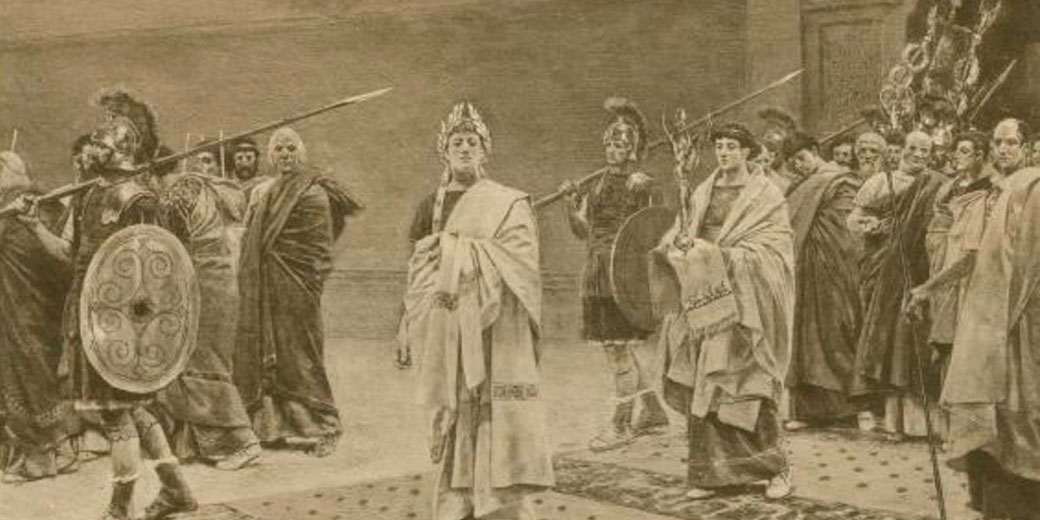
Pertinax, a respected senator and military commander, was proclaimed emperor the following day, on 1 January 193 AD.
His own reign lasted only eighty-seven days before he too was murdered, plunging Rome into the chaotic Year of the Five Emperors.
In 195 AD, Septimius Severus later rehabilitated Commodus's memory and pushed the Senate to deify him, a move that helped support his own claims of connection to Marcus Aurelius.