
Was the Colossus of Rhodes as big and impressive as we've been told?
Among the monuments celebrated by ancient writers, the Colossus of Rhodes was built during the early Hellenistic period, it honoured Helios, the island’s patron god, after Rhodes had repelled a large siege by Demetrius Poliorcetes in 304 BC.
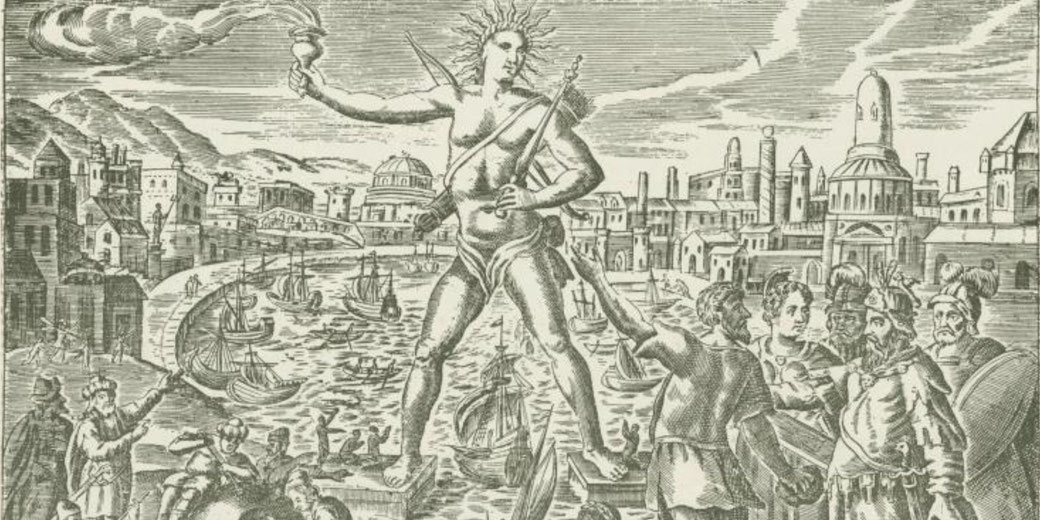
Over time, later writers and artists appear to have added details to its image and transformed the statue into a symbol that later authors described as very large in scale and fantasy-like in design.
Yet, without physical remains or reliable eyewitness descriptions, modern estimates must question whether the Colossus truly reached the heights or a particular posture described by ancient authors, and whether later accounts amplified its apparent splendour.
Why was the Colossus of Rhodes built?
By the early third century BC, Rhodes occupied an important position at the crossroads of Mediterranean trade.
Its influence depended on control of nearby sea routes and on a neutral foreign policy in the conflicts that erupted after the death of Alexander the Great.
In 305 BC, that strategy collapsed when Demetrius I of Macedon attacked the island with a large fleet and siege force, as he attempted to draw Rhodes into his sphere of influence.
During the siege, Demetrius’ engineers used advanced artillery and tall siege machines.
Among them stood the helepolis, a siege tower that ancient sources, such as Diodorus Siculus, claimed exceeded 40 metres in height and featured catapults and battering rams on multiple levels.
However, modern estimates suggest it may have been somewhat smaller. Even with the scale of the assault, Rhodes withstood the attack.
Support from Ptolemaic Egypt appears to have ensured that the population remained supplied.
The city’s sturdy defensive walls withstood Demetrius’ siege craft probably because, as a member of the League of the Islanders and an ally of Egypt, Rhodes benefited from a powerful external alliance that helped frustrate Demetrius' campaign.
After a year, Demetrius had withdrawn, abandoning his equipment on the beach, and, in response, the Rhodians decided to honour their survival by dedicating a statue to Helios, whom they credited with securing their deliverance.
To fund the monument, they appear to have melted down the bronze from the captured siege weapons and combined it with public donations.
Some ancient reports suggest that over 13 tonnes of bronze were reused in the statue's construction.
As a result, the project appears to have become a religious dedication and a public show of power.
It showed gratitude and presented a public claim to status within the fragmented world of post-Alexandrian Greece.
How was the Colossus of Rhodes built?
Construction probably began around 292 BC and continued for roughly twelve years.
Chares of Lindos was reportedly a Rhodian sculptor who had trained under Lysippos and who managed the work.
He brought with him both artistic skill and experience with bronze, which probably helped translate a religious concept into a large engineering task.
Modern scholars suggest he may have drawn inspiration from the very large bronze Athena Promachos in Athens, which also stood on high ground near the city’s entrance.
To raise the statue, labourers likely used an earth embankment that surrounded the structure as it grew in height.
This technique likely provided steady access to the upper sections and distributed weight safely during construction.
Workers would have packed soil around each completed level and continued to build upward, as bronze plates were added incrementally over an iron and stone interior frame.
Importantly, the interior structure probably combined stone filler with iron supports to carry the load.
The base of the statue, which was weighed down with heavy stones, gave stability to the entire monument.
Surviving ancient reports suggest the finished statue had stood around 32 metres high, though it remains unclear whether this measurement included the pedestal.
If accurate, it would have equalled or exceeded many temple facades and matched the heights of large buildings in other major cities.
Scholars have debated whether Chares used the lost-wax method, common in large Greek bronzes, to cast individual plates before assembling them into the final structure.
Sources give few details about the statue’s pose; however, artistic convention and engineering limits suggest that Helios, whose arms were possibly raised or at his sides, stood upright, both feet planted on solid ground.
Ancient sculptors usually preferred balanced, grounded stances when designing bronzes of large scale.
Given the tools and methods available, such a pose would have offered the best chance of structural success.
Pervasive myths about the structure
Over centuries, writers and artists recreated the Colossus as a figure that bore little resemblance to historical reality.
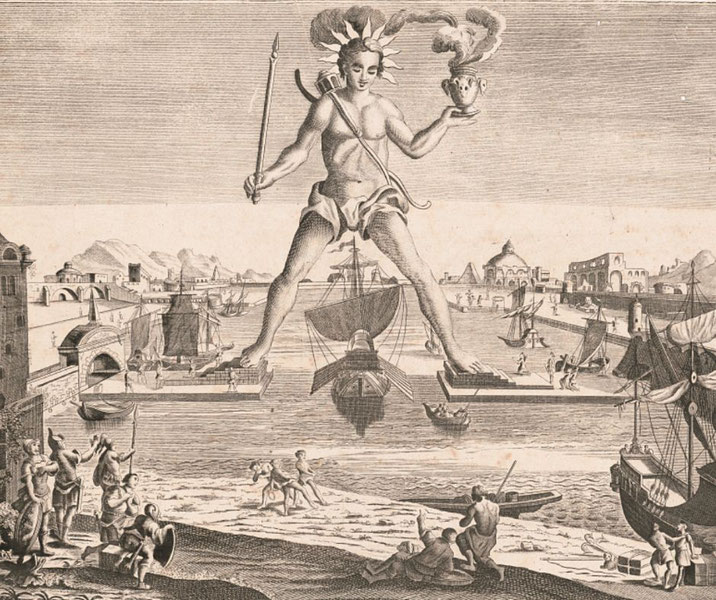
Most famously, Renaissance artists helped popularise the idea that the statue stood with legs astride the harbour so ships could pass between them, but ancient sources never described this arrangement.
On the contrary, the practical difficulties of casting and supporting such a pose made it nearly impossible.
Maarten van Heemskerck’s 16th-century woodcuts played a major role in spreading the harbour-straddling image, which had no basis in classical descriptions.
To support a structure of that size, the statue would have required great horizontal stability and precise distribution of weight.
No other bronze figure from the period is known to have come close to attempting such an engineering challenge.
Ancient artisans knew the limits of their materials and designed accordingly.
Therefore, the statue almost certainly stood with its feet close together on land, possibly near the harbour entrance but never straddling it.
Another modern invention imagines the Colossus holding a flaming torch. This detail appears nowhere in ancient descriptions and it likely originated from later confusion with the Lighthouse of Alexandria, which did emit light and operated as a beacon.
The torch-bearing figure has since become popular through comparisons with the Statue of Liberty, especially after its unveiling in 1886, yet the original Colossus had no connection to navigation or harbour lighting.
Over time, such embellishments replaced historical evidence. Many of the misconceptions arose during periods when original sources were unavailable and artists relied on imagination rather than archaeology.
Today, these myths persist in textbooks, films, and digital recreations, which makes it harder to distinguish historical fact from fantasy.
Why does it no longer exist?
In 226 BC, a violent earthquake struck the island of Rhodes. It destroyed temples, damaged city walls, and caused the Colossus to collapse.
According to ancient writers, the statue broke at the knees and fell inwards upon itself.
The bronze fragments had lain where they had fallen, which formed a large ruin that astonished travellers for centuries.
Modern seismologists estimate the quake to have measured between 6.5 and 7.0 in magnitude.
Shortly after the earthquake, the Rhodians consulted the oracle at Delphi, and the priestess reportedly advised them not to rebuild the statue and warned that Helios had become displeased.
Whether the decision reflected genuine religious concern or simply the very high cost of reconstruction, the ruins were left untouched.
Over time, the fallen statue became an attraction in its own right, as ancient tourists included Roman travellers and Hellenistic writers such as Strabo and Pliny the Elder who recorded their impressions of the wreckage.
Pliny noted that people could wrap their arms around a single finger or climb onto parts of the fallen limbs, and these descriptions, full of awe, reinforced the statue’s fame, even though it no longer stood.
Centuries later, during the early 600s AD, Arab forces captured Rhodes, and later Islamic accounts included those by Al-Masudi that claimed the bronze remains had been sold to a merchant from Edessa who transported them away on more than 900 camels.
Modern historians regard that number as legendary rather than true, but the claim reflects a widespread belief that the Colossus eventually vanished through salvage and trade.
Since then, no verified fragment of the statue has ever been recovered, and no archaeological find has confirmed the original site with certainty.
Why do we still talk about the Colossus today?
The Colossus continued to be regarded as one of the most lasting symbols of ancient skill, even though no part of it has survived.
Its inclusion in the Seven Wonders of the Ancient World, a list compiled by Greek and Roman authors, ensured that it remained part of the classical canon.
That list, widely circulated in the ancient world, helped enshrine the statue as a cultural reference for later generations.
As time passed, the Colossus evolved into a symbol of what communities could achieve when many people worked together, used advanced metallurgical methods, and maintained long religious rituals.
In recent decades, there have been efforts to design and fund a modern reconstruction of the statue.
The 2015 Colossus of Rhodes Project, which was developed by a group of European architects, proposed a new cultural centre and viewing platform to honour the ancient monument, but the proposal did not gain governmental backing and was never implemented.
Still, the ongoing interest reveals how deeply the Colossus continues to stir public imagination.