
When mad emperor Caligula declared war on the sea ... and then claimed he had defeated it
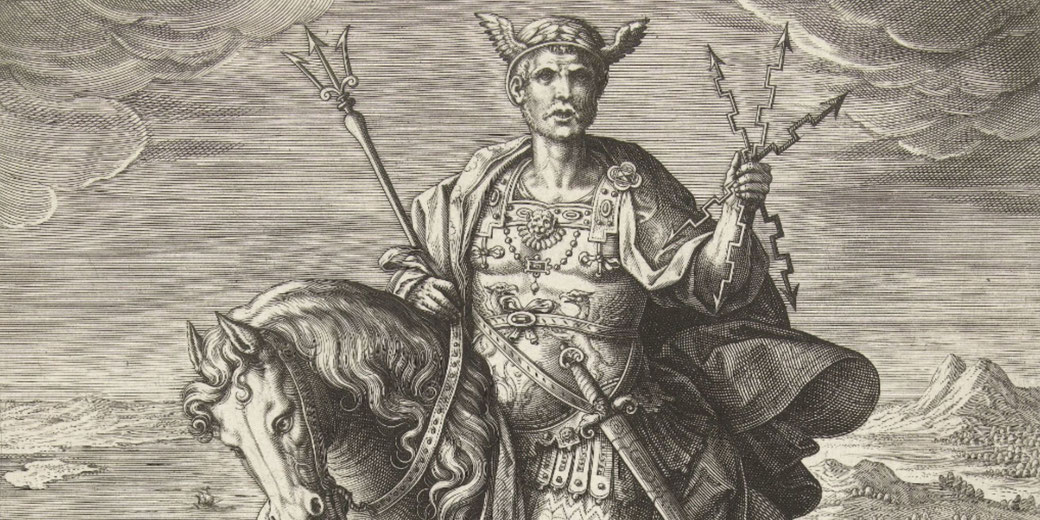
One of the strangest episodes of imperial behaviour recorded by Roman historians occurred on the day when Emperor Caligula marched his soldiers to the coast of Gaul, ordered them to collect seashells, and proclaimed victory.
While the story has often been dismissed as a fable used to emphasise his madness, the episode still reveals the theatrical displays of imperial rule, which turned public ritual into spectacle and used ceremony as a political tool, and the political instability that noted the final years of his reign.
But did it really happen?
An empire ruled by a madman
Caligula was born Gaius Julius Caesar Augustus Germanicus in AD 12 and became emperor in March AD 37 after the death of his great-uncle and adoptive grandfather, Tiberius.
Caligula belonged to Rome’s most powerful and politically connected family, as he was the son of Germanicus, who had commanded legions on the Rhine, and of Agrippina the Elder, who was the granddaughter of Augustus.
During his early years, he accompanied his father on campaign and wore a soldier’s outfit that included the small boots, caligae, which gave rise to his famous nickname.
After Germanicus had died under suspicious circumstances in AD 19, Caligula’s family had fallen from imperial favour, since Tiberius had exiled Agrippina and had executed her elder sons.
Caligula had survived as he had concealed his intentions and had remained outwardly loyal.
By the early 30s AD, he had joined Tiberius on the island of Capri, where he lived in isolation while the emperor conducted affairs of state in seclusion.
When Tiberius died in AD 37, Caligula’s succession proceeded smoothly with the support of the Praetorian Guard and the Senate, who welcomed a return to Julian leadership.
At first, his rule brought widespread public celebration, as he released political prisoners, paid generous donatives to the Guard, restored religious rites, and held lavish games that won the favour of the crowds.
After years of suspicion and secrecy under Tiberius, Roman citizens viewed Caligula as a symbol of renewal.
However, only months after taking power, he suffered a sudden and severe illness.
According to later sources, his recovery is considered to be the start of a sharp change in his personality.
After that, reports of cruelty and extravagant behaviour began to dominate accounts of his reign, which cast him as unpredictable and severe.
He ordered the executions of family members and close allies, referred to himself as a living god, and expected temples across the empire to display his image alongside Jupiter’s.
According to Seneca and Suetonius, he treated senators with contempt, imposed taxes without justification, and issued orders that defied logic or tradition.
Roman elites soon feared that the empire had passed into the hands of a man unbound by reason or restraint.
Philo of Alexandria, who had witnessed his rule, described him as emotionally unstable, consumed by superstition, and incapable of distinguishing between his human and divine selves.

How did Caligula wage war on the waves?
Around AD 39 or 40, Caligula travelled north during an imperial inspection and arrived at the coast near present-day Boulogne-sur-Mer in Gaul, then known as Gesoriacum, a key Roman naval base.
According to Suetonius and Dio, he summoned his legions to the shore, arranged them in battle formation, and ordered them to prepare for an assault on the sea.
Trumpets sounded, arms were raised, and the soldiers awaited further instructions as if facing a real enemy.
Then, with no warning, Caligula dismissed the battle and declared victory. Ancient authors later interpreted this as a symbolic triumph over the god Neptune.
Next, he instructed the troops to collect seashells along the beach and store them as trophies of the campaign.
According to these accounts, the shells were boxed and carried back to Rome as “spoils” of the conquest.
Some writers claimed that Caligula may have ordered a tower or lighthouse that would mark the event.
While no inscriptions or physical remains have so far been clearly linked to him, later medieval descriptions of a Roman tower near Boulogne were sometimes later attributed to his reign, though the evidence continues to be inconclusive.
Some sources claimed that he even distributed decorations and honours to officers who had taken part.
Occasionally, Caligula had used showmanship that blurred the boundary between ritual and command.
Earlier, he had constructed a floating bridge across the Bay of Baiae, which Suetonius claimed stretched over 3,600 paces, a measurement sometimes treated with scepticism, and ridden across it dressed in golden armour, surrounded by attendants and musicians.
He had also staged mock battles that served as entertainment and had demanded divine honours.
The “war on the sea” belonged to the same pattern of staged spectacle, where victory no longer required an enemy and command became a personal performance.

What motivated this strange behaviour?
Ancient writers presented Caligula’s behaviour as evidence of madness. According to Suetonius, he experienced delusions and cruel fantasies, accompanied by episodes that resembled seizures.
Seneca portrayed him as a man who ridiculed suffering and dismissed the distinction between mortal and divine.
After his illness in AD 37, many believed he had become mentally unwell, possibly from neurological damage or emotional trauma linked to the deaths of his mother and brothers.
Some modern scholars have proposed lead poisoning or temporal lobe epilepsy as possible contributing factors.
Although no diagnosis can be proven, the change in his conduct appeared abrupt and extreme.
However, some scholars have argued that the Neptune campaign had a political or symbolic function.
First, it may have been a parody of military tradition, since triumphs in Rome usually followed real victories, required Senate approval, and involved formal rituals.
By declaring war on the sea and collecting shells as spoils, Caligula mocked that system and reminded the Senate that honour had come not from merit, but from his personal will.
Second, the event may have aimed to reinforce loyalty within the army. The Rhine legions had once rebelled after Augustus had died in AD 14, and their loyalty remained a sensitive issue.
By forcing them to perform an absurd campaign and accept imaginary rewards, Caligula could test obedience while avoiding the risk of real battle.
At the same time, it displayed his power to command actions that defied logic yet still demanded compliance.
Third, his insistence on divine identity made the act more than a mockery. If Caligula saw himself as a god, an idea that he reportedly expressed both in temples and at public events, then a war against Neptune may have carried a kind of religious meaning.
Conquering the sea reinforced his claim to universal authority and placed him above traditional religious boundaries.
In his view, Rome’s emperor did not request divine support. He issued commands to the divine.
Can we trust the historical sources?
The most detailed descriptions of the Neptune episode appear in Suetonius’ The Twelve Caesars and Dio Cassius’ Roman History.
Suetonius, who had written during the reign of Hadrian, had shaped his biographies to entertain and to warn about the evils of poor moral choices.
As such, his narrative emphasised scandal and irony, and it presented those elements as evidence of moral decline.
Dio, who had written in the early third century, had followed similar patterns and had drawn from now-lost memoirs, official records, and court rumours.
Both authors wrote long after Caligula’s death and manipulated their stories to reinforce later imperial values.
Unfortunately, Tacitus’ account of Caligula has not survived beyond a few fragments.
His version may have been more restrained, but without it, modern historians rely on sources that mix fact with storytelling.
Roman historical writing often used portrayals to show political failure, and tyrants such as Nero, Domitian, and Commodus received the same narrative treatment.
Biographers presented madness and arrogance as signs of corrupt power, and they portrayed blasphemy as further proof of that corruption.
Josephus had also chronicled Caligula's reign and had described how the emperor had ordered a statue of himself to be erected in the Jerusalem Temple.
The statue was never installed, but the attempt caused unrest throughout Judea.
No archaeological evidence has yet confirmed the campaign or its monuments.
Although Roman structures exist near Boulogne, none can be definitively linked to Caligula.
No coins or inscriptions record a triumph over the sea. Still, agreement among sources suggests that some kind of performance probably took place.
Whether Caligula staged a mock battle, delivered a speech, or held a ritual offering, the act likely acted as imperial theatre with political effects.
What happened to Caligula after this event?
Soon after he had returned from the northern provinces, Caligula made his rule more excessive, as he imposed severe taxes, confiscated property, and used public auctions to raise funds.
According to Suetonius, he claimed to own the state and its people, and he frequently insulted senators during public appearances.
He constructed a palace that absorbed the Temple of Castor and Pollux, using it as a private entry hall, and invited foreign kings to worship him as a living deity.
Tensions in the capital worsened as the Senate had already been sidelined by imperial reforms and lost any remaining influence.
The Praetorian Guard had been well paid and had grown uneasy. On 24 January AD 41, while walking through a palace corridor during a festival, Caligula was attacked by officers of the Guard.
Cassius Chaerea had often been mocked by the emperor and delivered the first blow.
Other conspirators included Cornelius Sabinus and Julius Lupus, and they joined in, killing him, his wife Caesonia, and their daughter.
According to one account, Claudius was found hiding behind a curtain and proclaimed emperor by the Guard shortly after.
In the hours that followed, the Senate debated whether to restore the Republic.
The discussion proved short-lived, as the Praetorian Guard acted first by installing Caligula’s uncle, Claudius, as emperor.
Soon after, the new regime ordered the destruction of Caligula’s statues and the removal of his name from public monuments, and his short reign left a clear impression on Roman memory.
Whether the war on the sea occurred as described or not, the story endured as a symbol of the dangers of unchecked power, where authority turned spectacle into command and madness became indistinguishable from rule.