
How the Roman navy learned to rule the sea

There are not many military changes in ancient times that occurred with the urgency and size that defined Rome’s naval expansion during the third century BC.
Faced with Carthage’s control of the sea and western Mediterranean trade, the Roman Republic, previously dependent on land-based conquests, assembled a war fleet, and they initially lacked both naval bases and seafaring experience.
Over the next century, though, Roman commanders, engineers, and infantrymen changed sea warfare so that ship battles depended on soldiers who fought aboard enemy vessels, and they had built a fleet that helped Rome to dominate much of the Mediterranean for centuries.
Rome’s navy before the Punic Wars
Prior to the First Punic War, which began in 264 BC, Roman military success relied on its heavily trained legions, who had secured control over most of the Italian Peninsula through colony foundations and strategic alliances, supported by a system of military roads.
Naval matters received little attention from the Senate, and coastal defence had remained the responsibility of Rome’s southern Greek allies, such as Neapolis and Tarentum, who maintained small coastal squadrons.
However, conflict over Sicily brought Rome into direct confrontation with Carthage, whose navy had grown from Phoenician roots into a professional fleet of quinqueremes staffed by skilled sailors and supported by powerful dockyards in North Africa and western Sicily.
At this point, the Romans possessed no quinqueremes of their own and had never faced an enemy with much greater naval power.
Estimates suggest that Carthage entered the war with perhaps 120 or more warships and a long history of seafaring, which it had inherited from Tyre and Sidon.
How Rome built their first war fleet
According to Polybius, Roman engineers had copied a wrecked Carthaginian quinquereme, which they used to begin their own shipbuilding program.
They had reportedly produced over one hundred warships within a few months.
Despite their lack of seafaring experience, drafted workers, who manned Roman shipyards, and military officials, who oversaw them, managed to produce a fleet capable of confronting Carthaginian squadrons head-on.
However, Roman crews initially lacked the training to compete in ship handling or synchronised rowing, so they developed a mechanical boarding bridge known as the corvus.
The corvus measured up to 36 feet in length and weighed over a ton, and it fastened itself to an enemy ship using a heavy iron spike, which allowed Roman marines to cross and to initiate close fighting.
As a result, Roman naval battles began to resemble land engagements, where disciplined units and tight formations allowed marines to impose overwhelming force at close quarters.
Ancient critics later argued that the corvus made ships dangerously unstable in rough seas, which likely contributed to the loss of several fleets during storms.
At the Battle of Mylae in 260 BC, Gaius Duilius relied heavily on the corvus to negate the Carthaginians’ tactical superiority at sea, and he led the newly built fleet and secured Rome’s first major naval victory.
His success earned him a triumph in Rome, and a commemorative column bore ship prows and was called rostra, and it stood in the Forum for centuries.
The Column of Duilius also featured one of the earliest known Latin prose inscriptions on a public monument.
Over the next two decades, the Republic repeatedly lost fleets to storms and poor seamanship, yet the Senate continued to rebuild and rearm, and it treated naval construction as an urgent wartime necessity rather than an afterthought.
As such, the ability to produce large numbers of warships quickly largely became a strategic advantage, especially when matched with Roman infantry tactics adapted for maritime conditions.
Turning the tide against Carthage
By 256 BC, Rome had committed to a major naval invasion of North Africa, which required the assembly of over 300 warships and thousands of infantry.
At the Battle of Ecnomus, considered one of the largest naval engagements in ancient times, Roman formations managed to keep formation despite Carthaginian attacks and successfully landed forces near modern-day Tunisia.
According to Polybius, the Romans deployed around 680 ships and 140,000 men.
Polybius may have exaggerated the figures, though the overall scale of the operation is undisputed.
They arranged their fleet in a wedge formation to concentrate their strength.
Although the African campaign faltered on land, the naval victory demonstrated Rome’s growing ability to coordinate sea-based military operations.
When the war drew to a close in 241 BC, it was the Roman fleet under Gaius Lutatius Catulus that delivered the final blow.
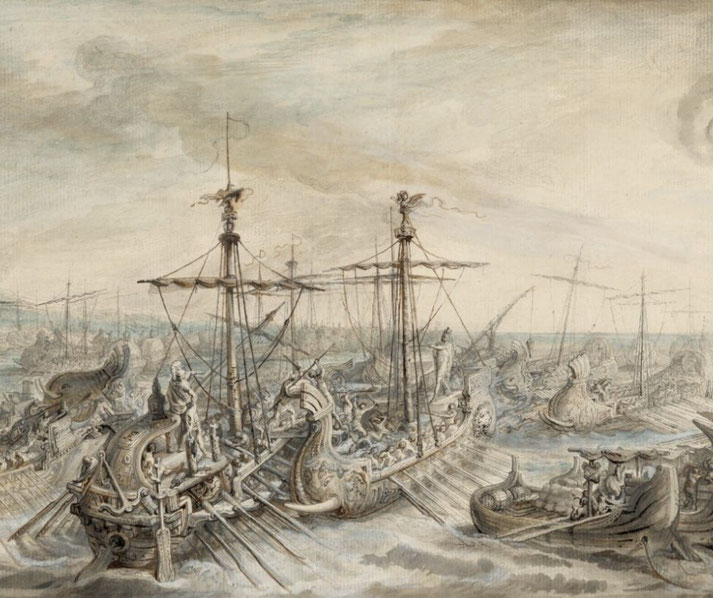
At the Battle of the Aegates Islands, the Romans destroyed the Carthaginian fleet using improved hull designs and better-trained rowers, after they had removed the cumbersome corvus to increase speed and their ability to manoeuvre.
This is a decision that modern historians inferred because sources do not mention its use and because the tactics emphasised agility.
Many of the Carthaginian crews were hastily recruited and inexperienced, which further tilted the battle in Rome's favour and forced Carthage to sue for peace and accept the loss of Sicily, Sardinia, and Corsica.
After the war, Rome continued to use its navy to protect grain convoys from Sicily, secure sea lanes, and monitor piracy across the Tyrrhenian and Adriatic Seas.
When the Second Punic War began in 218 BC, Carthage shifted its strategy to land campaigns under Hannibal, yet Rome’s navy remained active across the western Mediterranean, primarily in defensive and supply and support roles rather than sustained offensive campaigns.
As a result, they carried legions to Spain, maintained supply routes, and prevented reinforcements from reaching Hannibal’s forces in Italy.
For instance, Publius Scipio attempted to intercept Hannibal near Massalia but arrived too late to prevent his crossing of the Alps.
Roman commanders increasingly viewed naval power as a critical extension of their military system, which generally allowed them to pursue offensive campaigns in multiple theatres without endangering their homeland.
By the time Scipio Africanus defeated Hannibal at Zama in 202 BC, Roman naval supremacy had already influenced the course of the war by isolating Carthaginian holdings, and it had largely ensured uninterrupted supply support for land campaigns.
How the navy ruled the Medittereanean
As Rome expanded into Greece, Macedonia, and Asia Minor during the second century BC, naval forces transported armies, escorted officials, and helped establish new provinces.
Roman commanders such as Lucius Aemilius Paullus and Gaius Octavius used coordinated land-sea operations to dismantle the remaining Hellenistic kingdoms, while the Senate established permanent naval stations at Delos, Piraeus, and Rhodes.
Patrols in the Aegean suppressed piracy and protected merchant vessels, while large grain shipments from Egypt and Sicily reached Rome without interference.
Meanwhile, the state made the role of the navy official within its military hierarchy, assigning equestrian prefects to command major fleets and directing provincial governors to coordinate with regional squadrons.
During the final century of the Republic, the navy assumed new roles in civil conflict.
Julius Caesar crossed the Adriatic in 48 BC to confront Pompey, relying on his control of the western coast and the loyalty of key ports.
Later, when Sextus Pompey used a large fleet to blockade Rome’s grain supply from Sicily, Octavian responded by commissioning an entirely new fleet under Marcus Agrippa.
Agrippa trained new crews, built a naval base at Portus Julius, and introduced innovations such as the harpax, a grappling device launched by catapult described by Appian, which allowed for quicker boarding.
At the Battle of Naulochus in 36 BC, Agrippa defeated Sextus, ending the blockade and restoring grain shipments to Rome.
His success paved the way for the final civil war, in which Agrippa again led Octavian’s forces at the Battle of Actium in 31 BC.
With a fleet of approximately 400 ships, many of them lighter and faster than Antony’s larger deceries, Agrippa encircled the enemy and forced them into disorganised retreat, and he secured a clear victory that made Octavian the undisputed ruler of the Roman world.
The navy under the empire
Under the Principate, the navy became a permanent military institution with fleets stationed at key imperial centres.
The Classis Misenensis and Classis Ravennatis operated from the western Italian coast and the Adriatic respectively, while auxiliary fleets patrolled the Danube, Nile, and eastern Mediterranean.
Each fleet maintained a variety of ships, including fast liburnians, supply transports, and patrol vessels.
Naval prefects, who were often drawn from the equestrian class, reported directly to the emperor and oversaw both administrative and operational matters.
Notable commanders such as Sextus Lucilius Bassus helped to develop naval doctrine during the Flavian period.
Fleets escorted governors to new provinces, transported legions across dangerous crossings, and enforced Roman authority in regions prone to rebellion or piracy.
During Claudius’ invasion of Britain in AD 43, the navy transported legions across the Channel and supported operations by ferrying supplies and by building pontoon bridges.
Similar deployments occurred along the Rhine and Danube, where fleets moved troops quickly across difficult terrain and helped reinforce frontier defences.
Naval outposts along the Black Sea and Red Sea helped facilitate contact with client kingdoms and protected long-distance trade.
Although piracy persisted in parts of the eastern Mediterranean, Roman naval patrols typically responded with swift and effective force, and they generally prevented criminal groups from threatening imperial revenues.
What happened to Rome’s naval power?
Later, during the decline of the Western Roman Empire, the navy suffered from the same shortages and logistical failures that weakened the legions.
After the Vandals had seized Carthage in AD 439, they had established a base for maritime raids and had developed a new fleet capable of striking coastal Italy, and because of that, under King Geiseric, Vandal ships had reached Rome in AD 455 and plundered the city.
They removed valuables and took captives in a raid that exposed the deterioration of Roman naval defences and that showed how far the western naval presence had declined.
The imperial administration could no longer launch effective counterattacks or reliably protect its sea routes, which accelerated the empire’s fragmentation and economic instability.
Nonetheless, the eastern fleet, based in Constantinople, generally retained greater effectiveness and eventually evolved into the Byzantine navy, which introduced weapons such as Greek fire, a flammable liquid projected from siphons mounted on ships, to maintain naval supremacy into the Middle Ages.