
The controversial history of the Arch of Constantine the Great in Rome
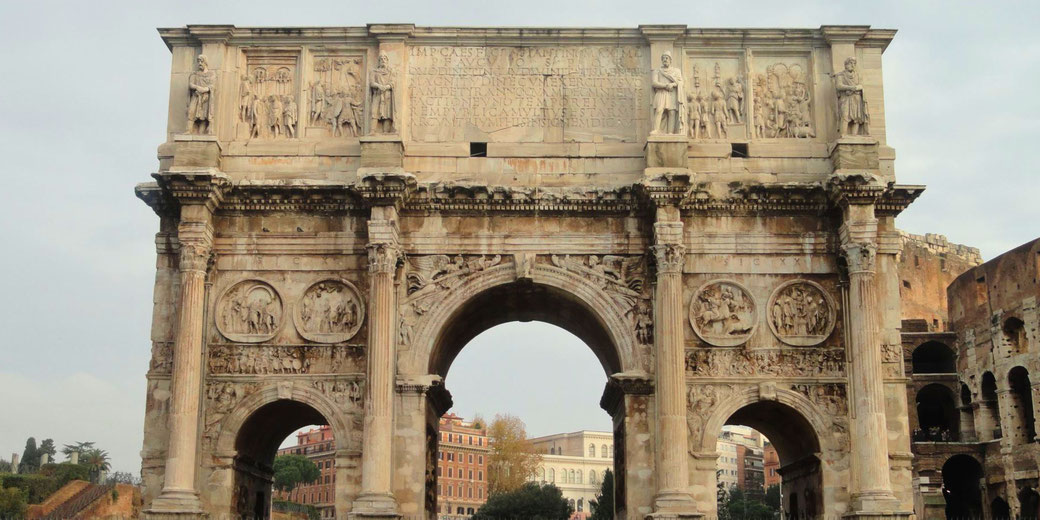
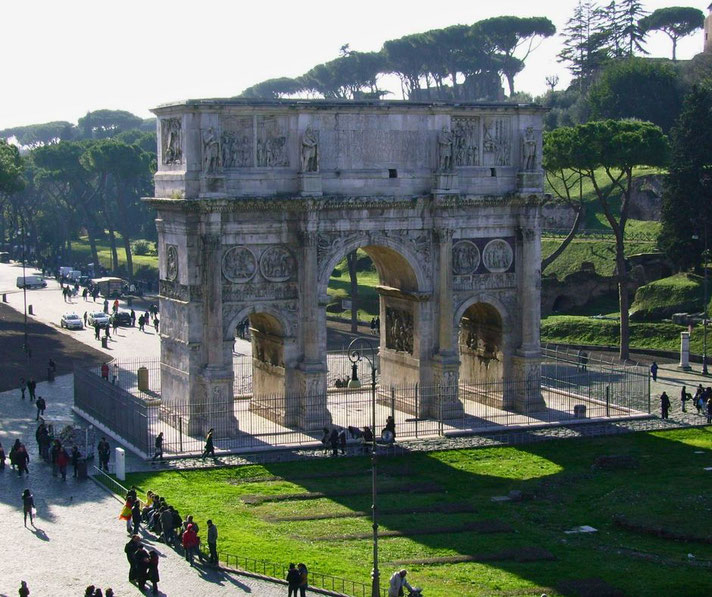
The Arch of Constantine currently stands beside the Colosseum along the ancient Via Triumphalis and has sparked debate among historians, archaeologists and theologians for centuries.
The monument was dedicated in AD 315 to honour Constantine’s victory over his rival Maxentius, with construction that likely began shortly after the Battle of the Milvian Bridge in AD 312, and it combined reused imperial artwork with unclear religious references.
At first glance, it appears to be a standard triumphal arch, yet closer inspection reveals intentional political messages, reused sculpture and religious uncertainty that suggest Constantine used the arch to secure his rule during a period of serious unrest in Rome.
The bloody conflict behind the arch
After Emperor Diocletian established the Tetrarchy in AD 293, he hoped to create a stable succession system by dividing imperial power between two senior rulers and two junior ones.
Following his retirement in AD 305, that system had largely collapsed under pressure as personal rivalries split the ruling elite, competing dynastic claims produced rival courts, and commanders raised their legions to pursue private power.
Maxentius was the son of the retired emperor Maximian and declared himself emperor in Rome with the backing of the Praetorian Guard, despite lacking formal recognition.
At the same time, Constantine, who had been elevated to the rank of Caesar by his father Constantius Chlorus and who had been confirmed by Galerius, governed from Gaul and also asserted his claim.
By AD 312, Constantine led his army, which modern estimates place at between 20,000 and 40,000 men, across the Alps, defeated Maxentian forces at Turin and Verona, and approached Rome from the north.
Maxentius commanded a larger force that may have numbered up to 75,000 and reportedly relied on Rome’s religious protection and misleading omens.
On 28 October, both sides prepared for battle near the Milvian Bridge. Maxentius positioned his men in front of a temporary pontoon bridge he had built across the Tiber.
During the retreat, the bridge collapsed, and thousands of his troops drowned, so his own body was later recovered from the river and paraded through the streets of Rome, while Constantine entered the capital as a victorious ruler endorsed by the Senate.

Constantine’s religious epiphany
Soon after the battle, some Christian writers began to shape a religious account around Constantine’s success.
According to Lactantius, he experienced a dream that instructed him to place a sacred sign on his soldiers’ shields.
Eusebius later claimed that Constantine saw a cross of light in the sky that bore the words, “By this sign, conquer.”
According to both sources, Constantine interpreted this as a religious message and credited the Christian God with his victory.
His later actions seemed to support this view. He issued the Edict of Milan in AD 313, alongside Licinius, which granted religious toleration to Christians and ordered the return of confiscated church property.
He also met with bishops on occasion, commissioned church buildings, and intervened in theological disputes.
However, he still formally retained the title pontifex maximus, issued coins that showed Sol Invictus, and took part in ceremonies linked to Rome’s traditional cults.
At the time of the arch’s construction, Constantine had not publicly identified himself as a Christian emperor.
The inscription on the monument referred only to “religious inspiration,” and it avoided specific mention of Christ or Christian doctrine.
Some modern scholars suggest that the original phrasing may have included "instinctu divinitatis mentis magnitudine," which implied a dual credit to religious influence and Constantine's own greatness.
Others have argued that the phrase may have been changed or had words added in late antiquity by copyists to match later Christian readings.
Consequently, observers from both Christian and pagan communities could interpret the language in ways that matched their own beliefs.
Why did Constantine build a triumphal arch?
When Constantine constructed a monumental arch in the heart of the capital, he followed the example of emperors who had used architecture to mark military victories and show control.
Unlike earlier arches, which honoured campaigns against foreign enemies, his monument celebrated a civil war victory over a fellow Roman.
To address this tension, the arch’s inscription apparently avoided naming Maxentius and instead described him as a tyrant and usurper who had oppressed the Roman people, since this choice of wording echoed the tradition of damnatio memoriae, which aimed to erase discredited figures from official memory.
To justify his campaign, Constantine framed himself as the defender of order and the restorer of peace, as the dedication described him as a man of “great spirit” who had acted “through religious inspiration” to free the state from unlawful rule.
His military success thus became a moral and religious act that also carried political weight.
Importantly, the arch also commemorated the tenth anniversary of his reign, a milestone known as the decennalia.
Its placement near the Colosseum, along the route of triumphal processions, ensured maximum public visibility, so that it displayed Constantine’s authority to anyone passing through the city’s main ceremonial space.
The monument also arguably gave visual form to his claim that he ruled with religious favour and had restored lawful government after a period of crisis.
Constantine’s destruction and reuse of other monuments
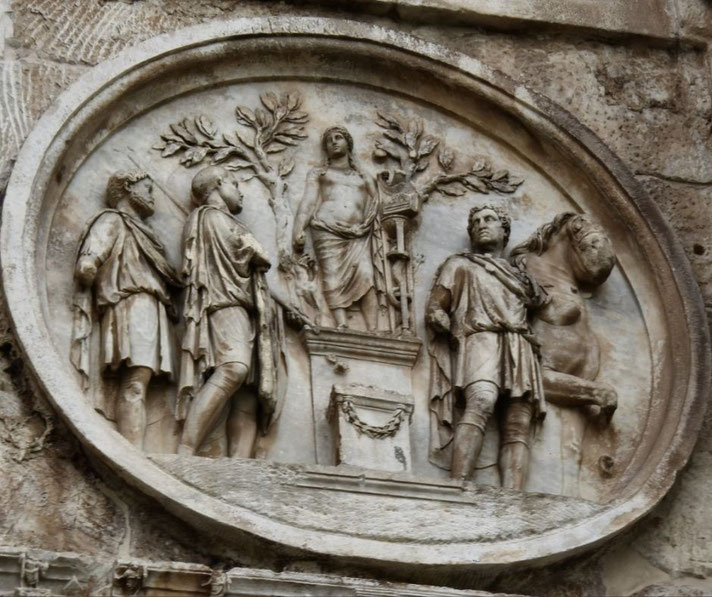
To complete the arch, Constantine’s builders removed reliefs and statues from earlier monuments that had been constructed under emperors such as Trajan, Hadrian, and Marcus Aurelius.
Specific scenes included lion hunts from Hadrianic reliefs, scenes of imperial clemency from Marcus Aurelius, and military campaigns from Trajan.
They re-carved the heads of earlier emperors, which they turned into images of Constantine, and reassembled the pieces on the new arch.
This approach left large sections of the monument that displayed scenes unrelated to Constantine’s reign, showing hunting trips, imperial audiences, and religious offerings from the second century AD.
At one level, this reuse may have shown a drop in sculptural skill or a shortage of resources during the early fourth century.
However, it is more likely that Constantine intentionally chose works from the reigns of respected emperors to associate himself with their memory.
The practice of spolia was not new, but this was widely regarded as one of the most systematic uses of earlier imperial imagery to support his political message.
The use of Hadrianic, Trajanic, and Antonine sculpture visually aligned Constantine with the so-called golden age of Roman emperors, which those earlier reigns had represented.
As a result, the arch presented a edited version of history. When he had inserted his own face into scenes that were originally made for other rulers, Constantine recast the past to fit his own narrative.
The contrast between the elegant classical style of the reused panels and the rougher workmanship of the new reliefs created an uneven visual effect.
Still, the message was arguably clear: Constantine now stood in the line of Rome’s most admired rulers and had inherited their religious sanction.
His desperation to please both old and new
To maintain his grip on power, Constantine needed to manage a divided population, since traditional Roman elites largely remained loyal to pagan religion, which still had considerable cultural and institutional influence in the capital.
At the same time, Christianity had won wide support among soldiers, merchants and provincial communities.
Without careful messaging, Constantine risked alienating one group or provoking resistance from both, so the arch avoided specific religious imagery and offered a compromise.
Its dedication to “religious inspiration” could plausibly apply to Jupiter as easily as to the Christian God, and its traditional sculptural themes appealed to the conservative values of the Senate.
At the same time, Many Christian viewers could interpret his victory and the monument itself as signs of God’s favour, especially given the events at the Milvian Bridge.
Elsewhere in the empire, Constantine pursued a more open Christian agenda, so he funded the building of basilicas, gave imperial land to the Church, and worked closely with bishops on questions of doctrine and discipline.
However, in the city of Rome, he maintained a more cautious tone, aware of its deep attachment to its pagan past.
Later Christian writers such as Ambrose and Prudentius often read Constantine’s rule more forcefully as guided by religious belief, but the arch itself stayed unclear.
Ultimately, the Arch of Constantine did not serve a single purpose, as it combined four aims: it broadcast a political message, offered a religious sign, presented an edited history and celebrated personal power.
When Constantine had assembled old fragments into a new structure, he produced a message of unity that largely masked the killings that scarred the streets, the ruined buildings left by recent fighting, and the widespread uncertainty among Romans about religious loyalties that lay beneath.
Notably, Renaissance artists later studied the arch for its classical elements, which helped it survive and remain influential long after the emperor who built it had died.