
The Second, Third, and Fourth Crusades explained
In the decades after the First Crusade’s sudden capture of Jerusalem, European rulers began three more major campaigns to defend and win back territory in the Holy Land.
Unlike the earlier crusade, the Second, Third, and Fourth Crusades fell apart in war and in politics, and many people criticised their behaviour.
From the mistakes in Anatolia to the looting of Christian Constantinople, these campaigns showed growing splits within the Christian world, and Muslim forces continued to fight under leaders such as Saladin.
What went so badly wrong to produce so many catastrophes?
Aftermath of the First Crusade
The First Crusade was fought from 1095 to 1099. It was successful in capturing Jerusalem and the surrounding area for the European forces.
Four Crusader states had been set up: the Kingdom of Jerusalem, the County of Tripoli, the Principality of Antioch, and the County of Edessa.
However, the Muslim nations in the Holy Land had not been defeated. In 1144, a Muslim leader was called Zengi, and he fought back against the crusaders and captured Edessa on the 24th of December.
Many Europeans found in the city were killed or sold as slaves.
This event made many Christians realise how risky their situation was: they were in a foreign land surrounded by enemy forces with more soldiers than them.
The Crusaders states knew that they could not hold on to their territories without further help from Europe.
The Second Crusade begins
Following the fall of Edessa to the Muslim armies, Pope Eugene III had called a Second Crusade in 1145.
Echoing the call of the First Crusade, the pope offered forgiveness of sins to any European lord or soldier who joined the military expedition.
To get more people to join, the pope asked the popular French abbot, Bernard of Clairvaux, to preach on the subject.
In response to the new crusade, around 60,000 men signed up, mostly from the regions of France and Germany.
The main armies were led by King Louis VII of France and Emperor Conrad III of Germany.
In fact, Eleanor of Aquitaine was the queen of France, and she accompanied her husband Louis VII on the Second Crusade, which made her one of the most well-known women to take part in the crusading movement.
The Crusaders travelled to Constantinople and marched through Anatolia, which was a mostly Muslim territory.
Along the way, they were joined by more soldiers from Italy, as well as others from France who had sailed to the Holy Land rather than walked.
The failure of the Second Crusade
The expedition was a disaster for most of the European forces. The Byzantine emperor had warned the Europeans that the Turkish forces were much stronger than during the First Crusade, and that they needed to exercise caution.
However, the Christian rulers did not follow this advice.
Once in Asia Minor, the two crusader forces were the Germans and the French, and they split up and took different routes towards the east.
Conrad III led the German army, and it did not take enough supplies and its food ran out quickly.
At Dorylaeum, they were attacked by the Seljuk Turks on the 25th of October 1147 and were driven back to the city of Nicaea.
Conrad was wounded and fled back to Constantinople.
Louis VII commanded the French army, and it defeated a Seljuk force in December 1147 but then suffered a severe defeat on the 7th of January, 1148, while crossing the Cadmus Mountains.
By the time they reached the Christian city of Antioch in March 1148, the army was in a mess.
In the end, the Turkish forces had destroyed about 90 percent of the German army and about half of the French troops during their attempt to cross Anatolia.
Around this time, Conrad had rejoined Louis with his remaining troops.
On the 24th of July 1148, the combined crusader army tried a poorly chosen and poorly planned attack on the Muslim city of Damascus, which was one of the richest cities in the region.
However, after just four days of weak siege warfare, the crusaders' assault on Damascus was stopped.
This was mainly because there was not enough water for their soldiers.
Then, the Europeans heard that a large Muslim army was being assembled nearby, which caused fear among the Crusaders.
As a result, it was decided to call an end to the rest of the crusade. Conrad III returned to his lands in Europe in September of 1148, and Louis did the same six months later.
The Second Crusade had been a clear military failure.
Rise of Nur ad-Din and Saladin
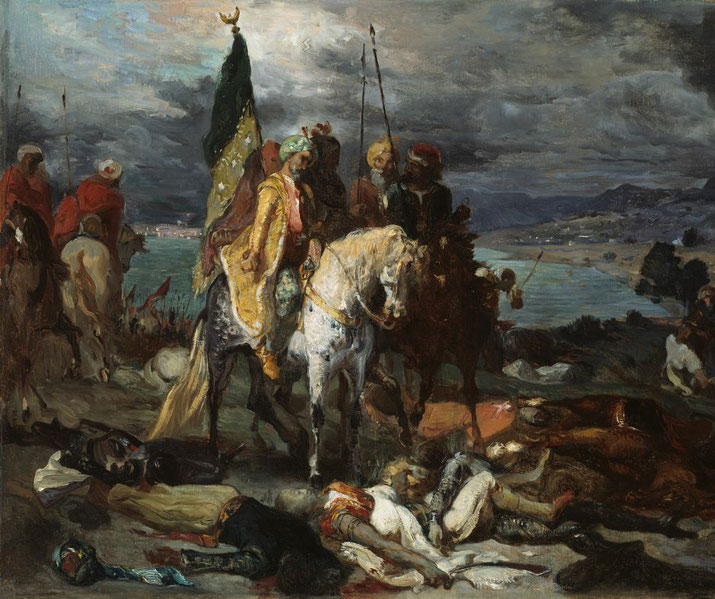
After the failed Second Crusade, two great Muslim leaders rose to power: Nur ad-Din and Saladin. Nur ad-Din was the ruler of Syria and Egypt.
He was a practical man who worked to bring many Muslim rulers together. Saladin was one of his generals.
He was from a Kurdish family who had migrated to Turkey.
In 1154, Nur ad-Din had seized Damascus, and he had made a detailed plan to surround the Crusader states by conquering Egypt to the south.
The Fatimid rulers of Egypt were helped against crusader attacks by Nur ed-Din's troops.
Saladin was one of Nur ad-Din's Egyptian expedition commanders and, in 1169, Nur ad-Din made him overall commander of his forces there.
In 1171, Saladin overthrew the Fatimid caliph. He worked officially for Nur ad-Din.
The thirty-three-year-old Saladin became the ruler of Egypt in practice.
When Nur ad-Din died in 1174, Saladin became the ruler of both Egypt and Syria, founding the Ayubid dynasty.
The Battle of Hattin and capture of Jerusalem
In 1185, an 8-year-old boy was called Baldwin V, and he became the king of Jerusalem.
In 1186, a Frankish nobleman broke the terms of a truce with Saladin and pillaged an enormous trade caravan which travelled from Egypt to Damascus.
Saladin's sister travelled with the caravan, and Saladin was furious.
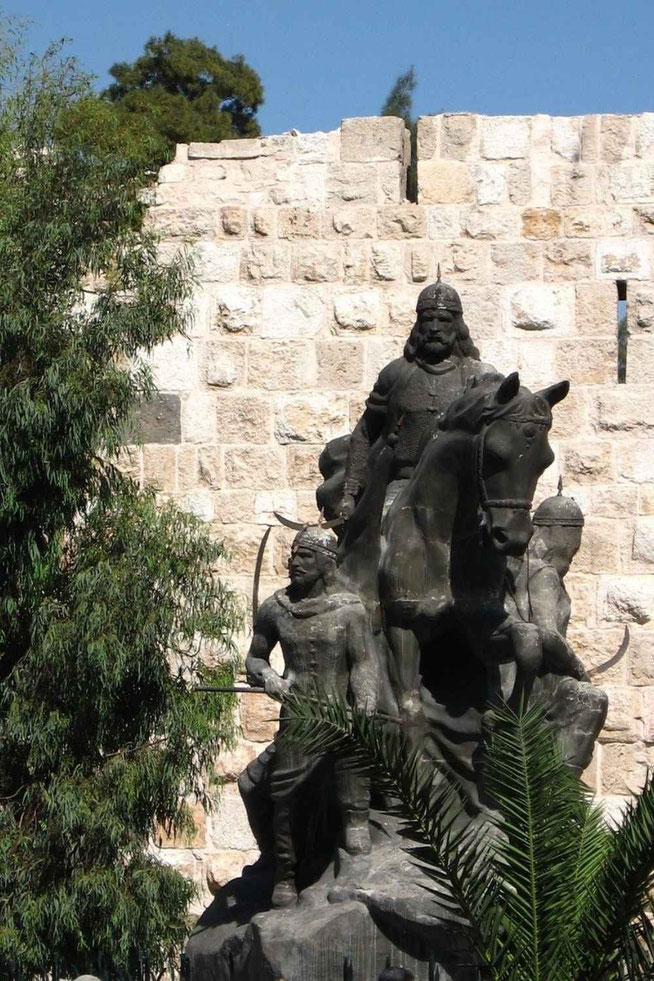
In response, Saladin invaded the kingdom of Jerusalem with a force of 20,000 men in May 1187 and captured the city of Tiberias from the Crusaders.
This was an important win because it cut off much of the Christians' access to the Sea of Galilee, which was their main source of supplies.
In July, Saladin faced off against a crusader army about the same size as his own, near two hills: the Horns of Hattin, which were west of the Galilee Sea.
The Franks, who accounted for the majority of the crusader army, marched north to try to recapture Tiberias, but made the error when they camped on a plateau with no access to fresh water.
By dawn on the battle's third day, the heat had already become intense, and the army was parched with thirst.
Weak and isolated, the crusader army was destroyed step by step by Saladin's army. Most of the Frankish leaders were killed or captured.
With the loss of so many men and valuable leaders, the city of Jerusalem was open to attack.
He then spent the next two months as he attacked Crusader strongholds in Galilee and on the Mediterranean coast.
Eventually, the two settlements of Acre and Gaza were captured by his troops. The important coastal city of Tyre continued to resist.
Finally, Saladin turned his forces towards Jerusalem, and the siege began on the 20th of September 1187.
Jerusalem eventually surrendered to him on the 2nd of October 1187.
Instead of killing the Christian soldiers and citizens in Jerusalem, Saladin gave them a pardon.
He accepted payment from some of the rich nobles to allow them to leave the city. Others continued to live under his rule.
With the fall of Jerusalem to the Muslim forces, the last remaining major Crusader stronghold in the Holy Land was the coastal city of Tyre.
Third Crusade
The Third Crusade was called by Pope Gregory VIII in 1187, after the Muslims had recaptured Jerusalem from the Christians.
The main armies were led by Philip II of France and Frederick I, the Holy Roman Emperor.
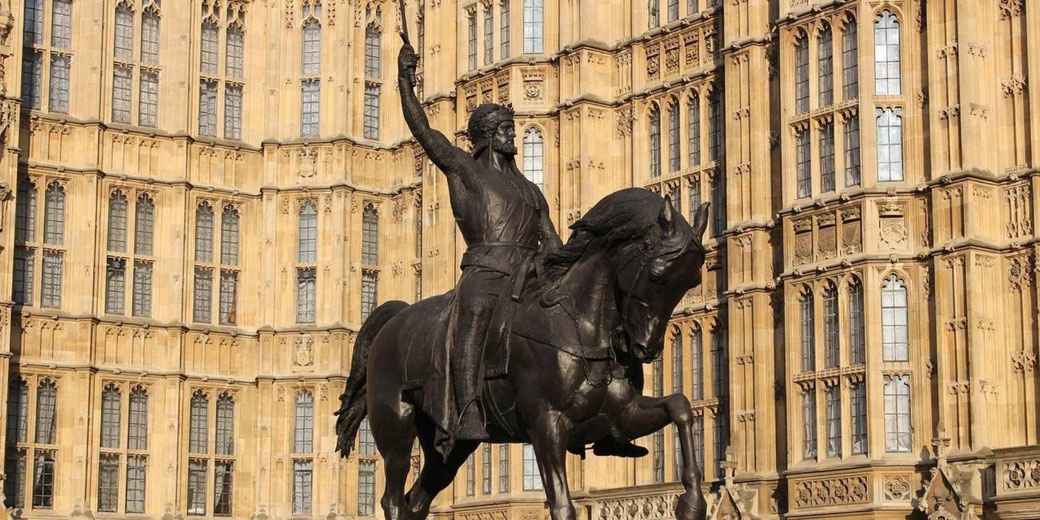
They were joined by a large army from England, led by King Richard I (also known as "Richard the Lionheart").
Frederick marched out in May 1189, with an army of around 20,000 mounted knights and foot soldiers.
However, when they tried to cross the Saleph River in eastern Anatolia in June 1190, the emperor drowned.
His troops then broke up.
The other Crusaders marched to the city of Acre, and they arrived in the early summer of 1191.
On July 12, they accepted the city's surrender, and they agreed to spare their lives in return for a payment of a large sum of money and the release of 1500 Christian prisoners.
However, by August, Saladin had failed to pay the agreed sum, and, in response, Richard killed 2700 captured Muslim soldiers who had defended the city.
In the same month, Philip II of France ended his participation in the crusade due to leadership disagreements with Richard I of England and headed back home to France.
This left Richard as the most important commander of the remaining European forces.
For the next year, Richard and Saladin tried to beat each other, both by force and by negotiation.
Richard won most of the battles, and he showed great personal courage on several occasions.
However, his forces were not enough to hold much of Palestine or to capture Jerusalem.
Finally, in 1192, a truce was signed between Richard and Saladin, which was called the Treaty of Ramia.
The Franks were allowed to keep a strip of coastline from Acre down to Jaffa, and Christian pilgrims were once again able to visit all of Palestine's holy sites.
With the crusade officially over, Richard then left for home.
Fourth Crusade
The Fourth Crusade was called for by Pope Innocent III in 1202, to take back the city of Jerusalem from the Muslims once more.
Count Baldwin IX of Flanders and Marquis Boniface of Montferrat led the main army, and they decided to attack Egypt first, rather than marching through Asian Minor as the previous crusaders had done.
Travel from Europe to the Holy Land became difficult again for the crusading armies.
However, wealthy traders from Venice offered to transport the entire army to Egypt for a price.
The Crusaders accepted their offer and, in 1202, set sail for Venice.
After they had arrived in Venice, the Crusaders found that they did not have enough money to pay for their passage.
The Venetians were unwilling to move the Crusade's fleet without payment, so an agreement was reached: in exchange for transportation, the Crusaders would help the Venetians conquer Zara (a Christian city).
The Pope banned such an action against other Christians but, after much discussion and debate, the majority of the Crusade's leaders decided to follow through with the deal.
In November 1202, they conquered Zara and then continued on to Constantinople.
Once in Constantinople, the Crusaders found themselves in conflict with the city's emperor, Alexius III.
The emperor refused to keep his agreement with Marquis Boniface and provide troops for the Crusade.
In response, the Crusaders captured and then looted the city of Constantinople in 1204.
After a period of time, order had returned, and a new emperor, Baldwin I, was crowned.
A new Latin Empire was set up with its capital in Constantinople. With Jerusalem still under Muslim control, however, the Crusade ultimately failed in its main objective and was called off.
What were the impacts of these failures?
By the end of the Fourth Crusade, the Christian world was in confusion. The Pope and the Eastern Orthodox Church were at odds, and the Latin Empire held Constantinople.
Although Jerusalem remained under Muslim control, the Europeans had established a number of Crusader states along the Mediterranean coast.
The Crusades also had a major effect on European society. They increased contact between Europeans and Muslims, and this contact introduced both sides to new ideas and technologies.
The Crusades also helped to strengthen a sense of national identity for both France and England.
For centuries after the last Crusade, much of Europe would be changed by its experience with holy war.