
If Alexander the Great had fought the ancient Romans, who would have won?
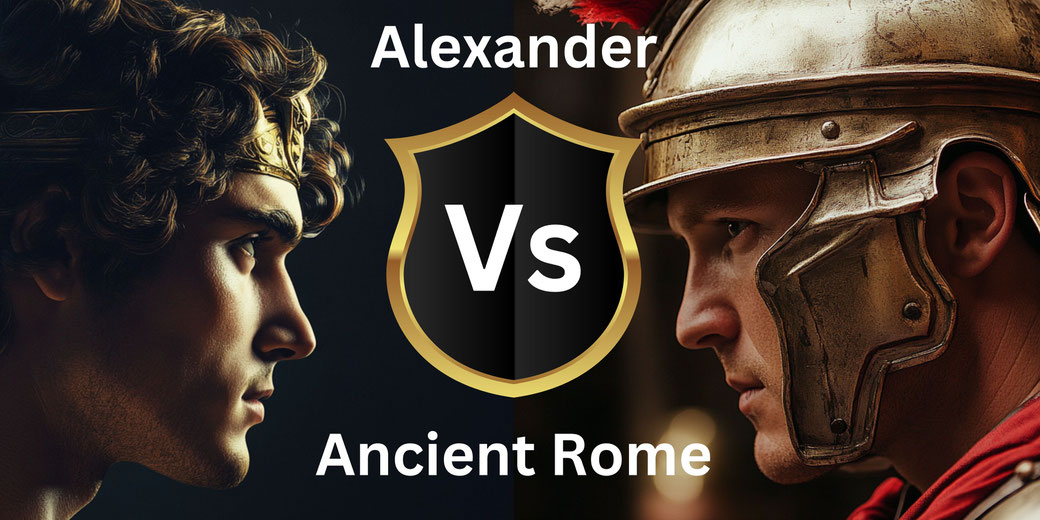
Alexander the Great led an army that crossed into Asia in 334 BCE and conquered the Persian Empire by 330. Less than a century later, the Roman Republic developed a system of military expansion that eventually dominated the Mediterranean and much of Europe.
The two powers never clashed, but asking what would have happened in a direct military conflict raises clear questions about command skill, battlefield systems, supply networks and staying power.
The two opponents explained
After he had defeated the Persian satraps at the Granicus River, Alexander forced his way down the western coast of Asia Minor, where he had captured Sardis and then had laid siege to Halicarnassus before he marched through Syria, Egypt, Mesopotamia and into Central Asia.
Each stage of the campaign showed his ability to direct different arms of the military as a unified force and he adapted to local resistance and unknown terrain.
At the outset, his army, which typically included approximately 40,000 troops of which 12,000 were Macedonian phalangites and 7,000 cavalry, was reinforced by Greek infantry and auxiliary forces from the League of Corinth.
He apparently inspired his troops because he had led from the front and had won consistently, which ensured that a relatively small but disciplined army could outmatch opponents who had greater numbers but lacked unity.
At every stage, he used both Macedonian and local troops, and he managed tensions between them and secured his rear with new settlements and garrisons.
By contrast, Roman expansion largely relied on formal treaties with defeated Italian communities and the regular creation of colonies to secure territory.
Between the fourth and third centuries BCE, Rome defeated the Volsci, Etruscans, Samnites and Gauls, often after repeated wars.
The Roman military machine developed slowly but with steady progress, building up a structure that did not depend on a single man’s leadership.
Generals could change between campaigns, but the organisation and training supported a recruitment system that remained intact.
By the Second Punic War, a standard consular army typically consisted of two legions of about 4,200 infantry and 300 cavalry each, supported by an equal number of allied infantry and cavalry, so that a Roman field force approached 20,000 men when fully assembled.
Macedonian Phalanx vs. Roman Legion
The Macedonian phalanx, which Philip II had refined and which Alexander used throughout his campaigns, centred on the long sarissa and operated best on level ground where its tightly packed files could present a very dense front.
Formations that were typically sixteen men deep advanced as one, with up to five rows of spears that projected outward, depending on the depth and terrain, while the rear files supported the momentum of the push.
Alexander combined the phalanx with lighter hypaspists, Thessalian cavalry and his own elite Companion cavalry.
However, the formation became less effective on uneven ground or if it had to pivot quickly under pressure from multiple angles.
These units provided mobility that allowed them to skirmish and they delivered the concentrated shock power that allowed him to pin enemies with the phalanx and to strike decisively elsewhere.
For example, at the Battle of Issus in 333 BCE, Alexander used the narrow terrain to prevent his centre from being outflanked and he directed his cavalry into a gap near the Persian king’s position, which broke the enemy morale.
Then, during the siege of Tyre in 332 BCE, he also constructed a kilometre-long causeway to breach the island city’s defences, which demonstrated engineering skill and showed the capacity to sustain complicated operations over time.
Roman legions, in contrast, developed around a manipular structure, which replaced rigid formations with more flexible arrangements.
Soldiers were organised into smaller units that could move independently and rotate forward or back during battle.
Each maniple occupied a position that allowed for gaps between formations, which gave the legion the ability to operate on broken ground or to respond to sudden threats.
Rather than using a single massed thrust, Roman tactics involved coordinated pressure that wore the enemy down.
Roman legionaries carried large curved shields called scuta, short stabbing swords known as gladii, and they typically wore chain mail armour called lorica hamata.
Segmented plate armour, known as lorica segmentata, did not appear until the early first century CE.
At Pydna in 168 BCE, Roman legions under Lucius Aemilius Paullus exploited the disorder that arose when a Macedonian phalanx lost unity on uneven terrain.
As gaps opened between files, Roman soldiers pushed through and attacked the less protected sides and backs of the phalangites.
A similar outcome had occurred at Cynoscephalae in 197 BCE, when the Roman commander Titus Quinctius Flamininus used the broken ground of Thessaly to prevent a full phalanx deployment, and he overwhelmed the Macedonian line in detail.
These battles showed that, under the right conditions, flexibility and adaptability could outmatch the raw power of the phalanx.
Alexander vs. Roman generals
Alexander controlled both military planning and battlefield execution, and he personally led charges, directed sieges, managed political appointments in newly conquered cities.
Also, he maintained unity within a varied army that included Greeks, Macedonians, Persians and Central Asians.
He often used speed and new tactics, and at Gaugamela in 331 BCE he staged a deceptive move to draw Persian cavalry away from the centre, opened a gap in the line and charged through it with his Companion cavalry to attack Darius directly.
Because it did not depend on a single leader, Rome produced a succession of generals who achieved victories across decades of conflict.
Scipio Africanus defeated Hannibal at Zama in 202 BCE, when he adjusted to the conditions of the African battlefield and he instructed his men to open lanes within their lines to channel the war elephants harmlessly through, and skirmishers and loud trumpet blasts supported this.
Likewise, Julius Caesar, during the Gallic Wars, showed strategic control across multiple regions by conducting rapid sieges, night marches and negotiations and by coordinating multiple legions at once.
Roman generalship also allowed commanders to try new tactics. For example, Marius reformed the recruitment base of the legions to allow for long-service professionals and later commanders built on his reforms.
Victory in the Roman world depended not only on one man’s skill but on a system that could transfer knowledge and maintain unity even when campaigns lasted for years or continued across continents.
Would the navy power prove a decisive factor?
Alexander’s naval resources mostly relied on Phoenician and Aegean fleets that he captured or that allied themselves to him during his eastern campaigns.
After his successful siege of Tyre, he had gained access to a powerful naval force, which had helped to secure the eastern Mediterranean and to cut off Persian movements.
However, after he marched inland, he allowed naval preparations to lapse and he concentrated instead on land operations where his cavalry and infantry could be brought to bear.
By comparison, Rome constructed a navy from scratch during the First Punic War.
They had a captured Carthaginian ship, which they used as a model, and they rapidly built hundreds of vessels, and they trained oarsmen on land before committing them to battle.
They attached boarding bridges, known as corvi, to their ships, which allowed legionaries to storm enemy decks and to transform naval combat into an infantry engagement.
If a naval clash had occurred between Alexander’s fleet and a mature Roman navy, the Romans’ use of the corvus could have made ship-handling superiority irrelevant and it could have turned the battle into a land-style melee.
Over time, Roman naval supremacy gradually became built into their system, with fleets stationed at key ports to ensure dominance of trade and to secure long-distance communications.
Since Roman fleets had gained control of Sicily and the central Mediterranean, it enabled them to isolate enemy supply lines and to land troops in hostile territory.
Had Alexander needed to launch an invasion across the Adriatic or into Sicily, he would have needed a navy capable of providing support for extended campaigns.
Without permanent naval bases and shipyards or experienced shipwrights and seamen, Macedonian naval efforts, which worked in the Aegean and eastern Mediterranean during Alexander’s lifetime, could not have matched Rome’s capacity to project military force across the wider Mediterranean or to provide support for large sea and land campaigns.
Who could supply their armies more effectively?
Alexander moved quickly and he lived off the land, and he forced conquered cities to provide supplies, animals and funds for his next march.
He travelled with engineers, interpreters and siege equipment, but his supply train remained limited so that he could keep up speed.
The disastrous crossing of the Gedrosian Desert showed how easily an extended campaign could spiral into a supply collapse, since the strategy that enabled him to cover long distances left his forces vulnerable if local populations resisted or resources became scarce.
By contrast, Roman armies developed a more robust and scalable system of supply.
Military roads allowed wagons and pack animals to travel efficiently between garrison towns, granaries and front-line camps.
Supply officers calculated grain and water needs in advance, and commanders worked with allied cities and colonies to store provisions before major campaigns.
During the Gallic Wars, Caesar constructed fortified supply depots and bridges to ensure year-round movement of troops and materials, even in winter.
For example, during the campaign in North Africa, Scipio ensured his men were supplied by sea and by land, and he kept pressure on Carthage and avoided being stretched too thin.
Roman warfare depended on staying power, which meant that campaigns could continue even after heavy casualties or the loss of a key battlefield.
As a result, they could rotate units, replace lost supplies and adjust their strategies over time.
Macedon had more limited resources and relied on rapid conquest, and it could not sustain the same level of long-term warfare.
So, could Rome have contended with Alexander’s genius?
If Alexander had landed in southern Italy during the early 320s BCE, Rome would have still been fighting Samnite resistance and had not yet conquered all of Latium.
In that scenario, he could have isolated key Roman allies, captured strategic cities such as Capua or Neapolis and imposed temporary settlements under Macedonian authority.
His experience from the sieges of fortified cities, such as Tyre and Gaza, would have given him an advantage against Rome’s walled towns.
A historical precedent exists in the campaigns of Pyrrhus of Epirus, who invaded Italy in 280 BCE with approximately 25,000 to 30,000 men and around 20 war elephants.
Despite his early victories, he ultimately withdrew due to Roman persistence and supply depth.
However, if he had invaded during the mid-200s BCE, when Rome had reformed its army, secured central Italy and developed naval infrastructure, the situation would have favoured the Republic.
Their annual recruitment and tax collection worked together with road maintenance to ensure that they could supply multiple legions at once and respond to losses more effectively than command controlled centrally in Macedon.
Their experience in fighting Hannibal, who used terrain, surprise and unconventional tactics, had prepared them for wars that lasted decades rather than months.
In short, Alexander may have defeated one or several Roman armies, especially early in their development.
Rome could recover, adapt and continue to fight, as it had against Pyrrhus, Hannibal and Mithridates.
Alexander relied on continuous success under his personal leadership, which produced loyalty tied directly to him.
Rome relied on a system that endured failure and produced strength from repetition.
After his death in 323 BCE, Alexander had left no clear successor, and his empire split apart among competing generals, which showed how centrally controlled his conquests truly were compared to Rome’s institutions that continued.