
Historical sources on WWII sea battles in the Pacific
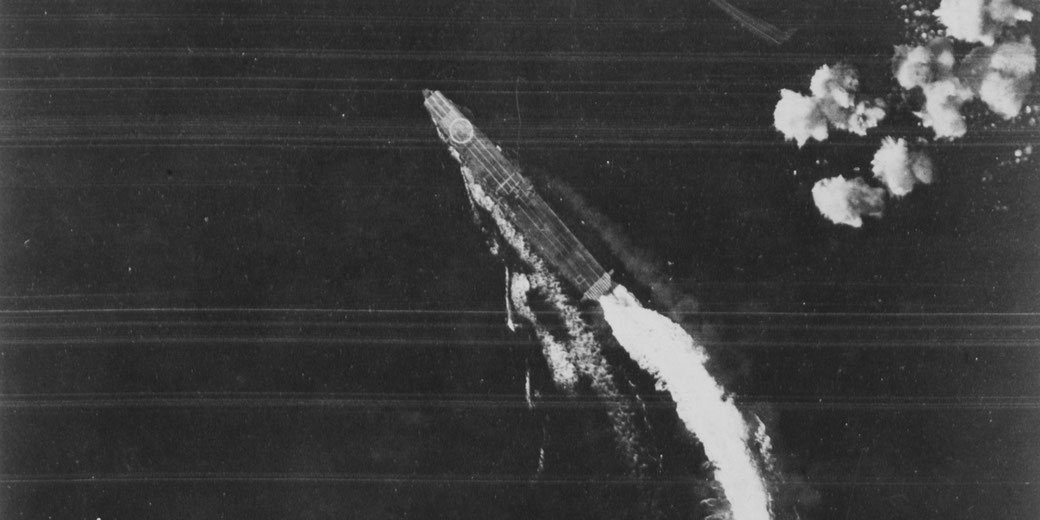
This page brings together six primary and secondary sources on major sea battles in the Pacific War. The sources cover Pearl Harbor, Coral Sea, Midway, Guadalcanal, and American codebreaking, so students can track how naval air power, island geography, and intelligence affected the fighting from late 1941 to 1942.
Source 1
“Mr. Vice President, Mr. Speaker, Members of the Senate, and of the House of Representatives: Yesterday, December 7, 1941—a date which will live in infamy—the United States of America was suddenly and deliberately attacked by naval and air forces of the Empire of Japan.”
Contextual information:
This paragraph is from President Franklin D. Roosevelt’s address to a joint session of the U.S. Congress on 8 December 1941, delivered the day after the attack on Pearl Harbor. It marks the formal public announcement that Japan had attacked on 7 December 1941 and frames that event as the beginning of open war between the United States and Japan in the Pacific.
Bibliographical reference:
Roosevelt, F. D. (1941, December 8). Joint Address to Congress leading to a declaration of war against Japan (“Day of Infamy” speech). Records of the U.S. Senate, Record Group 46, National Archives. Retrieved from https://www.archives.gov/milestone-documents/joint-address-to-congress-declaration-of-war-against-japan (opening paragraph).
Copyright: Public domain – work of the U.S. federal government, held by the National Archives.
Source 2
“The scene of impending conflict was Micronesia, an ocean area larger than the continental United States. Scattered throughout this vast expanse of ocean are tiny islands, numbering over 1,000 and clustered into four major groups whose total land area is about 1,200 square miles. The islands are of coral or volcanic origin and most of them are small, low, and infertile. Only a few can support a large population or serve as important bases, but these few are of great strategic value because they lie athwart the principal air and sea routes across the Central Pacific.”
Contextual information:
This paragraph appears in the official U.S. Army history volume Strategy and Command: The First Two Years, describing the geographic setting of the Central Pacific campaign. Written after the war by historian Louis Morton for the Office of the Chief of Military History, it explains how the Pacific theater was dominated by huge stretches of ocean dotted with only a few small but strategically vital islands.
Bibliographical reference:
Morton, L. (1962). Strategy and command: The first two years (U.S. Army in World War II: The War in the Pacific, ch. “The Central Pacific War,” para. 1). Washington, DC: Office of the Chief of Military History, U.S. Army. Retrieved from https://www.ibiblio.org/hyperwar/USA/USA-P-Strategy/Strategy-22.html
Copyright: Public domain – official historical work published by the U.S. Department of the Army.
Source 3
“From 4–8 May, at the Battle of the Coral Sea, aircraft from Task Force 17 trade strikes with Japanese forces. The surface ships in both forces never see each other; all attacks are by air. Although the Japanese succeed in sinking the American carrier Lexington and damaging Yorktown, they lose the light carrier Shōhō and suffer damage to the fleet carrier Shōkaku and heavy losses in aircraft. More importantly, their attempt to seize Port Moresby by sea is frustrated, forcing them to turn to the long and costly overland route across the Owen Stanley Range.”
Contextual information:
This paragraph is from the modern Navy reprint of the World War II Combat Narrative: Battle of Midway in the “background” section that summarizes the Battle of the Coral Sea. It highlights that Coral Sea was fought entirely by carrier aircraft—surface ships never sighted each other—and that the result forced Japan to abandon a seaborne assault on Port Moresby, which was meant to help isolate Australia from the United States.
Bibliographical reference:
Naval History and Heritage Command. (2017). Battle of Midway, June 3–6, 1942 (Combat Narrative) (Background section on the Battle of the Coral Sea). In World War II 75th Anniversary Commemorative Series. Washington, DC: U.S. Navy. Retrieved from https://www.govinfo.gov/content/pkg/GOVPUB-D221-PURL-gpo172661/pdf/GOVPUB-D221-PURL-gpo172661.pdf
Copyright: Public domain – U.S. Navy historical publication distributed via govinfo (U.S. Government Publishing Office).
Source 4
“Midway was a contest of air power. There were no contacts between surface vessels in the entire action. The Japanese and Allied forces attempted to destroy each other simultaneously by means of carrier‑based air attacks. The deployment and dispositions of the forces, the influence of weather, and the sequence of air strikes determined the outcome of the battle. Lessons drawn from this encounter emphasized the decisive role of carrier aviation and the vulnerability of major fleet units without adequate air cover.”
Contextual information:
This paragraph appears in a U.S. Navy bibliographic description of the original Combat Narrative: Battle of Midway, summarizing how the battle unfolded. It underlines that the opposing fleets never fought with surface guns or direct ship‑to‑ship engagement; instead, carrier aircraft delivered the crucial blows, showing students why aircraft carriers and their planes were the most important weapons at Midway.
Bibliographical reference:
U.S. Navy. (1943). The Battle of Midway (Combat Narrative) (as summarized in The Battle of Midway: A Bibliography, 4th ed., description of contents). Washington, DC: Office of Naval Intelligence. Retrieved from https://www.govinfo.gov/content/pkg/GOVPUB-D201-PURL-gpo69141/pdf/GOVPUB-D201-PURL-gpo69141.pdf
Copyright: Public domain – U.S. Navy and U.S. Government Publishing Office materials.
Source 5
“Perhaps the entire period between 7 August 1942, when the first Marines landed in the Solomons, and the final evacuation of Guadalcanal by the Japanese should be labeled ‘The Battle of Guadalcanal.’ Hardly a day went by during that 6 months which did not see action on land, in the air, or on the sea. Nevertheless, the climax and turning point of the campaign came with the shattering of the enemy’s supreme effort to overwhelm the island between 11 and 15 November. During the desperate sea and air battles of those 5 days, Japanese losses as estimated by CINCPAC were 2 battleships sunk and 2 damaged, 4 cruisers sunk and 6 damaged, 8 destroyers sunk and 4 damaged, and 12 transports sunk or destroyed. Our losses consisted of 1 battleship damaged, 2 cruisers sunk and 3 damaged, 7 destroyers sunk and 4 damaged, and 3 cargo vessels damaged, 2 of these negligibly.”
“With the coming of September they redoubled their efforts to bomb us off the island and to put reinforcements ashore. Small night landings by cruisers and destroyers—the so‑called ‘Tokio Express’—became increasingly prevalant throughout the month and in early October. This method of reinforcement proved unsatisfactory, however, because few men and no heavy matériel could be carried. Consequently the enemy found it necessary to bring in large transports. Before this could be done, our air power on Guadalcanal had to be reduced and eventually eliminated.”
Contextual information:
These paragraphs come from the Office of Naval Intelligence (ONI) Combat Narrative: Battle of Guadalcanal, written during World War II for commissioned U.S. Navy officers as a confidential analysis of recent operations. The authoring team were naval historians and officers working from action reports, war diaries, and interviews, giving a near‑contemporary official account of the six‑month Guadalcanal campaign and the Japanese night destroyer runs nicknamed the “Tokio (Tokyo) Express.”
Bibliographical reference:
Office of Naval Intelligence. (1943). Battle of Guadalcanal: 11–15 November 1942 (Combat Narrative). Washington, DC: Navy Department, Office of Naval Intelligence. Retrieved from https://ibiblio.org/hyperwar/USN/USN-CN-Guadalcanal/USN-CN-Guadalcanal-1.html (Introduction & Part One, paras. 1–2).
Copyright: Public domain – wartime publication of the U.S. Navy (U.S. federal government work).
Source 6
“The study chronicles how, by reorganizing and redirecting its resources, U.S. Navy communications analysts engineered a spectacular triumph over Japanese naval cryptography and how the reports produced by these analysts contributed to development of a new U.S. naval strategy in the Pacific. By intercepting, deciphering, and translating the Japanese Navy’s messages that contained their order of battle, the timetables for their military operations at Port Moresby, the Aleutians, and Midway, and a myriad of vital details concerning their most secret plans and intentions, the communications analysts were vindicated of any taint of failure from Pearl Harbor. Indisputably, however, at this stage of the Pacific war, no other source of either strategic or tactical intelligence could compare with radio intelligence. It truly gave Admiral Ernest J. King, Commander‑in‑Chief, U.S. Fleet, and Admiral Chester W. Nimitz, Commander‑in‑Chief, U.S. Pacific Fleet, a ‘priceless advantage’ over the Japanese.”
Contextual information:
This paragraph is from the introduction to A Priceless Advantage: U.S. Navy Communications Intelligence and the Battles of Coral Sea, Midway, and the Aleutians, an official NSA historical study by Frederick D. Parker. Written decades after the war from declassified records, it explains how breaking Japanese naval codes allowed U.S. commanders to read Japanese messages about the Midway operation’s timing and forces, giving Admiral Nimitz advance warning and a decisive edge in the battle.
Bibliographical reference:
Parker, F. D. (2017). A priceless advantage: U.S. Navy communications intelligence and the battles of Coral Sea, Midway, and the Aleutians (Introduction, pp. 1–2). Fort George G. Meade, MD: Center for Cryptologic History, National Security Agency. Retrieved from https://www.nsa.gov/History/Cryptologic-History/Historical-Publications/Historical-Publications-Lists/igphoto/2002761544/
Copyright: Public domain – official publication of the National Security Agency, a U.S. federal agency.