
Historical sources on WWI trench warfare
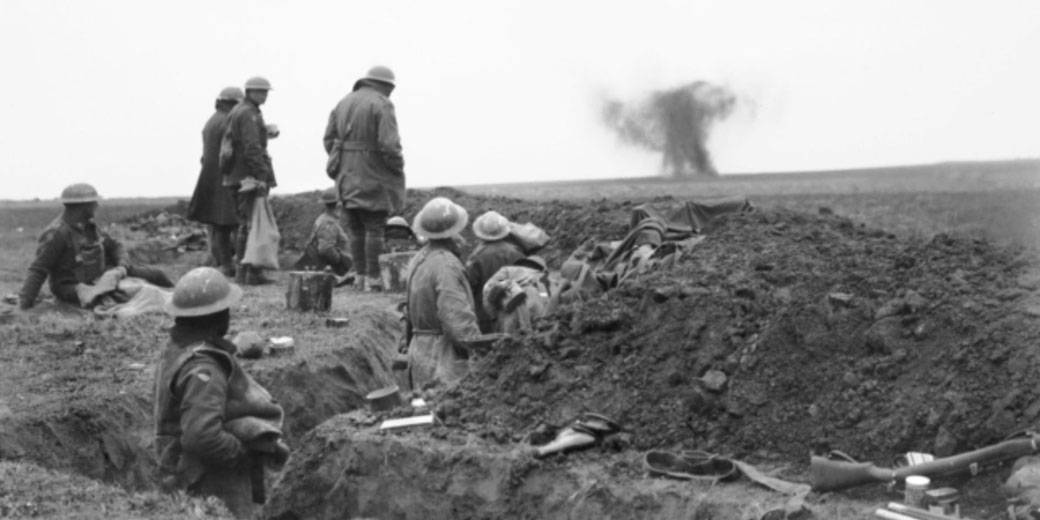
These sources provide first-hand and documentary accounts of life in the trenches on the Western Front during the First World War.
They range from published memoirs by soldiers who lived and fought in the trenches, including an American volunteer in the British Army, a French infantryman-novelist, and an Irish stretcher-bearer, to official training manuals written for American officers preparing to deploy to France in 1917.
The sources cover the physical conditions of trench life, the daily routines soldiers followed, the medical dangers they faced, and the engineering work required to keep the trench systems functional.
Read the sources carefully, paying attention to who wrote each one, when it was written, and for what purpose.
Source 1
Extract A
"This training consisted of the rudiments of trench warfare. Trenches had been dug, with barbed-wire entanglements, bombing saps, dug-outs, observation posts, and machine-gun emplacements. We were given a smattering of trench cooking, sanitation, bomb throwing, reconnoitering, listening posts, constructing and repairing barbed wire, 'carrying in' parties, methods used in attack and defense, wiring parties, mass formation, and the procedure for poison-gas attacks."
Extract B
"Just as it begins to get dark the word 'stand to' is passed from traverse to traverse, and the men get busy. The first relief, consisting of two men to a traverse, mount the fire step, one man looking over the top, while the other sits at his feet, ready to carry messages or to inform the platoon officer of any report made by the sentry as to his observations in No Man's Land."
Extract C
"Firing Step [was a] ledge in the front trench which enables Tommy to fire 'over the top.' In rainy weather you have to be an acrobat to even stand on it on account of the slippery mud."
Extract D
"'Cooties,' or body lice, are the bane of Tommy's existence. There is no way to get rid of them permanently. No matter how often you bathe, and that is not very often, or how many times you change your underwear, your friends, the 'cooties' are always in evidence. The billets are infested with them, especially so, if there is straw on the floor."
Extract E
"These cellars were cold, damp, and smelly, and overrun with large rats — big black fellows. Most of the Tommies slept with their overcoats over their faces. I did not. In the middle of the night I woke up in terror. The cold, clammy feet of a rat had passed over my face. I immediately smothered myself in my overcoat, but could not sleep for the rest of that night."
Extract F
"I sat on the fire step of the trench with the rest of the men. In each traverse two of the older men had been put on guard with their heads sticking over the top, and with their eyes trying to pierce the blackness in 'No Man's Land.'"
Extract G
"Parapet [was the] top part of a front trench which Tommy constantly builds up and the Germans just as constantly knock down."
Extract H
"I must have slept for two or three hours, not the refreshing kind that results from clean sheets and soft pillows, but the sleep that comes from cold, wet, and sheer exhaustion. Suddenly, the earth seemed to shake and a thunderclap burst in my ears. I opened my eyes, — I was splashed all over with sticky mud, and men were picking themselves up from the bottom of the trench. The parapet on my left had toppled into the trench, completely blocking it with a wall of tossed-up earth."
Extract I
"After 'stand down' the men sit on the fire step or repair to their respective dugouts and wait for the 'rum issue' to materialize. Immediately following the rum, comes breakfast, brought up from the rear. Sleeping is then in order unless some special work turns up. Around 12.30 dinner shows up. When this is eaten the men try to amuse themselves until 'tea' appears at about four o'clock, then 'stand to' and they carry on as before... and so it goes on from day to day, always 'looping the loop' and looking forward to Peace and Blighty."
Contextual information:
Arthur Guy Empey (1883–1963) was an American citizen who enlisted in the British Army in 1915 and served as a machine gunner on the Western Front. He published Over the Top in 1917 as a first-person account of his experiences in the trenches, and it became one of the best-selling books in America that year.
Bibliographical reference:
Empey, A. G. (1917). "Over the top," by an American soldier who went. G. P. Putnam's Sons. Chapters II, IV, V, X; "Tommy's Dictionary of the Trenches" (entries "Firing Step" and "Parapet").
Copyright: Public domain.
Source 2
Extract A
"Cocon is explaining to his neighbor the arrangement and intricacy of our trenches. He has seen a military map and made some calculations. In the sector occupied by our regiment there are fifteen lines of French trenches. Some are abandoned, invaded by grass, and half leveled; the others solidly upkept and bristling with men. These parallels are joined up by innumerable galleries which hook and crook themselves like ancient streets. The system is much more dense than we believe who live inside it. On the twenty-five kilometers' width that form the army front, one must count on a thousand kilometers of hollowed lines — trenches and saps of all sorts. And the French Army consists of ten such armies. There are then, on the French side, about 10,000 kilometers of trenches, and as much again on the German side. And the French front is only about one-eighth of the whole war-front of the world."
Extract B
"We pass through legions of flies which, massed on the walls in black hordes, fly abroad in buzzing swarms as we pass: 'It's beginning again like last year! Flies outside, lice inside —' 'And microbes still farther inside!'"
Extract C
"We are waiting. Weary of sitting, we get up, our joints creaking like warping wood or old hinges. Damp rusts men as it rusts rifles; more slowly, but deeper. And we begin again, but not in the same way, to wait. In a state of war, one is always waiting. We have become waiting-machines. For the moment it is food we are waiting for. Then it will be the post. But each in its turn. When we have done with dinner we will think about the letters. After that, we shall set ourselves to wait for something else."
Contextual information:
Henri Barbusse (1873–1935) was a French novelist who volunteered for the French Army in 1914 at the age of 41. He served as an infantryman on the Western Front and took notes for the novel in the trenches before completing it in 1916. Under Fire won the Prix Goncourt in 1916 and was translated into English by Fitzwater Wray in 1917.
Bibliographical reference:
Barbusse, H. (1917). Under fire: The story of a squad (W. Fitzwater Wray, Trans.). J. M. Dent & Sons. Chapters II ("In the Earth") and V ("Sanctuary").
Copyright: Public domain.
Source 3
Extract A
"In this, and subsequent descriptions of the trenches, I may lay myself open to the charge of exaggeration. But it must be remembered that I am describing trench life in the early days of 1914, and I feel sure that those who had experience of them will acquit me of any such charge. To give a recipe for getting a rough idea, in case you want to, I recommend the following procedure. Select a flat ten-acre ploughed field, so sited that all the surface water of the surrounding country drains into it. Now cut a zig-zag slot about four feet deep and three feet wide diagonally across, dam off as much water as you can so as to leave about a hundred yards of squelchy mud; delve out a hole at one side of the slot, then endeavour to live there for a month on bully beef and damp biscuits, whilst a friend has instructions to fire at you with his Winchester every time you put your head above the surface."
Extract B
"My plan for sustaining life under these conditions was to change my boots as often as possible. If there wasn't time for this I used to try and boil the water in my boots by keeping my feet to the fire bucket. I always put my puttees on first and then a pair of thick socks, and finally a pair of boots. I could, by this means, hurriedly slip off the sodden pair of boots and socks and slip on another set which had become fairly dry by the fire. We lived perpetually damp, if not thoroughly wet. My puttees, which I rarely removed, were more like long rolls of the consistency of nougat than anything else, thanks to the mud."
Extract C
"In front was a large expanse of root field, at the further side of which a long irregular parapet marked the German trenches. Behind those again was more root field, dented here and there with shell holes filled with water, beyond which stood a few isolated remnants which had once been cottages."
Extract D
"Oh, those days in that trench of ours! Each day seemed about a week long. I shared a dug-out with a platoon commander after that first night... Day after day, night after night, my companion and I lay and listened to the daily explosions, read, and talked, and sloshed about that trench together. The greatest interest one had in the daytime was sitting on the damp straw in our clay vault, scraping the mud off one's saturated boots and clothes. The event to which one looked forward with the greatest interest was the arrival of letters in the evening."
Contextual information:
Bruce Bairnsfather (1887–1959) was a British Army officer and cartoonist who served on the Western Front from late 1914. He became famous for his "Old Bill" cartoons depicting trench life with dry humour. Bullets & Billets was published in 1916 as a memoir of his first months in the trenches near Ploegsteert ("Plugstreet") in Belgium, intended for a general civilian readership in Britain.
Bibliographical reference:
Bairnsfather, B. (1916). Bullets & billets. Grant Richards. Chapters III, IV, and V.
Copyright: Public domain.
Source 4
Extract A
"Formerly, protection from the enemy's fire was obtained by thickness of parapet. In the trench warfare of today it is obtained by completely concealing the riflemen in a deep, narrow trench with a very low parapet. The height over which the average man can fire is about 5 feet or about five-sixths of his own height."
Extract B
"Except when the garrison are actually required to man the parapet, they will be kept under cover, with the exception of a few lookouts, whose duty it is to give timely warning of the movements of the enemy."
Extract C
"Every firing trench should fulfill the following essential conditions: (a) The parapet must be bulletproof. (b) Every man must be able to fire over the parapet with proper effect; that is, so he can hit the bottom of his own wire entanglement."
Contextual information:
Lieutenant Colonel William H. Waldron was a U.S. Army officer who compiled Elements of Trench Warfare in 1917 as a training manual for American troops preparing to deploy to the Western Front. The manual drew on British and French trench warfare doctrine to provide American soldiers with technical definitions of trench features and standard procedures.
Bibliographical reference:
Waldron, W. H. (1917). Elements of trench warfare, bayonet training. Edwin N. Appleton. Chapters III–IV, pp. 27–37.
Copyright: Public domain.
Source 5
"PREVENTION OF FROST BITES AND TRENCH FEET — These conditions are generally caused by long standing in cold water and mud, or the continuous wearing of wet socks, boots and puttees, and the conditions are accelerated when the blood circulation in the feet and legs is interfered with by the use of tight puttees, or anything calculated to cause constriction of the lower limbs. They can be prevented or diminished by constant improvement of trenches and reducing the time spent in the trenches as far as the general situation will permit by battalion arrangements; by insuring that men entering the trenches have clean, dry socks on and that they have an extra pair in their packs, by frequent rubbing of the feet, by the avoidance of tight puttees and tight boots or anything that tends to check the free circulation of the blood in the legs and feet."
Contextual information:
Second Lieutenant Joseph S. Smith of the U.S. Army wrote Trench Warfare in 1917 as a practical field manual for American officers and enlisted men deploying to France. The medical sections drew on British Army standing orders for trench hygiene and the treatment of conditions that had plagued the British Expeditionary Force since 1914.
Bibliographical reference:
Smith, J. S. (1917). Trench warfare: A manual for officers and men. E. P. Dutton. pp. 142–143.
Copyright: Public domain.
Source 6
"The soft bottoms of the whole system of defences must also be carefully consolidated to render their occupation possible and to enable the men to move about with ease. Duckboards, assembled just behind the front and then brought into the lines, have had to be laid everywhere with infinite labour in the muddy bottom of the trenches — dozens of miles of them — and relaid heaven only knows how often! It would be a good thing if one could regard the works when once carried through as definitely finished; but that would be too much to hope for, since the most solid revetments crumble in sorry fashion under bombardment, and the elements also seem to be bent on destroying them. Anything heavy settles little by little, owing to the lack of consistency in the subsoil. In bad weather especially, when the rain never ceases and the floods spread, our men daily report parapets giving way and duckboards disappearing under the water or mud. Then everything has to be done over again."
Contextual information:
Captain Willy Breton was a Belgian Army officer who wrote The Belgian Front during the war to document the conditions and engineering challenges faced by Belgian forces holding their sector of the Western Front. The Belgians defended the northernmost portion of the Allied line, where the low-lying Flanders terrain made flooding and mud a constant problem.
Bibliographical reference:
Breton, Capt. W. (c. 1917). The Belgian front. [Publisher not identified].
Copyright: Public domain.
Source 7
Extract A
"A modern battlefield is the abomination of abominations. Imagine a vast stretch of dead country, pitted with shell-holes as though it had been mutilated with small-pox. There's not a leaf or a blade of grass in sight. Every house has either been leveled or is in ruins. No bird sings. Nothing stirs. The only live sound is at night — the scurry of rats."
Extract B
"It's like walking through the day of resurrection to visit No Man's Land. Then the Huns see you and the shrapnel begins to fall — you crouch like a dog and run for it. One gets used to shell-fire up to a point, but there's not a man who doesn't want to duck when he hears one coming."
Contextual information:
Coningsby Dawson (1883–1959) was a British-born writer who had emigrated to the United States before volunteering for the Canadian Expeditionary Force in 1916. Carry On was published in 1917 as a collection of his letters home from the Western Front, and it became popular on both sides of the Atlantic for its vivid descriptions of conditions in France.
Bibliographical reference:
Dawson, C. (1917). Carry on: Letters in war-time. John Lane Company.
Copyright: Public domain.
Source 8
Extract A
"...the safety of a man so often depends upon the dexterous handling of his spade; the deeper a man digs, the better is his shelter from bullet and bomb; the spade is the key to safety."
Extract B
"Out ahead lay the German trenches. I could discern their line of sandbags winding over the meadows and losing itself for a moment when it disappeared behind the ruins of a farm-house — a favourite resort of the enemy snipers, until our artillery blew the place to atoms."
Extract C
"I listened; from the right front came the sound of hammering. 'They're putting up barbed wire entanglements and digging a sap,' said the sergeant. 'Both sides are working and none are fighting.'"
Extract D
"Here, in this salient, the war had its routine and habits, everything was done with regimental precision, and men followed the trade of arms as clerks follow their profession: to each man was allocated his post, he worked a certain number of hours, slept at stated times, had breakfast at dawn, lunch at noon, and tea at four."
Contextual information:
Patrick MacGill (1889–1963) was an Irish-born labourer and writer who enlisted in the London Irish Rifles in 1914. He served on the Western Front as a stretcher-bearer and rifleman. The Great Push was published in 1916 as a first-person account of his experiences during the Battle of Loos, and is regarded as one of the first accounts of that battle.
Bibliographical reference:
MacGill, P. (1916). The great push: An episode of the great war. Herbert Jenkins. Chapters I–II.
Copyright: Public domain.