
Historical sources on WWI aircraft
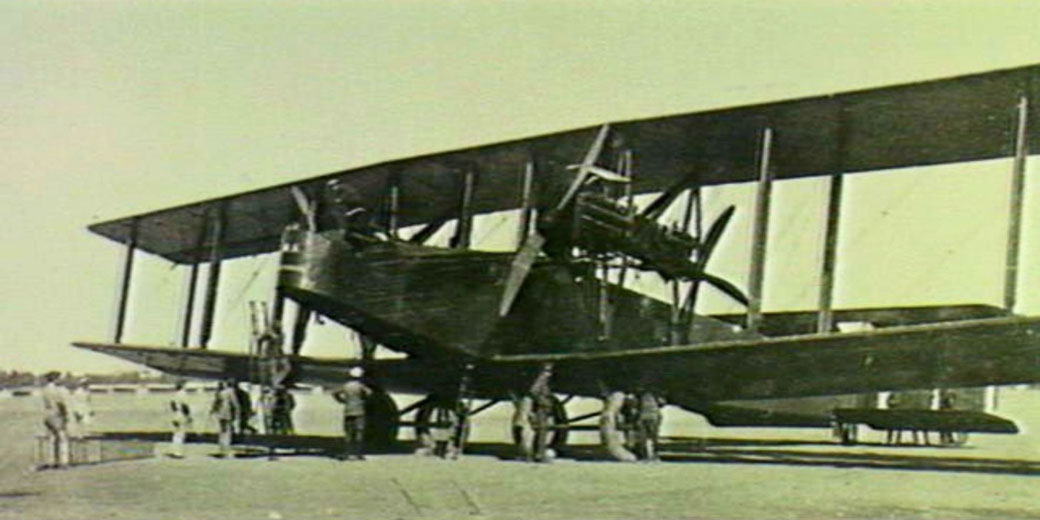
From the first fragile reconnaissance aircraft that flew over the trenches in 1914 to the deadly fighter squadrons that battled for control of the skies by 1918, the First World War transformed aviation into a major instrument of modern warfare.
These sources examine how aircraft changed military reconnaissance, artillery coordination, bombing, and aerial combat during the conflict.
They also explore the experiences and attitudes of the men who fought in the air, including the famous German ace Manfred von Richthofen, whose memoir helped create the public image of the heroic fighter pilot.
Source 1
Extract A
"Of these two new weapons the submarine was brought earlier to a state of war efficiency, and because it seemed to threaten the security of our island and the power of our navy, it excited the greater apprehension. But the navigation of the air, whether by airship or aeroplane, is now recognized for the more formidable novelty. The progress of the war has proved that within the narrow seas the submarine can be countered, and that the extension of its capabilities on the high seas is beset with difficulties. For aircraft the possibilities are immense. It is not extravagant to say that the 17th of December 1903, when the Wright brothers made the first free flight through the air in a power-driven machine, marks the beginning of a new era in the history of the world."
Extract B
"The Germans, who as a people fall easy victims to agreeable sentiment, indulged extravagant hopes from war in the air, and expected great achievements from their Zeppelins. On the other hand, the English, who are less excitable, were comparatively slow as a nation to appreciate the importance of the new invention. Conservative and humorous minds are always conscious chiefly of the immutable and stable elements in human life, and do not readily pay respect to novelty."
Extract C
"So our airship policy was tentative and experimental; a few small airships were in use, but none of the large size and wide range required for effective naval reconnaissance. Good and rapid progress, on the other hand, was made with aeroplanes and seaplanes, and when war broke out we had a small but healthy service, both naval and military, ready to take the air. Four squadrons of the Military Wing, or Royal Flying Corps, that is to say, forty-eight machines, with a few additional machines in reserve, bore a part in the retreat from Mons. A detachment of the Naval Wing, or Royal Naval Air Service, was sent to Belgium, and after bearing a part in the defence of Antwerp, established itself at Dunkirk, which remained throughout the war a centre for aerial operations."
Extract D
"In the actual operations of the war the uses of aircraft, and especially of the aeroplane, were very rapidly extended and multiplied. The earliest and most obvious use was reconnaissance. To the Commander-in-Chief a detailed knowledge of the enemy's dispositions and movements is worth more than an additional army corps; aeroplanes and balloons furnished him with eyes in the air. As observation was the first purpose of aircraft, so it remains the most important. During the war it was developed in many directions. The corps machines operating on the western front devoted themselves among other things to detecting enemy batteries and to directing the fire of our own artillery."
Extract E
"Serious battle in the air, which was engaged on no large scale until the second year of the war, was, in its essence, an attempt to put out the eyes of the other side. In the early days officers often took a revolver, a carbine, or a rifle, into the air with them, but machines designed expressly for fighting, and armed with Lewis or Vickers guns, did not appear in force until it became necessary to counter the attacks made by the Fokker on our observation machines. Then began that long series of dramatic combats, splendid in many of its episodes, which fascinated the attention of the public, and almost excluded from notice the humbler, but not less essential, and not less dangerous, duties of those whose main business it was to observe."
Extract F
"As soon as a wireless installation for aeroplanes came into use, and the observer was thus brought into close touch with his own gunners, this kind of observation became deadly in its efficiency, and was the chief agent in defeating the German scheme of victory by gun-power. When once a hostile battery was located, and our guns, by the aid of observation from the air, were ranged upon it, the fire of that battery was quickly silenced. Other branches of observation, developed during the war, were photography from the air and contact patrol. Complete photographic maps of Hun-land, as the territory lying immediately behind the enemy lines was everywhere called, were made from a mosaic of photographs, and were continually renewed."
Contextual information:
Sir Walter Raleigh (1861-1922) was the first Professor of English Literature at the University of Oxford, commissioned by the British government to write the official history of the Royal Air Force during the Great War. He completed this first volume before his death in 1922, drawing on official military records held by the Air Ministry. The project was continued by H. A. Jones in subsequent volumes.
Bibliographical reference:
Raleigh, W. (1922). The war in the air: Being the story of the part played in the Great War by the Royal Air Force (Vol. I, pp. 1-2, 5-6, 8-10). The Clarendon Press.
Copyright: Public domain.
Source 2
Extract A
"The next morning at seven o'clock I was to fly for the first time as an observer! — I was naturally very excited, for I had no idea what it would be like. Everyone whom I had asked about his feelings told me a different tale. The night before, I went to bed earlier than usual in order to be thoroughly refreshed the next morning."
Extract B
"During my whole life I have not found a happier hunting ground than in the course of the Somme Battle. In the morning, as soon as I had got up, the first Englishmen arrived, and the last did not disappear until long after sunset. Boelcke once said that this was the El Dorado of the flying men."
Extract C
"It occurred to me to have my packing case painted all over in staring red. The result was that everyone got to know my red bird. My opponents also seemed to have heard of the color transformation."
Extract D
"The two Englishmen who were not a little surprised at my collapse, greeted me like sportsmen. As mentioned before, they had not fired a shot and they could not understand why I had landed so clumsily. They were the first two Englishmen whom I had brought down alive. Consequently, it gave me particular pleasure to talk to them. I asked them whether they had previously seen my machine in the air, and one of them replied, 'Oh, yes. I know your machine very well. We call it "Le Petit Rouge."'"
Extract E
"The day began well. We had scarcely flown to an altitude of six thousand feet when an English squadron of five machines was seen coming our way. We attacked them by a rush as if we were cavalry and the hostile squadron lay destroyed on the ground. None of our men was even wounded. Of our enemies three had plunged to the ground and two had come down in flames."
Extract F
"We went to bed in the evening tremendously proud but also terribly tired. On the following day we read with noisy approval about our deeds of the previous day in the official communique. On the next day we downed eight hostile machines."
Extract G
"A very amusing thing occurred. One of the Englishmen whom we had shot down and whom we had made a prisoner was talking with us. Of course he inquired after the Red Aeroplane. It is not unknown even among the troops in the trenches and is called by them 'le diable rouge.' In the Squadron to which he belonged there was a rumor that the Red Machine was occupied by a girl, by a kind of Jeanne d'Arc. He was intensely surprised when I assured him that the supposed girl was standing in front of him."
Contextual information:
Manfred Albrecht Freiherr von Richthofen (1892-1918) was the top-scoring fighter ace of the entire First World War, credited with 80 aerial victories. He wrote this memoir in 1917 during the war itself, and it was published in English translation in 1918 with a preface by C. G. Grey, the editor of the British aviation journal The Aeroplane. Richthofen was killed in action on 21 April 1918, just months after publication.
Bibliographical reference:
von Richthofen, M. (1918). The red battle flyer (T. E. Barker, Trans.; pp. 57, 114, 129-131, 154-157). Robert M. McBride & Co.
Copyright: Public domain.
Source 3
Extract A
"In the same true spirit of knightliness an Englishman knocks a man down and then stands back so that he can get up and have another chance, whereas a more practical person would take excellent care that his opponent never got up till he had acknowledged himself beaten. It is all a matter of the point of view, and largely no doubt a matter of education. However, making due allowance for the point of view, one finds surprisingly little Hunnishness in von Richthofen's manners or methods as set forth in print."
Extract B
"It is one of the accepted facts of the war that the German aviators have displayed greater chivalry than any other branch of the German services. It was a common occurrence for their pilots to fly over our lines in the course of their business, and, by way of variety from that business, to drop packets containing letters from captured British aviators, or the personal belongings of the dead. One gathers that these acts of courtesy have become less frequent of late, owing to the intensification of aerial warfare, but it seems that captured and killed aviators still receive the full courtesies of war from the German aviators, whatever may be the fate of prisoners in other hands afterwards."
Extract C
"It is not surprising therefore to find that, taking him all round, Rittmeister von Richthofen conveys to one the general impression that, mutatis mutandis, he is very like an English public school boy of good family."
Extract D
"Von Richthofen's chaser squadron — or Jagdstaffel, as the Germans call these formations — was the first to be known as a 'circus.' The famous Boelcke squadron, although a fairly mobile body, the members of which co-operated closely on occasion, never developed formation fighting to the extent that von Richthofen did."
Extract E
"His men, although, as the book shows, they went out periodically on lone-hand ventures, generally flew in a body, numbering anywhere from half a dozen to fifteen or so. Their leader chose to paint his little Albatros a brilliant pillar-box red. The others painted their machines according to their fancy. Some had yellow noses, blue bodies and green wings. Some were pale blue underneath and black on top. Some were painted in streaks, some with spots. In fact, they rang the changes on the whole of the paint-box."
Extract F
"Also, the squadron was moved from place to place as a self-contained unit, so that it appeared wherever the fighting was thickest, or wherever British or French reconnaissance machines were busiest. It would be operating at Verdun one week. The next week it would be north of Arras. A few days later it would be down on the Somme. But as a rule it specialized on the British front. Wherever it pitched its tents it did its regular squadron performance, and followed it later in the day with lone-hand raids, or 'strafing' flight by two or three machines at a time."
Extract G
"When one considers the harlequin coloring of the machines, their acrobatic flying and their 'two shows a day' performances from their one-week pitches, it follows logically that the humorists of the R.F.C. simply had to call the squadron 'von Richthofen's Traveling Circus.'"
Contextual information:
C. G. Grey (1875-1953) was the editor of The Aeroplane, one of Britain's leading aviation journals during the First World War. He wrote this preface to the 1918 English-language edition of Richthofen's memoirs, providing a British aviation expert's analysis of German air tactics and the cultural attitudes surrounding fighter aces on both sides.
Bibliographical reference:
Grey, C. G. (1918). Preface. In M. von Richthofen, The red battle flyer (T. E. Barker, Trans.; pp. 3-5, 13-15). Robert M. McBride & Co.
Copyright: Public domain.
Source 4
"He ends by saying that no city would be proof against surprise, while the aerial ship could set fire to vessels at sea, and destroy houses, fortresses, and cities by fire balls and bombs. In fact, at the end of his treatise on the subject, he furnishes a pretty complete resume of the activities of German Zeppelins."
Contextual information:
E. Charles Vivian (1882-1947) was a British author and editor who wrote A History of Aeronautics in 1920-1921 as a general survey of the development of flight from ancient times through the First World War. In this passage, Vivian describes the seventeenth-century predictions of the Italian Jesuit Francesco Lana, noting that Lana's vision of aerial bombardment turned out to be a remarkably accurate description of what German Zeppelins actually did during the war.
Bibliographical reference:
Vivian, E. C. (1921). A history of aeronautics (pp. 31-32). Harcourt, Brace and Company.
Copyright: Public domain.