
Historical sources on urbanisation in the Industrial Revolution
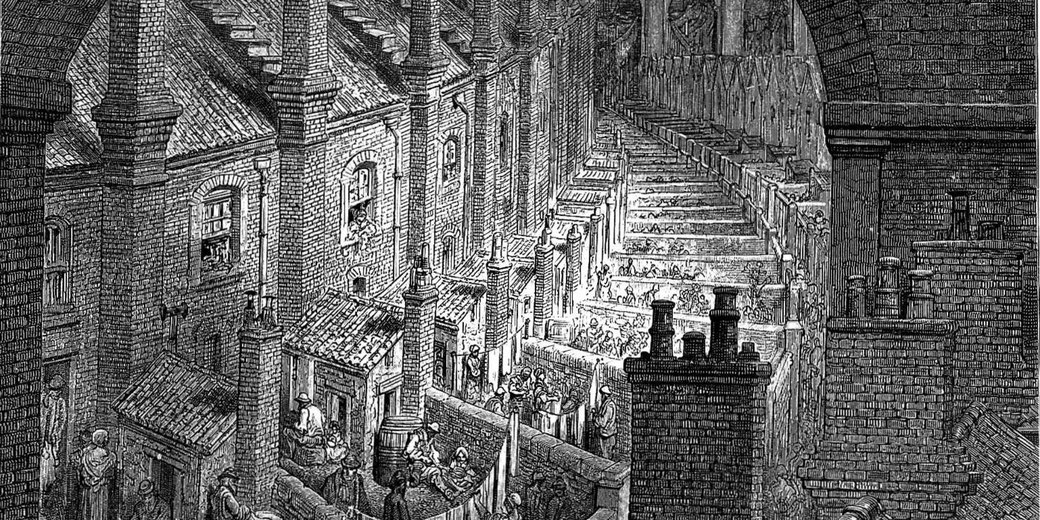
The Industrial Revolution transformed Britain from a largely rural society into an urban and industrial nation, as factories, steam power, and mass manufacturing drew millions of people into rapidly expanding towns and cities.
These historical sources examine the causes and consequences of that urban growth, including the movement of workers from the countryside, the crowded and unsanitary conditions of industrial slums, the spread of disease, and the growing pressure for public health reform.
Source 1
"The history of the proletariat [working class] in England begins with the second half of the last century [1750s onwards], with the invention of the steam-engine and of machinery for working cotton. These inventions gave rise, as is well known, to an industrial revolution, a revolution which altered the whole civil [organised] society; one, the historical importance of which is only now beginning to be recognised. England is the classic soil [the original location] of this transformation, which was all the mightier, the more silently it proceeded; and England is, therefore, the classic land of its chief product also, the proletariat [working class]."
"Coming to the facts of the Industrial Revolution, the first thing that strikes us is the far greater rapidity [speed] which marks the growth of population. Next we notice the relative and positive decline in the agricultural [farming] population. In 1811 it constituted 35 per cent. of the whole population of Great Britain; in 1821, 33 per cent.; in 1831, 28 per cent. An agrarian [farming] revolution plays as large a part in the great industrial change of the end of the eighteenth century as does the revolution in manufacturing industries, to which attention is more usually directed. Our next inquiry must therefore be: What were the agricultural changes which led to this noticeable decrease in the rural population? The three most effective causes were: the destruction of the common-field system of cultivation [the old shared farming system]; the enclosure, on a large scale, of common and waste lands [fencing off land that villagers used to share]; and the consolidation of small farms into large."
"The rapid extension [growth] of manufacture demanded hands, wages rose, and troops of workmen migrated from the agricultural districts to the towns. Population multiplied enormously, and nearly all the increase took place in the proletariat [working class]."
Contextual information:
Arnold Toynbee was a British economic historian who lectured at Oxford University in the late nineteenth century. His lectures, published in 1884, were among the first detailed academic studies of the Industrial Revolution, and he is credited with popularising that term. He drew on population statistics and Parliamentary records to trace the movement of workers from the countryside into industrial towns.
Bibliographical reference:
Adapted from Toynbee, A. (1884). Lectures on the industrial revolution in England: Popular addresses, notes and other fragments. Rivingtons. pp. 85, 87.
Copyright: Public domain.
Source 2
"Every great city has one or more slums, where the working-class is crowded together. True, poverty often dwells in hidden alleys close to the palaces of the rich; but, in general, a separate territory has been assigned to it, where, removed from the sight of the happier classes, it may struggle along as it can. These slums are pretty equally arranged in all the great towns of England, the worst houses in the worst quarters of the towns; usually one or two-storied cottages in long rows, perhaps with cellars used as dwellings, almost always irregularly built. These houses of three or four rooms and a kitchen form, throughout England, some parts of London excepted, the general dwellings of the working-class. The streets are generally unpaved, rough, dirty, filled with vegetable and animal refuse [rubbish and rotting waste], without sewers or gutters, but supplied with foul, stagnant pools instead. Moreover, ventilation [fresh air flow] is impeded [blocked] by the bad, confused method of building of the whole quarter, and since many human beings here live crowded into a small space, the atmosphere that prevailed in these working-men's quarters may readily be imagined."
"Again, the repeated visitations [outbreaks] of cholera, typhus, small-pox, and other epidemics [widespread diseases] have shown the British bourgeois [middle and upper classes] the urgent necessity of sanitation [clean water and sewage removal] in his towns and cities, if he wishes to save himself and family from falling victims to such diseases. Accordingly, the most crying [urgent] abuses described in this book have either disappeared or have been made less conspicuous [obvious]. Drainage has been introduced or improved, wide avenues have been opened out athwart [across] many of the worst slums I had to describe."
"In competition with consumption [tuberculosis] stands typhus, to say nothing of scarlet fever, a disease which brings most frightful devastation [destruction] into the ranks of the working-class. Typhus, that universally diffused [widespread] affliction [illness], is attributed by the official report on the sanitary condition of the working-class, directly to the bad state of the dwellings in the matters of ventilation, drainage, and cleanliness. This report compiled, it must not be forgotten, by the leading physicians [doctors] of England from the testimony of other physicians, asserts that a single ill-ventilated court, a single blind alley without drainage, is enough to engender [cause] fever, and usually does engender it especially if the inhabitants are greatly crowded."
Contextual information:
Friedrich Engels was a German writer and social thinker who spent time living and working in Manchester, England, during the 1840s. He wrote this book as a first-hand investigation into the living conditions of factory workers in industrial English cities. The English edition quoted here was published in 1892, with a new preface written by Engels to update his findings.
Bibliographical reference:
Adapted from Engels, F. (1892). The condition of the working-class in England in 1844 (F. K. Wischnewetzky, Trans.). Swan Sonnenschein & Co. pp. 26, 1 [Preface], ch. 7.
Copyright: Public domain.
Source 3
"That the various forms of epidemic [widespread], endemic [locally occurring], and other disease caused, or aggravated [made worse], or propagated [spread] chiefly amongst the labouring classes by atmospheric impurities [polluted air] produced by decomposing [rotting] animal and vegetable substances, by damp and filth, and close and overcrowded dwellings prevail amongst the population in every part of the kingdom, whether dwelling in separate houses, in rural villages, in small towns, in the larger towns, as they have been found to prevail in the lowest districts of the metropolis [capital city]."
"That the primary and most important measures, and at the same time the most practicable [practical], and within the recognised province [area of responsibility] of public administration, are drainage, the removal of all refuse [waste] of habitations [homes], streets, and roads, and the improvement of the supplies of water. That the chief obstacles to the immediate removal of decomposing refuse of towns and habitations have been the expense and annoyance of the hand labour and cartage [transport by cart] requisite [required] for the purpose. That this expense may be reduced to one-twentieth or to one-thirtieth, or rendered inconsiderable, by the use of water and self-acting means of removal by improved and cheaper sewers and drains. That refuse when thus held in suspension in water may be most cheaply and innoxiously [harmlessly] conveyed to any distance out of towns, and also in the best form for productive use, and that the loss and injury by the pollution of natural streams may be avoided."
"That such disease, wherever its attacks are frequent, is always found in connexion [connection] with the physical circumstances above specified, and that where those circumstances are removed by drainage, proper cleansing, better ventilation, and other means of diminishing atmospheric impurity [pollution in the air], the frequency and intensity of such disease is abated [reduced]; and where the removal of the noxious [harmful] agencies appears to be complete, such disease almost entirely disappears."
Contextual information:
Edwin Chadwick was a British government official and social reformer who held the position of Secretary to the Poor Law Commission. He produced this report in 1842 after a nationwide investigation into living conditions in industrial towns, drawing on evidence from local doctors, Poor Law officials, and factory inspectors. The report was presented directly to Parliament and led to the Public Health Act of 1848, which created the first national system of public sanitation in Britain.
Bibliographical reference:
Adapted from Chadwick, E. (1842). Report to Her Majesty's Principal Secretary of State for the Home Department, from the Poor Law Commissioners, on an inquiry into the sanitary condition of the labouring population of Great Britain. Her Majesty's Stationery Office. pp. 369–372.
Copyright: This is a UK Parliamentary paper published in 1842 by Her Majesty's Stationery Office. Crown copyright has expired.
Source 4
"His right hon. Friend the Chancellor of the Exchequer proposed to remove the duty on bricks, and to reduce the stamp duties. Now, he did not wish to depreciate [speak poorly of] the measures of his right hon. [right honourable] Friend; but if the Chancellor of the Exchequer was rich enough to reduce the duties on bricks and stamps, which were taxes on articles of luxury, he was surely rich enough, at least to reduce, if he could not entirely take off, the present tax on air and light which are articles of prime necessity."
"The window duties are a tax upon light and air — a tax more vicious [harmful] in principle and more injurious [damaging] in practical consequences than a tax upon food."
"That whereas the present mode [method] of assessing [calculating], levying [collecting], and collecting Taxes on air and light in England and Scotland interferes most prejudicially [harmfully] with the health and sanitary [hygiene and cleanliness] condition of the inhabitants of Great Britain, therefore it is expedient [necessary] that the Window Tax should be repealed [cancelled]."
"Encouraged by the gracious [generous] promises set forth so prominently in this Speech of Her Majesty, he regretted that it should fall to his lot to bring forward this Motion; but he did so with the full conviction that the repeal of the window tax was one of the most favourable measures that could be adopted for the promotion of sanitary reform."
"One of his principal arguments when he brought forward the question of the repeal of the window tax year after year was, that architects built houses hardly fit for people to live in, because they desired to put in as few windows as possible in order to avoid the tax. Now no houses would be so much benefited by the repeal of this tax as these very houses, for he believed that in a few weeks after the Bill before the House became law, the adequate [sufficient] number of windows would be put into them."
Contextual information:
Viscount Duncan was a British Member of Parliament who campaigned repeatedly for the repeal of the Window Tax throughout the late 1840s and early 1850s. These speeches were delivered in the House of Commons in 1850 and 1851, during parliamentary debates on the health consequences of the tax. His campaign succeeded when the Window Tax was repealed on 24 July 1851 under the Inhabited House Duty Act.
Bibliographical reference:
Adapted from Duncan, Viscount. (1850, April 9). Window tax debate. House of Commons, Hansard Parliamentary Debates, 3rd series, vol. 110, cc. 68–99. UK Parliament. https://api.parliament.uk/historic-hansard/commons/1850/apr/09/window-tax
Duncan, Viscount. (1851, July 7). Inhabited House Duty Bill debate. House of Commons, Hansard Parliamentary Debates, 3rd series, vol. 118. UK Parliament. https://api.parliament.uk/historic-hansard/commons/1851/jul/07/inhabited-house-duty-bill
Copyright: These are records of UK Parliamentary proceedings published in Hansard. Crown copyright on Parliamentary papers from 1850 and 1851 has expired.