
Historical sources on the Treaty of Versailles
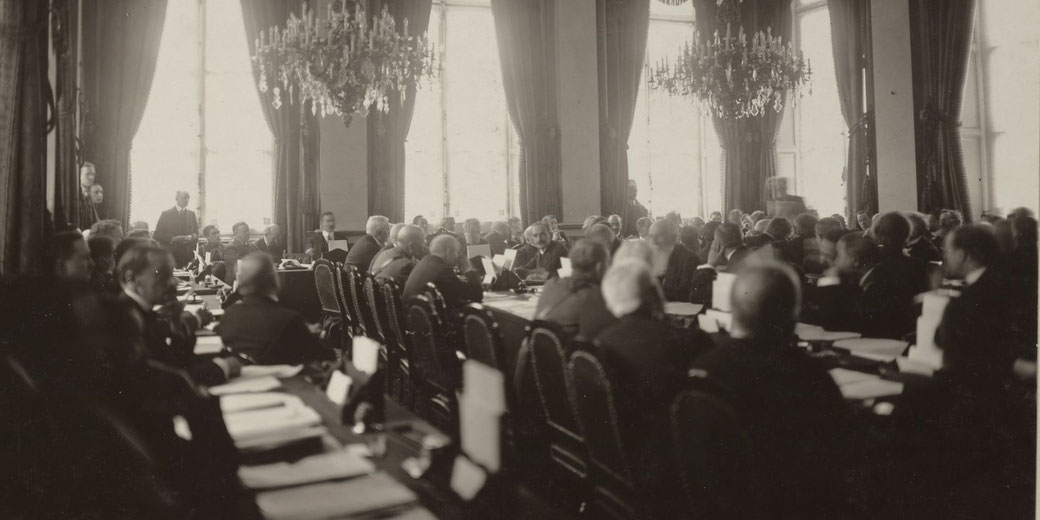
The Treaty of Versailles, signed on 28 June 1919, formally ended the First World War and imposed a series of far-reaching conditions on Germany.
The settlement emerged from months of complex negotiations in Paris, where the leaders of the Allied powers debated the terms of peace under considerable domestic pressure and in the shadow of an unstable post-war Europe.
The sources on this page offer several different angles on the events that led to and shaped the treaty: official documents that record the exact terms agreed upon, eyewitness accounts from participants who were present in the negotiating rooms, and early historical analyses drawing on documents released in the years immediately following the conference.
Source 1
Extract A
"An armistice has been concluded on the following conditions: I. Cessation of hostilities by land and in the air six hours after the signing of the armistice. II. Immediate evacuation of the invaded countries—Belgium, France, Luxemburg, as well as Alsace-Lorraine—so ordered as to be completed within 15 days from the signature of the armistice. The German troops which have not left the above-mentioned territories within the period fixed will become prisoners of war."
Extract B
"The present armistice was signed on the 11th day of November, 1918, at 5 o'clock a.m. (French time)."
Contextual information:
This is the official text of the Armistice Convention signed between Marshal Ferdinand Foch (representing the Allied powers) and a German delegation led by Matthias Erzberger, in a railway carriage at Compiègne, France. The document ended the fighting of World War I through a negotiated ceasefire, rather than through the military conquest of either side. It was reprinted by the United States Department of State as part of the official record of the Paris Peace Conference.
Bibliographical reference:
United States Department of State. (1942). Papers relating to the foreign relations of the United States: The Paris Peace Conference, 1919 (Vol. II, pp. 1–5). U.S. Government Printing Office.
Copyright: Public domain. United States federal government publication, not subject to copyright under 17 U.S.C. § 105.
Source 2
Extract A (Article 160)
“By a date which must not be later than March 31, 1920, the German Army must not comprise more than seven divisions of infantry and three divisions of cavalry. After that date the total number of effectives in the Army of the States constituting Germany must not exceed one hundred thousand men, including officers and establishments of depots. The Army shall be devoted exclusively to the maintenance of order within the territory and to the control of the frontiers. The total effective strength of officers, including the personnel of staffs, whatever their composition, must not exceed four thousand."
Extract B (Article 231)
"The Allied and Associated Governments affirm and Germany accepts the responsibility of Germany and her allies for causing all the loss and damage to which the Allied and Associated Governments and their nationals have been subjected as a consequence of the war imposed upon them by the aggression of Germany and her allies."
Extract C (Article 232)
"The Allied and Associated Governments recognize that the resources of Germany are not adequate, after taking into account permanent diminutions of such resources which will result from other provisions of the present Treaty, to make complete reparation for all such loss and damage. The Allied and Associated Governments, however, require, and Germany undertakes, that she will make compensation for all damage done to the civilian population of the Allied and Associated Powers and to their property during the period of the belligerency of each as an Allied or Associated Power against Germany by such aggression by land, by sea and from the air, and in general all damage as defined in Annex I hereto."
Extract D (closing clause)
"In faith whereof the above-named Plenipotentiaries have signed the present Treaty. Done at Versailles, the twenty-eighth day of June, one thousand nine hundred and nineteen, in a single copy which will remain deposited in the archives of the French Republic, and of which authenticated copies will be transmitted to each of the Signatory Powers."
Contextual information:
The Treaty of Versailles was the formal peace treaty signed on 28 June 1919 between Germany and the Allied powers at the Palace of Versailles, near Paris. The complete treaty contains 440 articles organised into 15 Parts, covering the Covenant of the League of Nations, territorial changes, military restrictions, reparations, and war guilt. The extracts above come from Part V (Military Clauses) and Part VIII (Reparation), with the closing clause from Part XV. Teacher note: Article 231 became known as the "War Guilt Clause" and formed the legal basis for the reparations demanded in Article 232.
Bibliographical reference:
Treaty of Peace between the Allied and Associated Powers and Germany. (1919, June 28). Signed at Versailles, Part V, Article 160 (p. 57); Part VIII, Articles 231–232 (p. 84); Part XV, closing clause (p. 152). His Majesty's Stationery Office, London (Cmd. 153).
Copyright: Public domain. International treaty published in 1919. UK Crown Copyright has expired.
Source 3
Extract A
"Gentlemen of the Congress: Once more, as repeatedly before, the spokesmen of the Central Empires have indicated their desire to discuss the objects of the war and the possible bases of a general peace."
Extract B
"What we demand in this war, therefore, is nothing peculiar to ourselves. It is that the world be made fit and safe to live in; and particularly that it be made safe for every peace-loving nation which, like our own, wishes to live its own life, determine its own institutions, be assured of justice and fair dealing by the other peoples of the world as against force and selfish aggression. All the peoples of the world are in effect partners in this interest, and for our own part we see very clearly that unless justice be done to others it will not be done to us. The programme of the world's peace, therefore, is our programme; and that programme, the only possible programme, as we see it, is this:"
Extract C (Point XIV)
"A general association of nations must be formed under specific covenants for the purpose of affording mutual guarantees of political independence and territorial integrity to great and small states alike."
Contextual information:
Woodrow Wilson, the 28th President of the United States, delivered this address to a Joint Session of the United States Congress on 8 January 1918, while the First World War was still being fought. In the speech he outlined fourteen specific war aims that became known as the "Fourteen Points," the last of which proposed the international organisation that would become the League of Nations. Germany later agreed to the November 1918 armistice on the understanding that the final peace would be based on Wilson's Fourteen Points.
Bibliographical reference:
Wilson, W. (1918, January 8). Address of the President of the United States delivered at a joint session of the two houses of Congress. Congressional Record, 65th Congress, 2nd Session, Vol. 56, Part 1, pp. 680–681. U.S. Government Printing Office.
Copyright: Public domain. Speech by a United States President, published in the official Congressional Record. Not subject to copyright under 17 U.S.C. § 105.
Source 4
Extract A
"Paris was a nightmare, and every one there was morbid. A sense of impending catastrophe overhung the frivolous scene; the futility and smallness of man before the great events confronting him; the mingled significance and unreality of the decisions; levity, blindness, insolence, confused cries from without,—all the elements of ancient tragedy were there."
Extract B
"His seat in the room in the President's house, where the regular meetings of the Council of Four were held (as distinguished from their private and unattended conferences in a smaller chamber below), was on a square brocaded chair in the middle of the semicircle facing the fire-place, with Signor Orlando on his left, the President next by the fire-place, and the Prime Minister opposite on the other side of the fire-place on his right."
Extract C
"Clemenceau was by far the most eminent member of the Council of Four, and he had taken the measure of his colleagues. He alone both had an idea and had considered it in all its consequences. His age, his character, his wit, and his appearance joined to give him objectivity and a defined outline in an environment of confusion."
Contextual information:
John Maynard Keynes, a British economist, attended the Paris Peace Conference in 1919 as the official representative of the British Treasury. He resigned in protest at the terms of the treaty in June 1919 and wrote this book over the following summer, publishing it at the end of the year. In Extract B, "His seat" refers to Clemenceau, "the President" is Wilson, and "the Prime Minister" is Lloyd George, identifying the four men who dominated the negotiations.
Bibliographical reference:
Keynes, J. M. (1920). The economic consequences of the peace (pp. 3, 32, 27). Harcourt, Brace and Howe.
Copyright: Public domain.
Source 5
Extract A
"Out of this situation grew the Council of Three (later the Four), the three heads of the great States, the most powerful men in the world, meeting together alone and secretly trying to come to some understanding among themselves. The Council of Ten had proved too cumbersome (sometimes there were thirty to fifty in attendance) and too open."
Extract B
"The next eight or ten days were the most difficult of the entire Conference—the really Dark Period. The leaders themselves were working in the dark, often without even a secretary present, and no minutes. The world was in the dark, without real news—for there was no news—but fed upon rumour and conjecture."
Contextual information:
Ray Stannard Baker was an American journalist who served as Woodrow Wilson's press secretary at the Paris Peace Conference in 1919, and who was later appointed as Wilson's authorised biographer with full access to the President's private papers. His three-volume account was published in 1922, just three years after the conference. The "Council of Four" he describes consisted of Wilson (United States), Lloyd George (Britain), Clemenceau (France), and Orlando (Italy).
Bibliographical reference:
Baker, R. S. (1922). Woodrow Wilson and world settlement: Written from his unpublished and personal material (Vol. 2, pp. 4, 33–34). Doubleday, Page and Company.
Copyright: Public domain.
Source 5
"Foch had been authorized to conclude an armistice with the representatives of Germany. On the following day the German delegation, headed by Minister Erzberger, left Berlin for the front. It was not until the night of the eighth that the delegation reached the French lines and was conducted to the station of Rethondes, six miles east of Compiegne. There an armistice was finally signed by the Germans and the Allies which resulted in the ending of the world war."
Contextual information:
Ralph Haswell Lutz was an Associate Professor of History at Stanford University who specialised in modern German history. His book on the German Revolution was published in 1922, only four years after the events it describes, drawing on German and Allied documents that had become available in the immediate post-war period. The passage confirms the precise location where the armistice was signed: the railway station at Rethondes in the Forest of Compiègne, in northern France.
Bibliographical reference:
Lutz, R. H. (1922). The German revolution, 1918–1919 (pp. 11–12). Stanford University Press.
Copyright: Public domain.