
Historical sources on the transatlantic slave trade
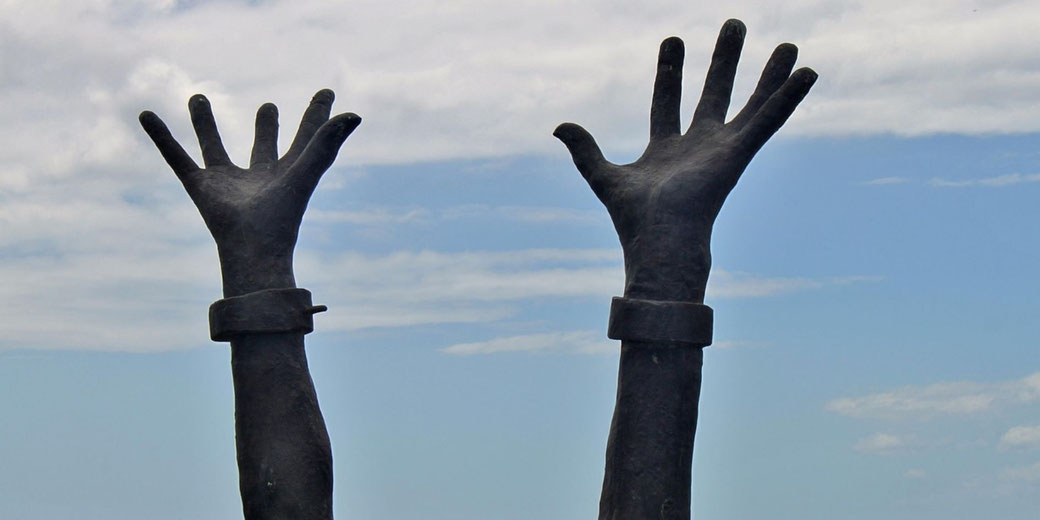
Drawn from first-hand testimony, medical observation, and later historical analysis, these sources present a confronting account of the transatlantic slave trade from capture in Africa to forced labour in the Americas.
They allow close examination of the human experience of slavery and the economic system that sustained it, which reveals both the suffering endured by enslaved people and the deliberate choices that allowed the trade to continue for centuries.
Source 1
Extract A
“One day, when all our people were gone out to their works as usual, and only I and my dear sister were left to mind the house, two men and a woman got over our walls, and in a moment seized us both, and, without giving us time to cry out, or make resistance, they stopped our mouths, and ran off with us into the nearest wood. Here they tied our hands, and continued to carry us as far as they could, till night came on, when we reached a small house, where the robbers halted for refreshment [food and rest], and spent the night.”
Extract B
“From what I can recollect [remember] of these battles, they appear to have been irruptions [raids] of one little state or district on the other, to obtain prisoners or booty [stolen goods]. Perhaps they were incited [encouraged] to this by those traders who brought the European goods I mentioned amongst us. Such a mode [method] of obtaining slaves in Africa is common; and I believe more are procured [obtained] this way, and by kidnapping, than any other. When a trader wants slaves, he applies to a chief for them, and tempts him with his wares. It is not extraordinary, if on this occasion he yields to the temptation with as little firmness, and accepts the price of his fellow creatures liberty with as little reluctance as the enlightened merchant.”
Extract C
“At last, when the ship we were in had got in all her cargo [goods being transported], they made ready with many fearful noises, and we were all put under deck, so that we could not see how they managed the vessel. The stench [terrible smell] of the hold while we were on the coast was so intolerably loathsome [unbearably disgusting], that it was dangerous to remain there for any time, and some of us had been permitted to stay on the deck for the fresh air; but now that the whole ship’s cargo were confined together, it became absolutely pestilential [filled with deadly disease]. The closeness of the place, and the heat of the climate, added to the number in the ship, which was so crowded that each had scarcely room to turn himself, almost suffocated us. This produced copious [large amounts of] perspirations, so that the air soon became unfit for respiration [breathing], from a variety of loathsome smells, and brought on a sickness among the slaves, of which many died, thus falling victims to the improvident avarice [reckless greed], as I may call it, of their purchasers. This wretched situation was again aggravated [made worse] by the galling [painful rubbing] of the chains, now become insupportable [unbearable]; and the filth of the necessary tubs, into which the children often fell, and were almost suffocated. The shrieks of the women, and the groans of the dying, rendered [made] the whole a scene of horror almost inconceivable [impossible to imagine].”
Contextual information:
Olaudah Equiano was an African-born man who was kidnapped from his village in the Kingdom of Benin (in present-day Nigeria) as a child, in approximately 1756, and sold into the Atlantic slave trade. He eventually bought his own freedom and became a prominent abolitionist in Britain. He published his autobiography in London in 1789 to expose the realities of slavery and support the campaign to abolish the slave trade.
Bibliographical reference:
Equiano, O. (1789). The interesting narrative of the life of Olaudah Equiano, or Gustavus Vassa, the African. Written by himself (pp. 45–46, 79–80). Printed for and sold by the Author.
Copyright: Public domain.
Source 2
Extract A
“After permission has been obtained for breaking trade [beginning to buy and sell], as it is termed, the captains go ashore, from time to time, to examine the negroes that are exposed to sale, and to make their purchases. The unhappy wretches thus disposed of, are bought by the black traders at fairs, which are held for that purpose, at the distance of upwards of two hundred miles from the sea coast; and these fairs are said to be supplied from an interior part of the country. Many negroes, upon being questioned relative to [about] the places of their nativity [birth], have asserted [stated], that they have travelled during the revolution [passing] of several moons, (their usual method of calculating time) before they have reached the places where they were purchased by the black traders. There is great reason to believe, that most of the negroes shipped off from the coast of Africa, are kidnapped.”
Extract B
“The men negroes, on being brought aboard the ship, are immediately fastened together, two and two, by hand-cuffs on their wrists, and by irons rivetted [fixed tightly] on their legs. They are then sent down between the decks, and placed in an apartment partitioned off for that purpose. But at the same time, they are frequently stowed [packed] so close, as to admit of no other posture [position] than lying on their sides. Neither will the height between decks, unless directly under the grating, permit them the indulgence [comfort] of an erect posture; especially where there are platforms, which is generally the case. The deck, that is, the floor of their rooms, was so covered with the blood and mucus [thick liquid] which had proceeded from them in consequence of the flux [severe illness causing loss of blood], that it resembled a slaughter-house. It is not in the power of the human imagination, to picture to itself a situation more dreadful or disgusting.”
Contextual information:
Alexander Falconbridge was a British surgeon who made four voyages on slave ships between 1780 and 1787, working as a ship’s doctor. After witnessing the conditions of the slave trade at first hand, he became a committed abolitionist. He wrote this account in 1788 at the request of the Society for Effecting the Abolition of the Slave Trade, intending it as evidence to present to the British Parliament.
Bibliographical reference:
Falconbridge, A. (1788). An account of the slave trade on the coast of Africa (pp. 12–13, 19–25). Printed by J. Phillips.
Copyright: Public domain.
Source 3
Extract A
“So early as in the year 1503 a few slaves had been sent from the Portuguese settlements in Africa into the Spanish colonies in America. In 1511, Ferdinand the Fifth, king of Spain, permitted them to be carried in greater numbers. Ferdinand, however, must have been ignorant [unaware] in these early times of the piratical [criminal] manner in which the Portuguese had procured them. He could have known nothing of their treatment when in bondage [captivity], nor could he have viewed the few uncertain adventurous transportations of them into his dominions [territories] in the western world, in the light of a regular trade. The object of Bartholomew de las Casas was undoubtedly to save the American Indians, whose cruel treatment and almost extirpation [destruction] he had witnessed during his residence among them, and in whose behalf he had undertaken a voyage to the court of Spain.”
Extract B
“The trade with all its horrors began at the river Senegal, and continued, winding with the coast, through its several geographical divisions to Cape Negro; a distance of more than three thousand miles. In various lines or paths formed at right angles from the shore, and passing into the heart of the country, slaves were procured [obtained] and brought down. The distance, which many of them travelled, was immense. Those, who have been in Africa, have assured us, that they came as far as from the sources of their largest rivers, which we know to be many hundred miles in-land, and the natives have told us, in their way of computation, that they came a journey of many moons.”
Extract C
“And here we are to view them first under the degrading [humiliating] light of cattle. We are to see them examined, handled, selected, separated, and sold. Alas! relatives are separated from relatives, as if, like cattle, they had no rational [reasonable] intellect, no power of feeling the nearness of relationship, nor sense of the duties belonging to the ties of life! We are to see them in a state of general degradation [humiliation] and misery. The knowledge, which their oppressors have of their own crime in having violated the rights of nature, and of the disposition [desire] of the injured to seek all opportunities of revenge, produces a fear, which dictates to them the necessity of a system of treatment by which they shall keep up a wide distinction between the two, and by which the noble feelings of the latter shall be kept down, and their spirits broken.”
Contextual information:
Thomas Clarkson was a British abolitionist and historian who spent decades gathering evidence against the slave trade and campaigning for its abolition in Parliament. He published this two-volume history in 1808, the same year the British Parliament passed the Slave Trade Act, to document how that victory had been achieved. He drew on decades of personal research, interviews with sailors, and parliamentary records.
Bibliographical reference:
Clarkson, T. (1808). The history of the rise, progress, and accomplishment of the abolition of the African slave-trade by the British Parliament (Vol. I, pp. 39–40, 116–117, 265–266). Longman, Hurst, Rees, and Orme.
Copyright: Public domain.
Source 4
Extract A
“That the slave-trade was the very life of the colonies had, by 1700, become an almost unquestioned axiom [accepted truth] in British practical economics. The colonists themselves declared slaves ‘the strength and sinews [muscles] of this western world,’ and the lack of them ‘the grand obstruction’ here, as the settlements ‘cannot subsist [survive] without supplies of them.’ Thus, with merchants clamoring [demanding loudly] at home and planters abroad, it easily became the settled policy of England to encourage the slave-trade. Then, too, she readily argued that what was an economic necessity in Jamaica and the Barbadoes could scarcely be disadvantageous to Carolina, Virginia, or even New York.”
Extract B
“From 1680 to 1688 the African Company sent 249 ships to Africa, shipped there 60,783 Negro slaves, and after losing 14,387 on the middle passage, delivered 46,396 in America. It is probable that about 25,000 slaves were brought to America each year between 1698 and 1707. The importation then dwindled, but rose after the Assiento [a contract giving Britain the right to supply slaves to Spanish colonies] to perhaps 30,000. Before the Revolution, the total exportation to America is variously estimated as between 40,000 and 100,000 each year.”
Contextual information:
W. E. B. Du Bois was an American historian and civil rights campaigner. He published this book in 1896 as the first volume of the Harvard Historical Studies series, based on his doctoral research at Harvard University. Du Bois was one of the first scholars to approach the history of the slave trade with systematic use of historical records.
Bibliographical reference:
Du Bois, W. E. B. (1896). The suppression of the African slave-trade to the United States of America, 1638–1870 (Harvard Historical Studies, Vol. I, pp. 12–13, 15, 17). Longmans, Green, and Co.
Copyright: Public domain.