
Historical sources on the Russo-Japanese War
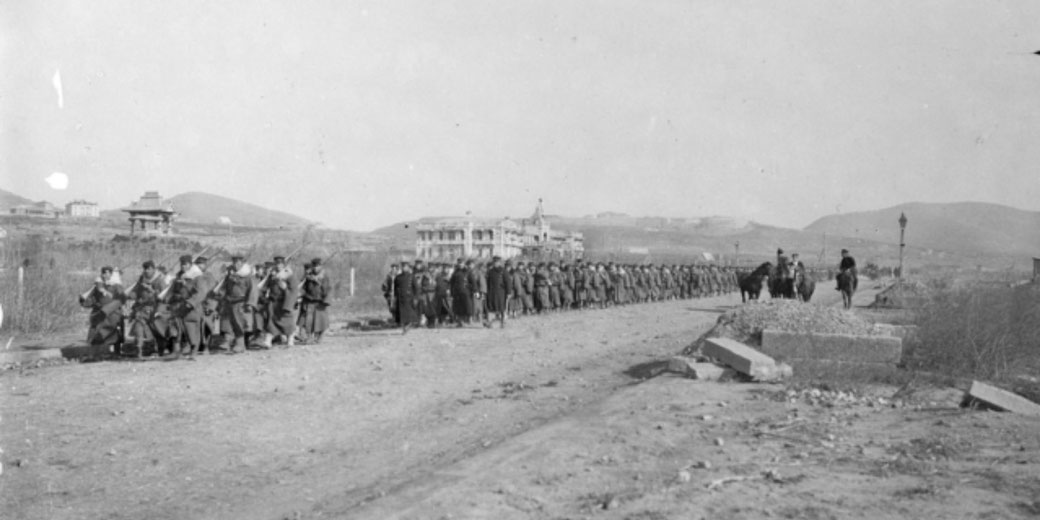
The Russo-Japanese War of 1904-05 was fought between the expanding empires of Russia and Japan over influence in Korea and Manchuria.
The conflict shocked the world when Japan defeated one of Europe's largest powers, proving that an industrialised Asian nation could match and overcome a major Western empire.
The following sources offer different perspectives on the war, including a contemporary account by an American war correspondent, a post-war analysis by a senior Russian commander, and the official peace treaty that brought the fighting to an end.
Source 1
"The expansion of the Russian Empire has been steadily eastwards; and the further conquest and dominion have spread, the more has the necessity been felt for an outlet to the navigable seas. Unless all the labor and sacrifices of years are to be in vain, and the great Siberian Empire is to remain a mere gigantic cul-de-sac [dead end], Russia must establish herself permanently in the Gulf of Pechili, and find in its ice-free ports that natural outlet for her trans-continental railway which will enable the life-blood of commerce to circulate through her torpid [sluggish] bulk. The struggle, therefore, was one between two irreconcilable [completely opposing] destinies."
"A single year's campaign in Manchuria and around famed Port Arthur furnish three land battles, greater in the number engaged in the awful cost of life, in the period of duration, than is presented by all of the pages of history. The siege of Port Arthur has no duplicate among all recorded military achievements. The opening of the second year of the war added a battle, that at Mukden, so vast, so brilliant from the standpoint of the victors, so disastrous from the standpoint of the defeated, that it has been accorded by masters of strategy a niche [place of honour] by itself in the chronicles of war."
"On the night of Monday, February 8th [1904], a daring attack by torpedo-boats was made on the Russian fleet lying at anchor in the Port Arthur roadstead [harbour anchorage], and at one fell swoop the boasted might of Russia at sea was hopelessly broken."
Contextual information:
Sydney Tyler was an American war correspondent who travelled to the Far East to cover the conflict at first hand. He wrote The Japan-Russia War in 1905, the year the war ended, drawing on his own direct observation of the campaign in Manchuria and Korea. His account was the first major English-language history of the war, published before the full documentary record had been assembled.
Bibliographical reference:
Tyler, S. (1905). The Japan-Russia War: An illustrated history of the war in the Far East (pp. intro, 39). P. W. Ziegler Co.
Copyright: Public domain.
Source 2
"To inflict a crushing blow upon our fleet so as to paralyze its activity once and for all, and thus guarantee freedom of movement to their transports. To attain this end they have not hesitated to attack us before the declaration of war (vide [see] the night operations of February 8 and 9 [1904])."
"Our hopes as to the promised improvement of the railway were unfortunately not realized, while our fleet, damaged by the enemy's onslaught before the declaration of war, was not only weaker than the enemy's, but failed even to perform the modest task expected of it in 1901. Consequently the concentration of our troops was a far slower business than we thought it would be, while the Japanese, having gained command of the sea, threw the whole of their army on to the continent. Thus, gaining the initiative on land as well as on the sea, and fired as they were with immense patriotism, the enemy commenced the war superior to us morally as well as materially."
Contextual information:
General Aleksei Nikolaevich Kuropatkin was the commander of the Russian Army in Manchuria during the Russo-Japanese War of 1904-05. He wrote this work in 1909 as a detailed post-war analysis of Russia's military failures, drawing on his own direct experience of commanding Russian forces throughout the campaign. As the most senior Russian field commander, his account gives a direct view of the war's outcome from inside the Russian military.
Bibliographical reference:
Kuropatkin, A. N. (1909). The Russian Army and the Japanese War, Vol. II (A. B. Lindsay, Trans.; pp. Chapter X/XII). E. P. Dutton and Company.
Copyright: Public domain.
Source 3
"ARTICLE I. There shall henceforth be peace and amity between their Majesties the Emperor of Japan and the Emperor of all the Russias [Russia], and between their respective States and subjects.
ARTICLE II. The Imperial Russian Government, acknowledging that Japan possesses in Korea [a country on the eastern coast of Asia, which was one of the main reasons the war was fought] paramount [supreme] political, military and economical interests, engages neither to obstruct nor interfere with measures for guidance, protection and control which the Imperial Government of Japan may find necessary to take in Korea.
ARTICLE III. Japan and Russia mutually engage: First. To evacuate [withdraw troops from] completely and simultaneously Manchuria [the northernmost region of China, bordering Russia, which was the main land battleground of the war], except the territory affected by the lease of the Liaotung Peninsula, in conformity with the provisions of the additional article I annexed to this treaty, and, Second. To restore entirely and completely to the exclusive administration of China all portions of Manchuria now in occupation, or under the control of the Japanese or Russian troops, with the exception of the territory above mentioned."
Contextual information:
The Treaty of Portsmouth was the peace agreement that formally ended the Russo-Japanese War on 5 September 1905. It was signed at the Portsmouth Naval Shipyard in the United States, with negotiations brokered by U.S. President Theodore Roosevelt, who was awarded the Nobel Peace Prize for his role. The treaty confirmed Japan's victory and required Russia to withdraw from Manchuria and to recognise Japan's control over Korea.
Bibliographical reference:
Treaty of Portsmouth. (1905). In S. Tyler, The Japan-Russia War (pp. 564-568). P. W. Ziegler Co.
Copyright: Public domain.