
Historical sources on the Reign of Terror during the French Revolution
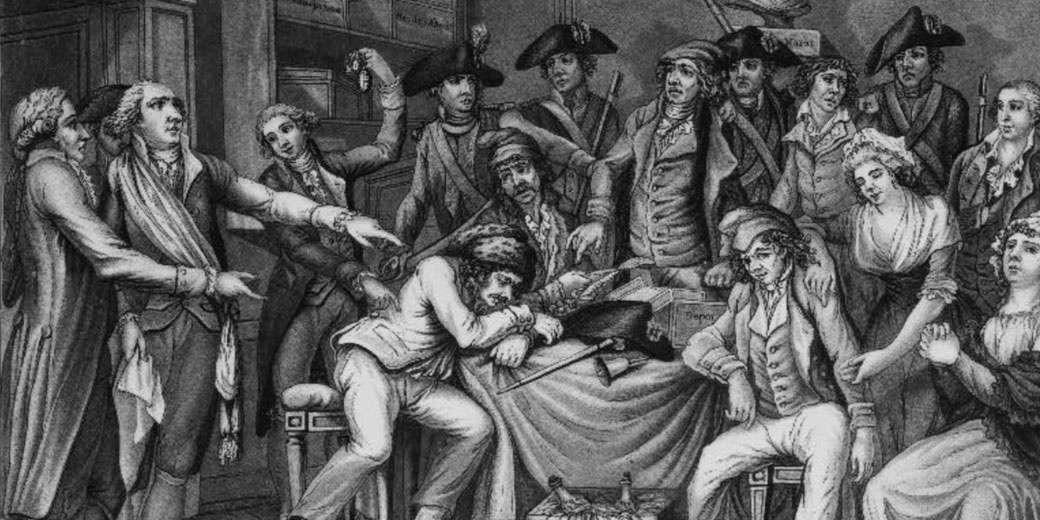
Set against the violence and political upheaval of 1793 to 1794, these sources examine the Reign of Terror through official decrees, eyewitness-style narratives, and retrospective accounts.
The collection begins with the Law of Suspects, which set out the legal basis for widespread arrests, and then moves to vivid descriptions of the Revolutionary Tribunal, executions, and the suppression of resistance in regions such as the Vendée.
Alongside these accounts, the sources include material on revolutionary culture, including the Festival of Reason, which illustrates attempts to replace traditional religion with new civic rituals, as well as references to figures such as Maximilien Robespierre and the early career of Napoleon Bonaparte.
Source 1
"Decree that orders the arrest of Suspect People. Of 17 September 1793. The National Convention, having heard the report of its legislative committee on the method of bringing into effect its decree of last 12 August, decrees the following:
Art. I. Immediately after the publication of the present decree, all suspects within the territory of the Republic and still at large, shall be placed in custody.
2. The following are deemed suspects:
1– those who, by their conduct, associations, comments, or writings have shown themselves partisans of tyranny or federalism and enemies of liberty;
2– those who are unable to justify, in the manner prescribed by the decree of 21 March, their means of existence and the performance of their civic duties;
3– those to whom certificates of patriotism have been refused;
4– civil servants suspended or dismissed from their positions by the National Convention or by its commissioners, and not reinstated, especially those who have been or are to be dismissed by virtue of the decree of 14 August;
5– those former nobles, together with husbands, wives, fathers, mothers, sons or daughters, brothers or sisters, and agents of the émigrés, who have not constantly demonstrated their devotion to the Revolution;
6– those who have emigrated between 1 July 1789, and the publication of the decree of 30 March (8 April 1792), even though they may have returned to France within the period established by said decree or prior thereto."
Contextual information:
This is the text of the Law of Suspects itself, drafted in the National Convention by Philippe-Antoine Merlin de Douai and Jean-Jacques Régis de Cambacérès and adopted on 17 September 1793. The Convention was the elected revolutionary assembly governing France at the time, and the decree was issued during the food crisis and military emergencies of that summer. It is the central legal instrument of the Reign of Terror because it allowed local committees to arrest anyone whose words, writings or background could be read as hostile to the Republic.
Bibliographical reference:
National Convention. (1793, September 17). Decree ordering the arrest of suspect persons. In J.-B. Duvergier (Ed.), Collection complète des lois, décrets, ordonnances, règlements, avis du conseil d'état . . . de 1788 a 1830 (2nd ed., Vol. 6, pp. 172–173). Paris.
Copyright: Public domain.
Source 2
Extract A
"Five Judges; a standing Jury, which is named from Paris and the Neighbourhood, that there be not delay in naming it: they are subject to no Appeal; to hardly any Law-forms, but must 'get themselves convinced' in all readiest ways; and for security are bound 'to vote audibly;' audibly, in the hearing of a Paris Public. This is the Tribunal Extraordinaire; which, in few months, getting into most lively action, shall be entitled Tribunal Revolutionnaire, as indeed it from the very first has entitled itself: with a Herman or a Dumas for Judge President, with a Fouquier-Tinville for Attorney-General, and a Jury of such as Citizen Leroi, who has surnamed himself Dix-Aout, 'Leroi August-Tenth,' it will become the wonder of the world. Herein has Sansculottism fashioned for itself a ‘Sword of Sharpness’ [or "national razor"/rasoir national]: a weapon magical; tempered in the Stygian hell-waters; to the edge of it all armour, and defence of strength or of cunning shall be soft; it shall mow down Lives and Brazen-gates."
Extract B
"On Monday the Fourteenth of October, 1793, a Cause is pending in the Palais de Justice, in the new Revolutionary Court, such as these old stone-walls never witnessed: the Trial of Marie-Antoinette. The once brightest of Queens, now tarnished, defaced, forsaken, stands here at Fouquier Tinville's Judgment-bar; answering for her life! The Indictment was delivered her last night. To such changes of human fortune what words are adequate? Silence alone is adequate. There are few Printed things one meets with, of such tragic almost ghastly significance as those bald Pages of the Bulletin du Tribunal Revolutionnaire, which bear title, Trial of the Widow Capet...
"At eleven, Marie-Antoinette was brought out. She had on an undress of pique blanc: she was led to the place of execution, in the same manner as an ordinary criminal; bound, on a Cart; accompanied by a Constitutional Priest in Lay dress; escorted by numerous detachments of infantry and cavalry. These, and the double row of troops all along her road, she appeared to regard with indifference."
Extract C
"Guillotining there was at Nantes, till the Headsman sank worn out: then fusillading 'in the Plain of Saint-Mauve'; little children fusilladed, and women with children at the breast; children and women, by the hundred and twenty; and by the five hundred, so hot is La Vendée: till the very Jacobins grew sick, and all but the Company of Marat cried, Hold!"
[And, looking back from the end of the war]:
"Likewise, General Hoche has even succeeded in pacificating La Vendee. Rogue Rossignol and his 'Infernal Columns' have vanished: by firmness and justice, by sagacity and industry, General Hoche has done it. Taking 'Movable Columns,' not infernal; girdling-in the Country; pardoning the submissive, cutting down the resistive, limb after limb of the Revolt is brought under. La Rochejacquelin, last of our Nobles, fell in battle; Stofflet himself makes terms; Georges-Cadoudal is back to Brittany, among his Chouans: the frightful gangrene of La Vendee seems veritably extirpated. It has cost, as they reckon in round numbers, the lives of a Hundred Thousand fellow-mortals; with noyadings, conflagratings by infernal column, which defy arithmetic. This is the La Vendee War."
Extract D
"Mrs. Momoro, it is admitted, made one of the best Goddesses of Reason; though her teeth were a little defective."
Extract E
"All eyes are on Robespierre's Tumbril, where he, his jaw bound in dirty linen, with his half-dead Brother and half-dead Henriot, lie shattered, their 'seventeen hours' of agony about to end. The Gendarmes point their swords at him, to show the people which is he."
[Please note: Robespierre and his closest allies were arrested on 9 Thermidor (27 July 1794) and guillotined the following day. This event is what historians call the Thermidorian Reaction, and it brought the Reign of Terror to a close in 1794].
Contextual information:
Thomas Carlyle was a Scottish historian and essayist whose three-volume The French Revolution: A History appeared in London in 1837. He drew on memoirs, the Moniteur newspaper, the Histoire Parlementaire, and the recollections of figures such as Madame Campan and the Deux Amis de la Liberté. The work was written less than fifty years after the events themselves, when many participants were still alive, and it was praised by John Stuart Mill as having "the beauty and the strength of an epic poem." Carlyle takes a strongly anti-Jacobin view, so students should be encouraged to notice his loaded language.
Bibliographical reference:
Carlyle, T. (1837). The French Revolution: A history. Volume III: The Guillotine. London: James Fraser. (Reproduced in the Methuen Standard Library edition, edited by C. R. L. Fletcher, London: Methuen & Co., 1902, pp. 86–88, 98–100, 134–135, 191–193, 207–210, 232.)
Copyright: Public domain.
Source 3
"A prodigious number of musicians raised the roof with the cherished songs of the Revolution; a troop of republican girls, dressed in white, girded with tricolour ribbons and with garlands of flowers on their heads, preceded and surrounded Reason. This was a woman, a faithful image of beauty; she had on her head a bonnet of liberty; on her shoulders was a blue cloak, and she held in her right hand a pike. Seated on a simple litter, decorated with oak garlands, she was carried aloft by four citizens; her imposing and gracious appearance commanded respect and love. These sentiments were demonstrated with the greatest enthusiasm; the cries of Long live the Republic redoubled; bonnets and caps were thrown in the air; the people gave themselves over to cries of the most pure joy. The goddess of Reason was placed in front of the bar, opposite the president."
Contextual information:
This is the official account of the Festival of Reason, recorded in the minutes of the National Convention on 20 Brumaire Year II, which corresponds to 10 November 1793. The festival was the centrepiece of the Dechristianisation campaign organised by Pierre-Gaspard Chaumette, Antoine-François Momoro, and Jacques Hébert of the Paris Commune, who turned the cathedral of Notre-Dame into a "Temple of Reason" for the day. The "goddess" was an opera singer carried in procession, and the ceremony was repeated in churches across France over the following weeks.
Bibliographical reference:
National Convention of France. (1793, November 10). Procès-verbal de la Convention nationale, 20 Brumaire An II. Paris: Imprimerie Nationale.
Copyright: Public domain.
Source 4
"It was during my absence from France that Bonaparte, in the rank of chef de bataillon, performed his first campaign, and contributed so materially to the recapture of Toulon."
"I have since served with some distinction at Toulon, and earned a part of the laurels of the army of Italy at the taking of Saorgio, Oneille, and Tanaro."
Contextual information:
Louis Antoine Fauvelet de Bourrienne was a schoolmate of Napoleon Bonaparte at the Military College of Brienne and later became his private secretary from 1797 until 1802, working in the same room with him and handling his official and private correspondence. Bourrienne wrote his memoirs in retirement after his fall from favour, drawing on documents Bonaparte himself had given him, including the personal note of self-defence Bonaparte had composed during his arrest in August 1794. The first extract is Bourrienne's editorial summary of where Bonaparte was during his own absence from France in 1793, and the second extract is Bonaparte's own words from the note he addressed to the representatives Albitte and Salicetti, in which he listed Toulon among his services to the Republic as evidence of his patriotism.
Bibliographical reference:
Bourrienne, L. A. F. de. (1829). Memoirs of Napoleon Bonaparte, Volume 1 (R. W. Phipps, Ed.; Chapters II and III).
Copyright: Public domain.