
Historical sources on the post-WWII divisions
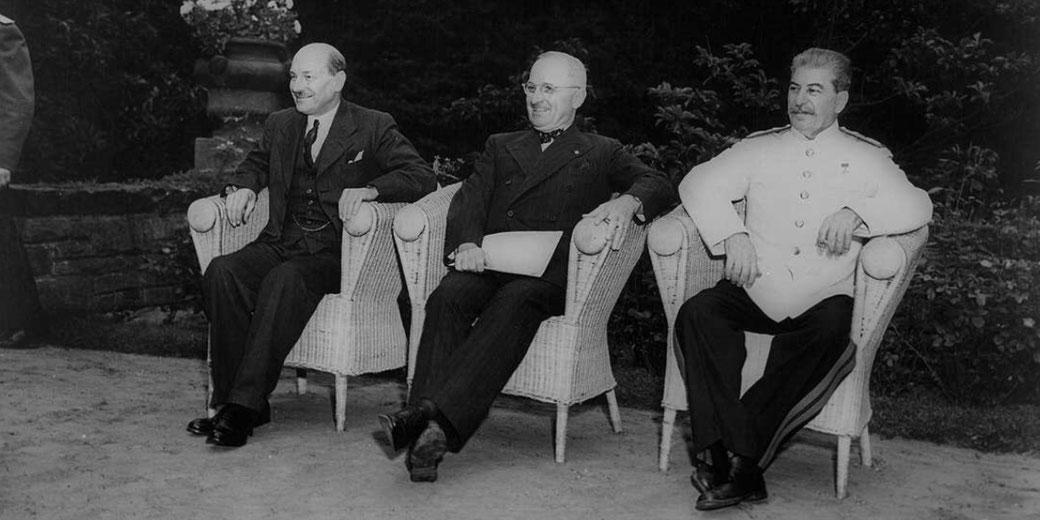
Following World War II, Europe moved into a series of deals and conference decisions that redrew borders and divided nationals sphers of power.
The sources below track that path from the secret 23 August 1939 German–Soviet protocol to the Allied negotiations that followed Germany’s defeat in 1945.
The Yalta agreements, including the plan to shift Poland’s frontiers around the Curzon Line, and the Potsdam occupation system that placed Germany into zones under a joint Control Council, show how the wartime alliance operated through formal agreements.
Source 1
On the occasion of the signature of the Nonaggression Pact between the German Reich and the Union of Socialist Soviet Republics the undersigned [representatives] of each of the two parties discussed in strictly confidential conversations the question of the boundary of their respective spheres of influence in Eastern Europe. These conversations led to the following conclusions:
In the event of a territorial and political rearrangement in the areas belonging to the Baltic States (Finland, Estonia, Latvia, Lithuania), the northern boundary of Lithuania shall represent the boundary of the spheres of influence of Germany and the U.S.S.R. In this connection the interest of Lithuania in the Vilna area is recognized by each party.
In the event of a territorial and political rearrangement of the areas belonging to the Polish state the spheres of influence of Germany and the U.S.S.R. shall be bounded approximately by the line of the rivers Narew, Vistula, and San. The question of whether the interests of both parties make desirable the maintenance of an independent Polish state and how such a state should be bounded can only be definitely determined in the course of further political developments. In any event both Governments will resolve this question by means of a friendly agreement.
With regard to Southeastern Europe attention is called by the Soviet side to its interest in Bessarabia. The German side declares; its complete political disinterestedness in these areas.
This protocol shall be treated by both parties as strictly secret. Moscow, August 23, 1939. For the Government of the German Reich: V. RIBBENTROP Plenipotentiary of the Government of the U.S.S.R.: V. MOLOTOV
Contextual information:
The text is an official diplomatic protocol from 23 August 1939, signed in Moscow by Nazi German Foreign Minister Joachim von Ribbentrop and Soviet Foreign Minister Vyacheslav Molotov. It was captured from German archives at the end of the war and first published by the U.S. Department of State in 1948.
Bibliographical reference:
U.S. Department of State. (1948). Secret additional protocol to the German–Soviet Non‑Aggression Pact (23 August 1939). In Nazi–Soviet relations, 1939–1941: Documents from the archives of the German Foreign Office). U.S. Government Printing Office.
Source 2
During 1942, the Axis advance reached its high tide on all fronts and began to ebb. Nowhere was this more true than on the Eastern Front in the Soviet Union. After receiving a disastrous setback on the approaches to Moscow in the winter of 1941–1942, the German armies recovered sufficiently to embark on a sweeping summer offensive that carried them to the Volga River at Stalingrad and deep into the Caucasus Mountains. The Soviet armies suffered severe defeats in the spring and summer of 1942 but recovered to stop the German advances in October and encircle and begin the destruction of the German Sixth Army at Stalingrad in November and December. This volume describes the course of events from the Soviet December 1941 counteroffensive at Moscow to the Stalingrad offensive in late 1942 with particular attention to the interval from January through October 1942, which has been regarded as a hiatus between the two major battles but which in actuality constituted the period in which the German fortunes slid into irreversible decline and the Soviet forces acquired the means and capabilities that eventually brought them victory. These were the months of decision in the East.
Contextual information:
The paragraph comes from the preface of Moscow to Stalingrad: Decision in the East, written by historian Earl F. Ziemke for the U.S. Army’s Center of Military History. As a U.S. government work (Army Historical Series), the text is in the public domain.
Bibliographical reference:
Ziemke, E. F. (1987). Moscow to Stalingrad: Decision in the East (Army Historical Series). U.S. Army Center of Military History.
Source 3
After Germany's defeat in the Second World War, the four main allies in Europe – the United States, Great Britain, the Soviet Union, and France – took part in a joint occupation of the German state. With the original understanding that the country would eventually be reunified, the Allied Powers agreed to share the responsibility of administering Germany and its capital, Berlin, and each took responsibility for a certain portion of the defeated nation. This arrangement ultimately evolved into the division of Germany into a Western and an Eastern sector, thereby contributing to the Cold War division of Europe.
During the Second World War, one of the major topics under discussion at conferences of the Allied leadership was how to deal with Germany after the war. Having experienced great losses as a result of German invasions in the First and Second World Wars, Soviet leader Joseph Stalin preferred that a defeated Germany be dismembered and divided so that it could not rise to its former strength to threaten European peace and security again. At the Tehran Conference between U.S. President Franklin Roosevelt and Soviet leader Joseph Stalin in 1943, the two countries agreed that after the war Germany would be divided and occupied jointly. At the final wartime conference between these two men at Yalta in 1945, the two powers agreed to shift the eastern border of Germany to the West, enlarging western Poland as compensation for the eastern sections of that country annexed by the Soviet Union. They also determined that the occupation would divide Germany into sections, with each Allied power taking responsibility for one section, although they would be governed as a single economic unit in anticipation of their eventual reunification...
At the final wartime conference between these two men at Yalta in 1945, the two powers agreed to shift the eastern border of Germany to the West, enlarging western Poland as compensation for the eastern sections of that country annexed by the Soviet Union. They also determined that the occupation would divide Germany into sections, with each Allied power taking responsibility for one section, although they would be governed as a single economic unit in anticipation of their eventual reunification.
Contextual information:
This is a modern historical summary written by the Office of the Historian, U.S. Department of State, explaining the Allied occupation of Germany and decisions taken at Yalta. Both are U.S. government works and thus in the public domain.
Bibliographical references:
Office of the Historian. (2008, July 17). Allied occupation of Germany, 1945–52. U.S. Department of State. https://2001-2009.state.gov/r/pa/ho/time/cwr/107189.htm
Source 4
March 24 – The text of the agreements reached at the Crimea (Yalta) Conference between President Roosevelt, Prime Minister Churchill and Generalissimo Stalin, as released by the State Department today, follows:
The Crimea Conference of the heads of the Governments of the United States of America, the United Kingdom, and the Union of Soviet Socialist Republics, which took place from Feb. 4 to 11, came to the following conclusions...
Contextual information:
The paragraph is from a U.S. State Department press release (24 March 1945) publishing the official text of the Yalta agreements. The agreements themselves were drawn up and approved by the three Allied leaders and then issued in this English version by the U.S. Government, which places this text in the public domain.
Bibliographical reference:
U.S. Department of State. (1950). Protocol of proceedings of Crimea (Yalta) Conference, February 11, 1945. In A decade of American foreign policy: Basic documents, 1941–1949 (Senate Doc. No. 123, 81st Cong., 1st sess., pp. 23–28). U.S. Government Printing Office.
Source 5
The three heads of Government consider that the eastern frontier of Poland should follow the Curzon Line with digressions from it in some regions of five to eight kilometers in favor of Poland. They recognize that Poland must receive substantial accessions in territory in the north and west. They feel that the opinion of the new Polish Provisional Government of National Unity should be sought in due course of the extent of these accessions and that the final delimitation of the western frontier of Poland should thereafter await the peace conference.
Contextual information:
This is a modern historical summary written by the Office of the Historian, U.S. Department of State, explaining the Allied occupation of Germany and decisions taken at Yalta. Both are U.S. government works and thus in the public domain.
Bibliographical references:
U.S. Department of State. (1950). Declaration on Poland (Crimea Conference). In A decade of American foreign policy: Basic documents, 1941–1949 (Senate Doc. No. 123, 81st Cong., 1st sess., pp. 23–28). U.S. Government Printing Office.
Source 6
The Berlin Conference of the Three Heads of Government of the U. S. S. R., U. S. A., and U. K., which took place from July 17 to August 2, 1945, came to the following conclusions...
Occupation of Germany and the four zones In accordance with the Agreement on Control Machinery in Germany, supreme authority in Germany is exercised, on instructions from their respective Governments, by the Commanders-in-Chief of the armed forces of the United States of America, the United Kingdom, the Union of Soviet Socialist Republics, and the French Republic, each in his own zone of occupation, and also jointly, in matters affecting Germany as a whole, in their capacity as members of the Control Council.
Contextual information:
These extracts are from the official “Protocol of the Proceedings” of the Berlin (Potsdam) Conference, issued in English as a U.S. government publication and later reprinted in A Decade of American Foreign Policy.
Bibliographical reference:
Allied Control Council. (1945). Protocol of the proceedings of the Berlin (Potsdam) Conference, August 1, 1945. Official Gazette of the Control Council for Germany, Supplement 1, p. 13. (Reprinted in U.S. Department of State, A decade of American foreign policy: Basic documents, 1941–1949.)
Source 7
The Cold War begins After World War II, the United States and its allies, and the Soviet Union and its satellite states began a decades-long struggle for supremacy known as the Cold War. Soldiers of the Soviet Union and the United States did not do battle directly during the Cold War. But the two superpowers continually antagonized each other through political maneuvering, military coalitions, espionage, propaganda, arms buildups, economic aid, and proxy wars between other nations.
Contextual information:
This is an overview written for the John F. Kennedy Presidential Library and Museum (part of the U.S. National Archives system). It introduces the Cold War and clearly identifies the United States and the Soviet Union as the two superpowers that dominated global politics after 1945.
Bibliographical reference:
John F. Kennedy Presidential Library and Museum. (2018). The Cold War. U.S. National Archives. https://www.jfklibrary.org/learn/about-jfk/jfk-in-history/the-cold-war