
Historical sources on the Japanese attack on Pearl Harbor in 1941
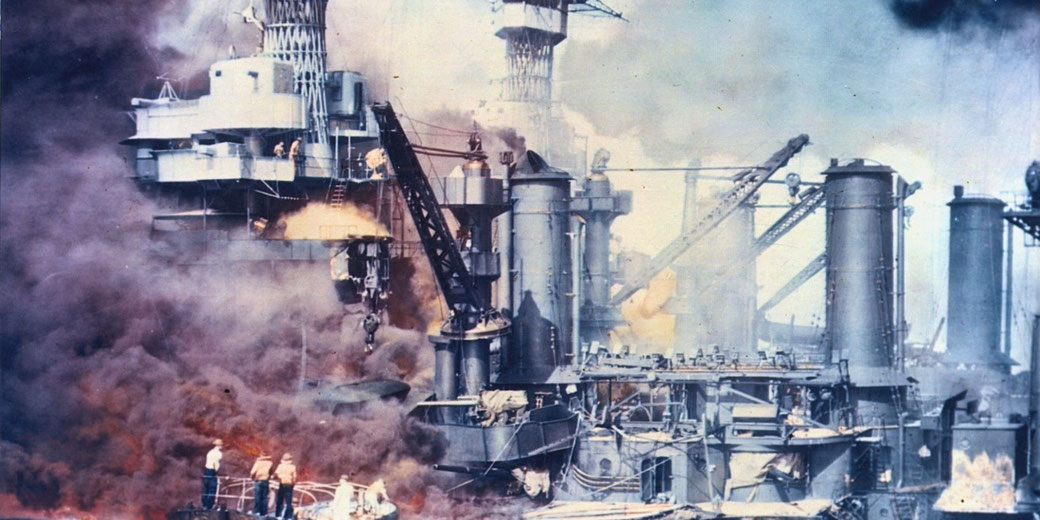
On 7 December 1941, Japanese naval and air forces launched a surprise attack on the United States Pacific Fleet at Pearl Harbor, Hawaii, killing more than 2,400 Americans and drawing the United States into the Second World War.
The sources collected here examine the attack and its immediate consequences from several standpoints: an American president seeking a declaration of war, military analysts reconstructing Japanese planning, official naval records documenting the destruction, and the diplomatic exchanges that followed as Germany and Italy joined Japan in declaring war on the United States.
Together, these documents allow you to examine how different institutions recorded and interpreted the same event, and to consider the purposes that shaped what each source chose to emphasise.
Source 1
Extract A:
"Mr. Vice President, and Mr. Speaker, and Members of the Senate and House of Representatives: Yesterday, December 7, 1941—a date which will live in infamy—the United States of America was suddenly and deliberately attacked by naval and air forces of the Empire of Japan."
Extract B:
"The United States was at peace with that Nation and, at the solicitation of Japan, was still in conversation with its Government and its Emperor looking toward the maintenance of peace in the Pacific. Indeed, one hour after Japanese air squadrons had commenced bombing in the American Island of Oahu, the Japanese Ambassador to the United States and his colleague delivered to our Secretary of State a formal reply to a recent American message. And while this reply stated that it seemed useless to continue the existing diplomatic negotiations, it contained no threat or hint of war or of armed attack."
Extract C:
"I ask that the Congress declare that since the unprovoked and dastardly attack by Japan on Sunday, December 7, 1941, a state of war has existed between the United States and the Japanese Empire."
Contextual information:
Franklin D. Roosevelt was the 32nd President of the United States. He delivered this address to a joint session of Congress on 8 December 1941, the day after the Japanese attack on Pearl Harbor, requesting a formal declaration of war against Japan. The Senate voted unanimously in favour, and only one member of the House of Representatives dissented; Roosevelt signed the declaration of war at 4:10 p.m. that same afternoon.
Bibliographical reference:
Roosevelt, F. D. (1941, December 8). Address to Congress requesting a declaration of war with Japan [Speech transcript]. Records of the United States Senate, SEN 77A-H1, Record Group 46. National Archives. https://www.archives.gov/milestone-documents/joint-address-to-congress-declaration-of-war-against-japan
Copyright: This is an official work of the United States government and is not subject to copyright under 17 U.S.C. § 105.
Source 2
Extract A:
"The purposes of the surprise attack on Pearl Harbor were: To render impotent the United States Pacific Fleet in order to gain time and to insure freedom of action in the South Seas Operation, (including invasion of the Philippine Islands), and to facilitate the defense of the mandated islands. The attack was conceived and proposed by Admiral Isoroku Yamamoto, CinC of the Japanese Combined Fleet. In January 1941, Rear Admiral Tokijiro Onishi, Chief of Staff of the 11th Air Fleet was ordered to make a preliminary study of the operation, and in the first part of September 1941 members of the Operations Section of the Naval General Staff and selected members of the Staffs of the Combined Fleet and the First Air Fleet commenced work on the details of the actual plan."
Extract B:
"Short range torpedo runs are very accurate. Therefore the pilots most skillful at shallow water torpedo drops were selected in order to put as many battleships and carriers temporarily out of action due to underwater damage as the conditions mentioned would permit. (Because the carriers were not at their anchorages on the day of the attack, the planes concentrated on the battleships)."
Extract C:
"The first group arrived over Oahu at about 0740, were ordered to attack at 0750 and attacked as follows: Dive Bombing Unit — Wheeler Field — 0755; Torpedo Attack Unit — Battleships — 0757; Fighter Striking Unit — Grounded Aircraft — 0800; Horizontal Bombing Unit — Battleships — 0805."
Contextual information:
The United States Strategic Bombing Survey was established by the Secretary of War in 1944 to produce an impartial assessment of the effects of aerial operations during the war. The Naval Analysis Division compiled this report using postwar interrogations of Japanese officers who had planned and carried out the Pearl Harbor attack, including Captain Mitsuo Fuchida, who led the first wave of aircraft.
Bibliographical reference:
United States Strategic Bombing Survey (Pacific), Naval Analysis Division. (1946). The campaigns of the Pacific war (Chapter 2: The Japanese attack on Pearl Harbor, planning and execution). U.S. Government Printing Office. https://www.ibiblio.org/hyperwar/AAF/USSBS/PTO-Campaigns/USSBS-PTO-2.html
Copyright: This is an official United States government publication produced under authority of the Secretary of War and published by the U.S. Government Printing Office. It is not subject to copyright under 17 U.S.C. § 105.
Source 3
Extract A:
"About 7:55 a. m. Honolulu time (1:25 p. m. Eastern standard time) on Sunday, December 7, 1941, Japanese forces attacked Army and Navy installations and ships of the Pacific Fleet in Oahu, T. H."
Extract B:
"Although the United States and Japan were at peace on that morning, Japan planned to announce to the Secretary of State of the United States at 1 p. m. of that day, eastern standard time (7:30 a. m. Honolulu time) the severance of diplomatic relations and simultaneously to attack the island of Oahu and Pearl Harbor. The military preparations for this breach of international faith and honor were put in train and the forces for its consummation had been dispatched weeks prior to any intimation of the planned severance of relations."
Contextual information:
The Roberts Commission was appointed by President Roosevelt on 18 December 1941, just eleven days after the attack, to investigate and report on the circumstances of the Pearl Harbor raid. It was chaired by Associate Justice Owen J. Roberts of the U.S. Supreme Court, and its findings were presented to the President on 23 January 1942 as Senate Document No. 159.
Bibliographical reference:
Commission Appointed by the President of the United States. (1942). Report of the Commission appointed by the President of the United States to investigate and report the facts relating to the attack made by Japanese armed forces upon Pearl Harbor in the Territory of Hawaii on December 7, 1941 (Senate Document No. 159, 77th Congress, 2d Session, Finding of Facts, Section I). U.S. Government Printing Office. https://www.ibiblio.org/pha/pha/roberts/roberts.html
Copyright: This is an official Congressional document published by the U.S. Government Printing Office. It is not subject to copyright under 17 U.S.C. § 105.
Source 4
Extract A:
"PHASE I -- 0755-0825 (COMBINED TORPEDO PLANE AND DIVE BOMBER ATTACKS) The time of the first attack on Pearl Harbor is fixed by the fact that it occurred with the hoisting of the morning preparatory signal for eight o'clock colors. At this time, namely, at 0755, Japanese dive bombers appeared over Hickam Field and Ford Island, and, bare seconds later, enemy torpedo planes and dive bombers swung in from various sectors to concentrate their attack on the heavy ships moored in Pearl Harbor. An estimated 18 planes engaged in the attack on Hickam Field while approximately 9 dive bombers from out of the northeast bombed and strafed the Naval Air Station, concentrating particularly on Hangar No. 6 and the planes parked in that vicinity. With the dropping of the first bombs on Ford Island, Commander Patrol Wing TWO, at 0758, broadcast the warning to All Ships Present: 'AIR RAID, PEARL HARBOR. THIS IS NOT DRILL!'"
Extract B:
"The most damaging effect of the dive bombing attack was felt by the Arizona, whose forward 14-inch powder magazine exploded, resulting in a ravaging fire. The oil fire from the Arizona sent up a great cloud of smoke and interfered with antiaircraft fire."
Contextual information:
This report was compiled by the Commander-in-Chief of the United States Pacific Fleet (CinCPac) and submitted to the Secretary of the Navy on 15 February 1942. It is the official U.S. Navy after-action report documenting the Japanese raid on Pearl Harbor, written from the perspective of the fleet command that was directly attacked.
Bibliographical reference:
Commander-in-Chief, United States Pacific Fleet. (1942, February 15). Report of Japanese raid on Pearl Harbor, 7 December 1941 (Serial 0479, Sections II–III). Naval History and Heritage Command. https://www.history.navy.mil/research/library/online-reading-room/title-list-alphabetically/c/cincpac-report.html
Copyright: This is an official United States Navy report. It is not subject to copyright under 17 U.S.C. § 105.
Source 5
Extract A:
"World War II came to the United States of America on Sunday morning, 7 December 1941, with a massive surprise attack by the Imperial Japanese Navy. 'Like a thunderclap from a clear sky,' Japanese carrier attack planes (in both torpedo and high-level bombing roles) and bombers, supported by fighters, numbering 353 aircraft from six aircraft carriers, attacked the U.S. Pacific Fleet at Pearl Harbor in two waves, as well as nearby naval and military airfields and bases. The enemy sank five battleships and damaged three; and sank a gunnery training ship and three destroyers, damaged a heavy cruiser, three light cruisers, two destroyers, two seaplane tenders, two repair ships and a destroyer tender. Navy, Army, and Marine Corps facilities suffered varying degrees of damage, while 188 Navy, Marine Corps, and U.S. Army Air Force planes were destroyed. Casualties amounted to: killed or missing: Navy, 2,008; Marine Corps, 109; Army, 218; civilian, 68; and wounded: Navy, 710; Marine Corps, 69; Army, 364; civilian, 35."
Extract B:
"The attack failed to damage any American aircraft carriers, which had been providentially absent from the harbor. Our aircraft carriers, along with supporting cruisers and destroyers and fleet oilers, proved crucial in the coming months."
Extract C:
"American dead numbered 2,403. That figure included 68 civilians, most of them killed by improperly fused anti-aircraft shells landing in Honolulu. There were 1,178 military and civilian wounded."
Contextual information:
The Naval History and Heritage Command (NHHC) is the official history programme of the United States Department of the Navy, responsible for preserving and publishing the service's historical records. These overview pages synthesise information from official Navy records and after-action reports to provide authoritative summaries of the Pearl Harbor attack for public reference.
Bibliographical reference:
Naval History and Heritage Command. (n.d.). Pearl Harbor attack. U.S. Department of the Navy. https://www.history.navy.mil/browse-by-topic/wars-conflicts-and-operations/world-war-ii/1941/pearl-harbor.html; Naval History and Heritage Command. (n.d.). The Pearl Harbor attack, 7 December 1941. U.S. Department of the Navy. https://www.history.navy.mil/research/library/online-reading-room/title-list-alphabetically/p/the-pearl-harbor-attack-7-december-1941.html
Copyright: These are official publications of the United States Department of the Navy. They are not subject to copyright under 17 U.S.C. § 105.
Source 6
"The German Government, consequently, discontinues diplomatic relations with the United States of America and declares that under these circumstances brought about by President Roosevelt Germany too, as from today, considers herself as being in a state of war with the United States of America. Accept, Mr. Charge d'Affaires, the expression of my high consideration. December 11, 1941. RIBBENTROP."
Contextual information:
On 11 December 1941, four days after the Pearl Harbor attack and three days after the United States declared war on Japan, both Germany and Italy formally declared war on the United States. The German diplomatic note was signed by Foreign Minister Joachim von Ribbentrop.
Bibliographical reference:
Ribbentrop, J. von. (1941, December 11). The German declaration of war with the United States. In Department of State Bulletin, 5(129). Avalon Project, Yale Law School. https://avalon.law.yale.edu/wwii/gerdec41.asp
Copyright: The German diplomatic note was published in the Department of State Bulletin, also a U.S. government publication not subject to copyright under 17 U.S.C. § 105.
Source 7
"On the morning of December 11 the Government of Germany, pursuing its course of world conquest, declared war against the United States. The long known and the long expected has thus taken place. The forces endeavoring to enslave the entire world now are moving toward this hemisphere. Never before has there been a greater challenge to life, liberty, and civilization. Delay invites greater danger. Rapid and united effort by all the peoples of the world who are determined to remain free will insure a world victory of the forces of justice and of righteousness over the forces of savagery and of barbarism. Italy also has declared war against the United States. I therefore request the Congress to recognize a state of war between the United States and Germany and between the United States and Italy."
Contextual information:
On 11 December 1941, four days after the Pearl Harbor attack and three days after the United States declared war on Japan, both Germany and Italy formally declared war on the United States. Roosevelt's message to Congress that day, along with the German diplomatic note signed by Foreign Minister Joachim von Ribbentrop, were read into the Congressional Record, and Congress immediately passed joint resolutions recognising a state of war with both nations.
Bibliographical reference:
Roosevelt, F. D. (1941, December 11). Message to Congress requesting declarations of war with Germany and Italy. In Congressional Record, 77th Congress, 1st Session. Avalon Project, Yale Law School. https://avalon.law.yale.edu/wwii/dec04.asp
Copyright: The Congressional Record is an official publication of the United States government and is not subject to copyright under 17 U.S.C. § 105.